Here are the occasional reflections of a joyful traveller along the strange pathways of fantasy and adventure. All my reviews are independent and unsolicited. I read many books that I don’t feel sufficiently enthusiastic about to review at all. Rather, this blog is intended as a celebration of the more interesting books I stumble across on my meandering reading journey, and of the important, life-affirming experiences they offer. It is but a very small thank you for the wonderful gifts their writers give.

Tuesday, 24 March 2015

The Mark of the Dragonfly by Jaleigh Johnson


It is one of the classic formats of fantasy fiction for the narrative to be built around a journey. The Mark of the Dragonfly sits securely within this tradition and the protagonist, Piper, sets herself the mission of taking the lost and amnesiac Anna back to her supposed home in the distant 'Dragonfly Territories'. It is however unique in my experience of reading children's fantasy for almost all of such a journey to be made on board an old and very special steam train, as it is in Jaleigh Johnson's exciting debut.

And this is far from the only imaginatively mould breaking element of her book.
 
At the core of the world this writer creates is a dystopian society operating with rather crude mechanics (essentially 'steampunk' ), where disparate and largely broken elements of 'our' more advanced civilisation are scavenged as treasures. This is, in itself, a set up that I have encountered in so many recent books that is in danger of becoming over worked and rather tired as a concept. In addition the geography of the relatively small world of her narrative is split into two rival kingdoms clearly close to the brink of war. This is another fantasy trope that hangs for me on balance between convention and cliché. However here Jayleigh Johnson revitalises these elements by mixing them with other surprising and superficially rather inconsistent elements. Her creation has elements of pure science fiction in that, alongside the human inhabitants of her world, live a race of completely non- humans, the tentacled 'sarnuns' . Their place, at least In this particular narrative, is almost incidental and close to feeling gratuitous. Yet their presence does give the world a strong feeling of 'otherness' and challenges what could otherwise have been an easy assumption that this is simply part of our own earth projected into some post apocalyptic future. On top of this, or perhaps more accurately within it, are elements which belong far more to high fantasy. Not the least of these comes with the realisation that one of the story's key characters belongs to yet another race of beings and is in fact a shape shifter who can transform from his human form into a winged, rather dragonish, creature. There is magic too, at least of a kind, and the protagonist, Piper, discovers that she is a 'synergist', with the power to command and control mechanisms, both constructively and also with dramatically destructive force. This is all very strange - but in a good way, in fact a wonderful way. All these elements could feel very disparate and confused, yet Jayleigh Johnson manages to meld them very effectively into a totally convincing and enthralling world.
 
The great strengths of the book lie in its story-telling, which skilfully provides both compelling narrative drive and rich character development. The plot is gripping and has many surprising, even shocking, twists and turns. Edge of the seat excitement abounds. Yet the author also allows her story space and time. It is relatively long for a first children's novel, but here this is an asset. It gives ample opportunity for reflection on and enrichment of her world and her characters. The protagonist, Piper, together with Anna and Gee, who develop into her two very close friends - she is just a little young for outright romance - are all splendid creations. They are complex, endearing without being saccharine and certainly not idealised. Their development is as much a gripping element of the story as is the action which precipitates it. Other characters are strongly drawn as well, both the good guys on the train and those met en route. The chief 'baddie' is appropriately chilling too, and also turns out to be somewhat more complex that first painted. However this is very much Piper's story and it is excellent to have found yet another great fantasy adventure with a strong and feisty female lead. I hope we are moving steadily towards blurring or even erradicating silly distinctions between girls' and boys' books and through literature, licencing the young of each gender to identify with the thoughts and feelings of the other. We may then truly move closer towards genuine 'He for She/She for He' society. This book should certainly help. It deserves to reach a wide audience and I hope it will shortly be published over here as well as in the US. However, thanks to the Internet I am pleased to say that it is already fairly easily obtainable.

Strangely, neither this volume nor its accompanying website make any specific mention of a sequel. I hope and trust there is actually more on the way, and soon. Here is a story crying out to be developed into, say, a trilogy or quartet. Despite this book's warm and satisfying ending, there is so much in both this world and these characters which the reader is left aching to know more about. As it stands, this is an excellent fantasy read. If the author can extend its potential into a cohensive, fully developed and resolved sequence, then it could be the start of a great work of children's literature.
 

Tuesday, 3 March 2015

Ophelia and the Marvellous Boy by Karen Foxlee


Here is another stunningly good find from publishing house Hot Key who seem to have been signing up some wonderful writers recently.

It is good too to have made my first recent discovery of a great new book by an Australian author. There is such a strong tradition of outstanding children's literature from Australia. Going back a while, I would certainly place Patricia Wrightson on my list of all-time greats, and there are many deserved classics like Ruth Park's Playing Beatie Bow. More recently Sonya Hartnett and Morris Gleitzman spring to mind (especially the latter's deeply affecting Once, Then, Now and After sequence) and there are many more

Karen Foxlee certainly proves herself to be a writer fully worthy of this rich heritage. However Ophelia and the Marvellous Boy also belongs to a tradition of children's literature to which I refered in a vey recent post (on Holly Black's Doll Bones), that in which young people's traumatic issues are worked out through a (metaphorical) involvement in fantasy, often in the form of reimagined or reinvented fairy tale. This is a sub-genre which I primarily associate with US writers, although of course there is a lot of cultural interchange between The States and Australia. Ophelia is certainly a splendid addition to this important strand of children's literature. The tradition has already provided many all time greats and there is good reason to think that here we have another.

Superficially, however, there are several basic aspects of this book that seem rather a long way from being particularly original. The central issue of the book concerns a young girl, the eponymous Ophelia, trying to cope with the recent early death from serious illness of her mother. Such bereavement of children has already been the subject matter of a good many notable antecedents. It is, of course, an important topic and will come as fresh and vital to many of this book's young audience. However, in children's literature terms, it has been rather well worked already.

In the fairy tale world which intrudes itself into Ophelia's life the principal character is an evil Snow Queen who is holding the land in perpetual winter. Of course, one of the features of fairy tale is that it uses easily recognisable archetypes. Certainly too this queen is an excellent metaphor for the frozen emotions that Ophelia's family experience following the bereavement. However, it is also a figure that has already been very well used in children's story, not least of course by C S Lewis. Is it perhaps getting over-worked? The idea of this fairy tale persona eventually conflating with the principal adult character of the 'real' story is again not new.

The setting too, a museum, although offering lots of fascinating potential is one that has already featured in numerous children's books. And then the core of the inner narrative revolves around a 'prophesy', the fulfilment of which eventually inevitably emerges as falling to Ophelia. If any story device in a fantasy book is likely set my alarm bells ringing it is that old chestnut the prophesy!

In fairness, Karen Foxlee does add to these familiar elements many imaginative and inventive features of her own. The whole character and story of the Marvellous Boy himself, the unlikely hero who has been sent to find the 'Other One' needed to defeat the Winter Queen, is charming and original. Additionally many of the witch's minion creatures, not least the 'misery birds', do very potently conjour up nightmarish fears.

However it is not the plot as such, nor even the basic theme, important and potent as it is, that makes this book so very compelling. It is the way that the novel is written. This is quite wonderful and undoubtedly transforms what could have been a good but slightly unoriginal story into an all-time gem of children's literature.

Three things particularly excite me about Karen Foxlee's writing, although I could go on for ages about its many delights and stunningly effective qualities.

The first is her use of language itself. What is remarkable here is not so much the vocabulary she employes, although this is has that quality of apt and deceptive simplicity that makes it easily readable yet immediately communicative. Rather it is her turn of phrase, her imagery, and her patterning of language which is such a constant delight. Often mellifluous, always fresh and exciting, this writer can build words together in ways which constantly enlighten and enliven her storytelling. Her wording really draws the reader into her characters, as well as into the two initially different, but gradually integrating, worlds of her story. There is a richness that continually catches both the imagination and the inner ear of the reader. It unobtrusively but surely beguiles that reader to enter right inside her narrative. Karen Foxlee's creation proves, is effect, not to be that of an impoverished or derivative voice, but of an enormously rich and lively authorial imagination. Over and again she demonstrates a lightness but sureness of touch which belies very considerable writing skill. One particular aspect of this is that she is almost obsessed by lists. But not in a bad way, in a totally entertaining and delightful way. The beautifully constructed and patterned lists which permeate this narrative - lists of the museum rooms through which Ophelia runs, lists of her putative names for the Marvellous Boy, lists of the thoughts of the ghost girls who haunt one of the rooms - give it an energy and rhythm which verge on the poetic and would make it a wonderful text to read aloud. And there are not only actual lists, but stylistic 'lists' too. Karen Foxlee makes frequent and effective use of those rhetorical devices of repeated words and phrases which are often associated with Churchillian speeches; things like anaphora and isocolon, if we want tobe technical. But technicalities don't really matter here. Felicities abound.

The second feature of this writing which so impressed and thrilled me is the clever subtlety with which character, plot and theme are in practice revealed and communicated. This writer never hits you over the head with exposition or explanation. Rather she reveals gently, often briefly, but always tellingly too. And what she reveals is therefore all the more believable and all the more affecting. A great of example of this is the way in which, once we have been introduced to her little behaviours, it only takes a simple statement that Ophelia has puffed at her inhaler, or tugged on one of her own hair plaits, casually mentioned, often without elaboration, for us to know exactly how she is feeling and reacting. All the depth of thought and feeling associated with the loss of her mother is dealt with in exactly the same casually simple but profoundly revealing way. In fact the central character, Ophelia herself, is so cleverly and sensitively drawn that she ends up as one of the most endearing and moving protagonists that I have encountered in a children's novel for a long time. In her own way she is very much a Frodo. She is basically insecure, lost, afraid, and yet she presses on with doing the difficult things which need to be done in a way that shows character and bravery far exceeding flashy heroics. This is epitomised in one of my very favourite lines, spoken by Ophelia after the Marvellous a Boy has thanked her for rescuing him: 'I probably shouldn't do it again. I have very bad asthma.'

The third aspect of the writing that I found so compelling was the structuring of the whole narrative. The way the 'back story ' of the Marvellous Boy Is integrated through the early sections is beautifully handled with gently differing styles distinguishing the two realities. Even more telling is the way the two world converge as Ophelia's quest evolves. The metaphorical dimension of her crucial part in defeating the Snow Queen becomes gradually clearer as her own 'real' emotional journey deepens. The resolution, which is of both the fairy story and of the real-life issue, is a small triumph of storytelling.

As well as being a book about dealing with loss and grief , this is also a book about the importance of fantasy itself. Initially Ophelia finds her security in order, rational explanation and scientific understanding, traits very much inherited from her father. By the end she has allowed her life, her thinking, and her being to be balanced by imagination, by the creativity that is the legacy of her story writing mother. Opelia has learned to follow her heart as well as her head, and this is another wonderful thing.

On the surface, this is a relatively short, easy read intended primarily for a young audience. There is no problem in that. Indeed the writing skill, the imagination and the sensitivity which have gone into its crafting have resulted in a true little gem. I am tempted to include it on my list of the real greats of twenty first century children's literature to date. In fact I will. Children who read it thoughtfully will not only have an enthralling experience but also end up more sensitised to important aspects of the human condition. Even if unaware of it, they will have experienced extremely skilful writing too - and that is another most valuable thing. They will have been enriched.


Tuesday, 24 February 2015

The Boy with the Tiger's Heart by Linda Coggin


This is a strange book - but strange in a good way, in fact strange in a rather wonderful way.

The title is a very good one and in many ways captures the strangeness and power of the book. The boy in question, a prominent figure in the story, yet not the actual protagonist, has the heart of a tiger in both a literal and a metaphorical sense. Yet the literal is not actually possible. We are on the verge of fantasy. Reality is ambivalent.

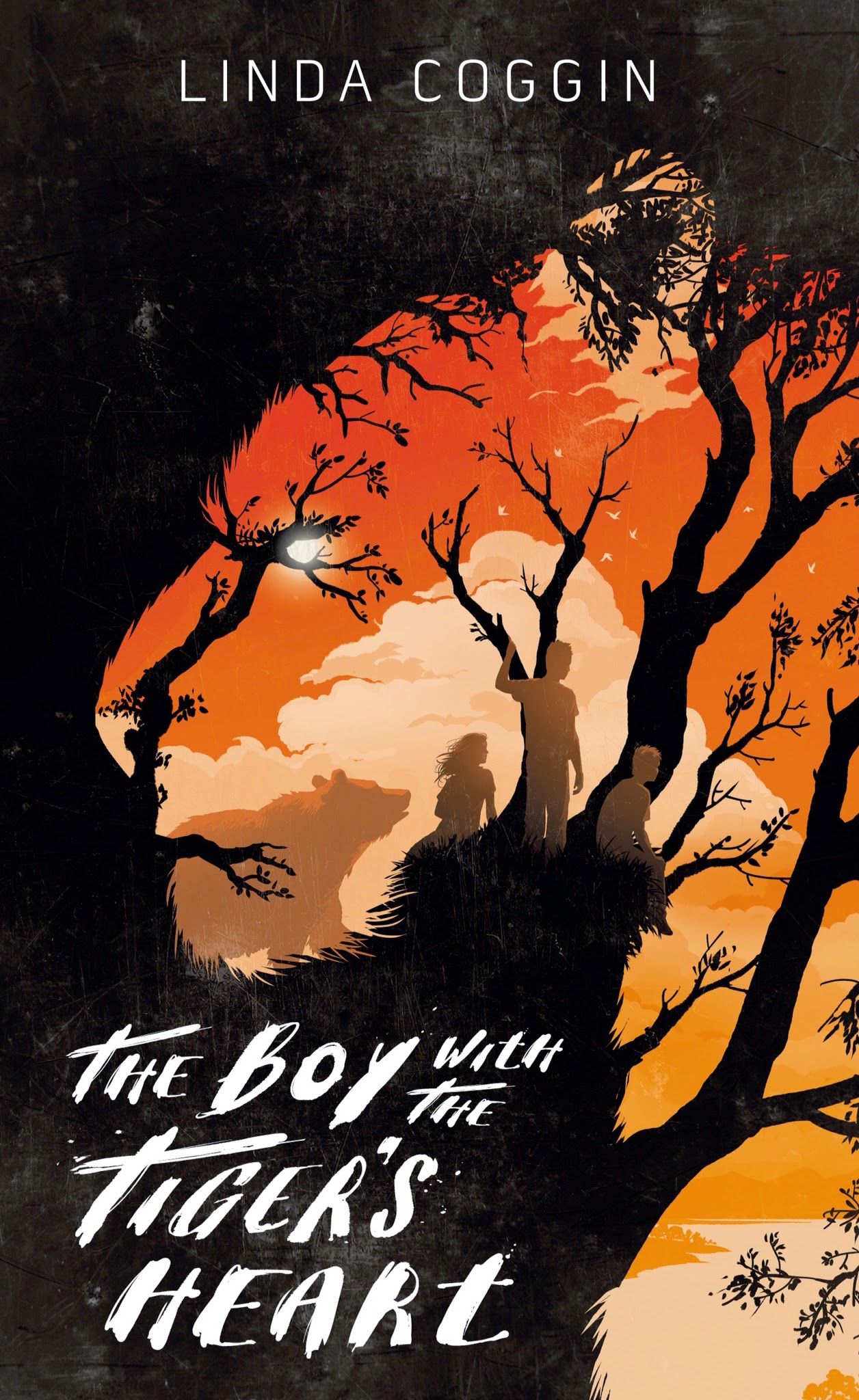
The same quality of ambiguity is evident in the very dramatic and wonderfully apt cover illustration by Levente Szabo. The image is simultaneously of a tiger's head and of a wooded outcrop with figures. It is the trees that form the tiger 's stripes - or possibly vice versa. Perception shifts between the two depending how you look at it, in a way that approaches the old optical illusion of candlesticks and faces. The realities merge. The picture is illusive. So is the book. It has no concrete presence, just shifting images that hover between nature and fantasy.

The protagonist of the story, a girl initially unnamed but later called Nona, has been brought up by dogs, although later adopted by an odd and eccentric 'scientist'. He is an experimenter who has kept specimens of live wild aminals in a world where almost all the rest have been purged to keep the population 'safe'. However, the book does not so much explore the implications of the girl's feral upbringing, to the extent that several other fictions on this subject do. Rather it uses it as a explanation for her empathy with animals and as a symbol of her essential wildness.

When Nona's adoptive Father is hounded by the ruling authoritarian regime, he releases his specimen animals and kills himself. Wrongly accused of his murder the girl flees in search of a free, wild world beyond that in which she now lives. She sets off on a long and difficulty journey-quest, accompanied by an erstwhile dancing bear but pursued by the evil authorities. Later she meets and teams up with an abused boy, as well as the tiger-boy of the title and a number of other escapee beasts.

One of the few words I can come up with for this book is poetic. But I do not want to give a false impression. Its language is not elaborate or fanciful. Rather the reverse. It is extremely clear and straightforward; at times almost clipped, particularly in its dialogue. Rather it is poetic in the sense that its story, its characters, its actions are more image than reality, metaphors; its reality is gently shifting, vague, translucent around the edges.

Both the geographical and human landscape through which the companions travel are a strange mixture, sometimes almost fairy tale, at others dystopian grunge, almost cyber-punk in feel. Many of the incidents on the journey and the characters met are not totally credible in a naturalistic sense. The 'circus' Nona reaches part way through is not quite like any other circus, more perhaps of a freak show, though whether the humans or the aminal are freaks . . . ? The small band of children and beasts who journey on from the circus is not quite a fellowship in the Tolkein sense; all are rather prone to wander off on their own; they have their own motivations as well as a common one. A pit of innumerable snakes bars the way out of the animal-culled, allegedly danger-clear world. It seems to represent the fear of the unknown which cows and contains the inhabitants of this world. But the snakes have eaten themselves by the time the children reach it. Yet the land which they eventually succeed in reaching is no Shangri La. It has always been called and remains The Edge. It is unknown, wild and dangerous. But it is alive.

Another way to describe the world of this book might be as a dreamscape. But this too could potentially mislead. This is not a simplistic then-they-woke-up-and-it-was-all-a-dream story. Rather it is a dream in the sense that odd things happen without them seeming odd. Explanations are not always completely rational, or logical, but do not need to be. This world is engrossing yet distanced; perceived rather than experienced.

One of the features which helps create this pervading strangeness is that the story is written entirely in the historic present tense. This is an authorial device that can often seem rather pretentious and become tiresome to the reader, particularly when sustained over a whole book. Yet here it strangely works. It puts the reader at something of a distance from the action, almost watching from outside, more as you would experience a film rather than a novel, sympathising rather than empathising. Yet it is not as simple as this. The author sometimes slips from an objective narration and let the reader into the thoughts and feelings of a character. It is odd, but effective. Strange.

The book is easy and quick to read, but lingers long. It is thought-provoking, strong in message, but without haranguing. It is gently disturbing. It is exciting and frightening in parts. It is sometimes beautiful. It is certainly original, unique. It is a strange book - but strange in a good way.


Thursday, 19 February 2015

The Iron Trial by Holly Black and Cassandra Clare

There are a number of reasons why I did not think I was going to like this book anywhere as near as much as I actually did.

Firstly it is a collaboration and I cannot easily think of any book authored in this way that I would call truly great. The idea of authorial collaboration often puts me in mind of that oft-quoted quip that goes: a camel is a horse designed by a committee. Now I admit right off that I think this is grossly unfair to the camel, which after all, is quite wonderfully adapted to its life and habitat. But I know what they mean. A number of folk chipping in ideas, especially where they are very creative ones, can lead to an interesting and inventive amalgam. Rarely if ever, though, does it lead to something with the same clarity of concept and design, the same sleekness and integrity of vision as the creation of an inspired individual. Certainly I find this is so with fiction writing. I sometimes love it when creative minds spark ideas off each other - and I know full well that this can be a most enjoyable and stimulating way of working. But it is the individuality and integrity of a particular authorial voice which always thrills me most as a reader. So although we have two fine writers involved here (even if Cassandra Clare's principal work does not come within the sphere of writing that interests me much personally) I did not have too high hopes of this collaboration.

Of far greater concern to me though, as I initially read further and further into The Iron Trial was that so many aspects of its core narrative are Harry Potter derivative. Here is the tale of a young boy who finds himself in his first year at a wizarding 'boarding school' where he quickly establishes firm friendship, with another boy and a very bright girl in the same initial year or grade. It appears certain, too, that this first book, representing the experiences of their first year in the school (here the 'Iron Grade' in the 'Magisterium') will be the first in a series following the experiences of the three trainee magicians through each year (with, predictably, 'Bronze', 'Silver' and 'Gold' stages still to come). In school our protagonist is plagued by the hostile and spiteful attentions of a maliciously jealous fellow pupil. On the wider front, the whole world is threatened by the monstrous evil of an 'Enemy of Death' figure, who it seems was, a former outstanding pupil of the Magesterium, now turned bad.

The book does suffer, too, from what is at times a rather episodic narrative, which possibly relates to my fear that the writing may have been parcelled out between its two writers. Nonetheless is well written and indeed captures many of the strengths of The Potter books as well 'borrowing' many of their key ingredients. It has a very great deal of the same ability to fascinate and absorb, to involve and excite. Particularly, it engenders very strong and easy identifications with its young protagonists which soon develop into something close to an emotional bond. All this means that, despite reservations, it soon develops into a very good read. There are significant differences too of course which add to the distinction and reader absorbtion of this new version. Unlike enthusiastic and wonder-struck Harry, Call, the protagonist here, is a rather unwilling and uneasy student at the wizard academy. The school itself, too, is very different indeed from Hogwarts, both physically (here a maze of underground caverns, rocky passageways and canals) and in its ethos, it's teachers and its approach to magic. All of this is most vividly created and the wonderful imaginations of thes two very experienced fantasy writers very much show through. However, I am never going to be too much impressed by such an obvious clone, well written or not.

BUT THEN (and the capitals are deliberate here) things change in most interesting ways. Around two thirds of the way through, the storyline takes a number of really very shocking and most intriguing jolts that suddenly make it very different in both content and feel from HP. It becomes clear that rather than settle for a lazy semi-pastiche, the authors have very cleverly used familiar features from this very specific fantasy genre in order to set up expectations that they then intend to thwart. And they do so to quite thrilling effect. Suddenly we have a very different book and a see totally different level of authorial skill. It becomes quite a read and, by the end, sets up eager anticipation of the sequel.

Descriptions along the lines of 'the best thing since Harry Potter' are so overused and abused in publishers' hype as to have become, infuriating, hilarious or simply derisible. However this is the only book I have read that so well feeds on the HP tradition, but then subverts it in a shocking but totally enthralling and entertaining way. In doing so it comes close to recapturing the same quality of reading engagement as its illustrious predecessor whilst adding enough difference to be truly special.

However the jury must remain out on the impending full series until there is more to read. In a sense the big shock has now been sprung. It will be most intriguing to see how its implications are worked through. The question is can these two skilled authors maintain and develop interest through several more years at the Magesterium, in ways that are original and special enough to fulfil the promise of greatness this debut instalment now makes?


Sunday, 15 February 2015

Mortal Engines Quartet by a Philip Reeve


Some months ago I missed out this wonderful work from my full listing because it did not quite fit my definition of magical fantasy. Now I have tried to free myself from some of these sillier constraints and it just has to be included. It is without doubt one of the greats of children's literature of recent years.

The Mortal Engines quartet, now re-titled Predator Cities, (Mortal Engines, Predator's Gold, Infernal Devices, A Darkling Plain) does not have wizards but is nevertheless a most wonderful and imaginative fantasy. Probably more Sci-Fi than anything, it is, however, totally itself; unique and quite magnificent. Its inventiveness is truly magical and the spells cast by its vast array of incredibly-imagined characters are over the reader if not over each other. Its protagonists are some of the most engagingly and sensitively developed of recent creations (the kind you leave behind with almost a sense of bereavement at the end of a book) and its plot progressions are complex, rich and gripping; always vastly entertaining. It is quite simply a masterwork of contemporary children's literature - terrifying, exciting, jokey, humane, thought- provoking and staggeringly original.


Thursday, 12 February 2015

Doll Bones by Holly Black

Holly Black's best known work, The Spiderwick Chronicles, is an authorial collaboration (with Tony DiTerlizzi), as is her very recent fantasy, The Iron Trial (this time with Cassandra Clare). These books almost inevitably suffer from some lack of individual distinctiveness of voice. This is not, of course, to say that they do not do what they do exceptionally well. The enormous popularity of the Spiderwick books speaks for itself. They very effectively bring the engrossing thrill of good fantasy into the scope of very young readers. These short, accessible books provide what is probably one of the very best introductions to this genre for children who are ready to make their first moves into independent novel reading. In this sense they do for modern children what the books of Edith Nesbit did for children in the early 20th century, those of Enid Blyton for those of the postwar generations, and Roald Dahl in the later years of the century; they provide accessible reading that is at once both exciting and comforting, highly imaginative adventuring from the safety of the sofa, vicarious escape from the constraint of adults that involves no need to leave home.

For more confident and experienced young readers The Iron Trial builds from established conventions to provides what is one of the very best if-you-enjoyed-Harry-Potter-you-will-love-this reads that I have come across in a long time.

However it is in the quite remarkable, independently authored Doll Bones that I feel the writing of Holly Black really comes into its own. This is a work of truly original voice, stunning imagination, deep sensitivity and enriching humanity.

I would not really call Doll Bones a fantasy novel, yet I have no hesitation in including it here because it is in every aspect a book about fantasy. Despite any impression to the contrary that the titular doll and its accompanying dominant cover illustration might give, this is to me very much a boys' book, or at least a book about a boy. Although two of its three principal characters are girls, feisty Poppy and the somewhat dreamier Alice, we only really know and discover them in so far as the book's real protagonist, Zach, comes to know and discover them. Although not a first person narrative, we see them, and indeed the whole world of the book through his eyes.

The girls are the collaborators in Zach's world of 'play' and they share an elaborate and ongoing game of imaginative world-building and role enactment, supported by their various collections of old toys, dolls and action figures, who represent its cast of heroes and villains. The lives of these three children are rich in story and enriched by make-believe. They clearly read widely and then use their own imaginations to extend and elaborate the worlds they have found in their books, to make them 'real' for themselves and to keep themselves within them. Their sharing in this 'play' bonds them closely together in a very special friendship.

Yet Zach is twelve. He is on the verge of growing past such things, or at least in the eyes of many around him. However he is not yet ready to move on. Although he sometimes feels he should, he does not really want to.

The catalyst of both the action and the development in the story is Zach's father who particularly desperately wants his son to 'get real' and 'man up'. He almost succeeds in destroying the boy's imaginary world when one day he removes and destroys the action figures which are Zach's story props.

Devastated, Zach feels he can no longer 'play' with the girls. His characters have been killed off and therefore the whole game terminated. But Poppy soon succeeds in reeling him back in by taking one of their existing characters, an antique doll from a cabinet in her home, and building around it a new and 'spooky' story about a girl wo was killed and whose bones were subsequently ground down to create the china from which the doll is made. This doll now wishes to be taken home and buried there so that she can find 'closure' and rest.

Both of the girls in the story introduce a confusion between imagination and reality, although in very different ways. Poppy wants so much to keep him sharing her story life that she gets him to play out in actuality a fantasy adventure, the quest to quiet the 'ghost' of the titular doll. Alice, on the other hand, although ambivolently still attached to the imaginative world of their 'play', wants to pull Zach back with her to the real world because of embryonic romantic feelings for him.

Whether or not this is a real ghost story remains ambiguous; it is the tale of the doll and the way in which Zach is drawn in to acting it out which is far more important.

In this book Holly Black has stepped aside from writing in the fantasy tradition itself, although it is that very tradition which so influences her characters. It is clear that Zach, Poppy and Alice are avid readers and the books of Tolkein, Rowling, Riorden, Paver and their like are what feed their imaginations. In contrast, her own book, for me, sits in that wonderful tradition of American children's fiction where the very real issues of its its young protagonists are played out through exploration of their imaganitive lives. I suppose the classic of the genre is Katherine Patterson's The Bridge to Terabithia, although there are other wonderful,examples from the likes of Betsy Byers, Lowis Lowry, and more recently Anne Ursu's Breadcrumbs.

Yet Holly Black's creation is not in the least derivative. It takes an imaginative, sensitive boy's issues in beginning to face adolescence and the emerging demands of 'being a man' and explores them through his interactions with two girl friends, each going through their own growing. It is both an exciting adventure and an intriguingly spooky story. Superficially it is a reckless road trip, inwardly it is a magical, mystical quest.

The book's greatest triumph of all is that its resolution is quite wonderfully affirmative. At its end Zach, together with Poppy and Alice, faces a real future which is uncertain and very probably difficult. But he has learned that it is possible to live out and, indeed, fulfil a quest; stories can and will continue, imagination will still play a huge part in his life. The corollary is that stories can play a part in all our lives too. We need never grow out of them. And this is a wonderful message.

It is a book for which fully deserves the accolades and awards it has achieved. It is a small masterpiece and a must for imaginative boys everywhere. It should become another classic of the canon.


Wednesday, 21 January 2015

The Witch's Boy by Kelly Barnhill

 
Here is another gem of a book from an American author, although it is totally different from some of the others I have found most recently; this one is much more of an actual children's book (broadly 8-12?) rather than a young adult read. It was a delightful change, too, to come across fiction for this age group that isn't trying to be trendy or jokey. Not that there isn't a place for the cross-dressing, wimpy schoolboy Dracula and his cyber bathroom adventures with a grimy grandmother. There certainly is. But, sometimes . . .
 
Although not published here in the UK, The Witch's Boy can easily and quickly be sourced on line. Normally I strongly advocate supporting local bookshops, particularly independent ones. If we don't then we are in danger of losing a wonderfully enriching community resource. However, I have to say that it is a strong plus for our internet world that we can so readily discover and access books published elsewhere. It would be a great pity to miss reading delights like this one.
 
Whilst most definitely sited in an imagined world, this book does not inhabit the realms of 'high fantasy'; its core elements of setting, character and storyline are much closer to those of Fairy Tale, as is much of its style. Here are a mother who sews the soul of her dead son into the chest of her surviving one, giants who have been turned into stone and a stache of dangerous magic kept in a pot, There is even a deep, dark forest with a wolf, although in this case the creature in question is not particularly big and certainly not bad. This is a not a retelling of an existing tale, nor is it a pastiche; it is a highly original and entertaining story in its own right.

One of the endorsements on its back cover is from Anne Ursu, and it does not surprise me that the publishers chose this particular writer to offer comment. Although no clone, there is certainly a fairly close affinity between the tone of The Witch's Boy and Breadcrumbs, or perhaps especially her truly wonderful The Real Boy. Kelly Barnhill's book also put me in mind several times of Astrid Lindgren's classic Ronia the Robber's Daughter, first published in English in 1983, and not only because this one has a bandit's daughter too. In my mind, this is certainly not an invidious comparison, quite the opposite. Ronia is a book that in my long-past days of class teaching I read several times to different children, always to my own great pleasure and their evident delight. I would count it as one of my twentieth century greats.

There is much that is very skillful about the writing and construction of the 'Fairy Tale' that is The Witch's Boy. Whilst fully acknowledging the potency of traditional Fairy Tales, Philip Pullman points out in his introduction to his own retelling of the Grimm Tales (Penguin Books, 2012) that they are typically fast paced narratives with stock elements and little in the way of detailed description or characterisation. And this is essentially how Kelly Barnhill's book starts. However she quickly but subtly eases the reader into sharing the thoughts and feelings of her characters, particularly those of the story's two young protagonists, the witch's son and the bandit's daughter. Even though these characters are never realistic, they do soon become very real in the reader's mind. Indeed they are truly lovable, despite, or perhaps because of their undoubted flaws. They may essentially be there to represent love and friendship and real courage, but they do so most endearingly. So Kelly Barnhill's story quickly develops into into an expansion and considerable enrichment of the original genre, without altogether losing its fairy tale feel. She also pointedly, and very properly, avoids some of the gender (and animal) stereotyping associated with the traditional tales. In her story you will find that the good, wise monarch is a queen, not a king, that neither the witch nor the wolf are evil, and that some councillors, soldiers, bandits and indeed woodcutters are, quite naturally, female. The story expands considerably too from the limits of traditional Fairy Tale, not only In length and complexity, but in scope and scale. Indeed its theme of a king and his army invading a neighbour to reclaim lost territory almost approaches the world of 'high fantasy' which is so far from its starting point.

Yet despite its length and authorial sophistication, its split narratives and its rich and diverse cast of characters The Witch's Boy has a logic and integrity which enables all its threads to be comfortably brought together in an ending which coheres everything into a satisfying whole. There are elements of the story's denouement that perhaps verge on sentimentality, though certainly no more so than, say, those of The Lion, the Witch and the Wardrobe. However, they are also strong, positive and life-affirming and that is no bad thing in a book for children. Indeed there are times when those of us much older appreciate such affirmations too. And amongst the self-sacrifice, the celebration of family and friendship, of goodness and of love, there are moments of touching poignancy too, and lightness and humour. Perhaps more than anything there are moments of wonderful lyricism, for scattered throughout this beautifully written and crafted tale are frequent felicities of wording and phrasing that are truly poetic, in a way that truly enriches the flow of language rather than over embellishing it. This is unobtrusively stylish writing and most effective storytelling.

All in all, The Witch's Boy is not quite the excitingly ground breaking work that some of my other recent finds have been. However it is one of the most unashamedly enjoyable reads I have had for quite a while. It provoked a nostalgia for childhood like nothing else recently and I take that to be a very good indicator. It is a bedtime book in the best sense. Even when it is frightening or saddening it has somehow cosy undertones. And it is constantly engaging; you would want to continue reading it with a torch under the bedclothes long after lights-out. Much of this is because it is so skilfully written, both in the structure and pacing of what is a fairly long story, and in its language, which is all the more effective for being unpretentious. Although relatively complex, its narrative has a logic and cohesion which slowly reveals itself as the tale unfolds. It is, at heart, a completely refreshed and reimagined version of a core classic (possibly the core classic) of children's fiction. A boy and a girl each in their own way grow up and discover the joys and tragedies of life, learn to be themselves, and ultimately leave their comfortable homes to face a future that is unknown but exciting. The Witch's Boy is made of the very stuff of a great children's book. It will be a much loved and, I suspect, a long enduring one. UK readers don't miss out - and don't let your children or grandchildren miss out. Books like this feed and grow the imagination and indeed the 'soul'. They are the perfect antidote to too much time thumbing a tiny keypad.

This book is not Kelly Barnhill's debut. I most seek out her earlier works and add them to my reading pile.