Here are the occasional reflections of a joyful traveller along the strange pathways of fantasy and adventure. All my reviews are independent and unsolicited. I read many books that I don’t feel sufficiently enthusiastic about to review at all. Rather, this blog is intended as a celebration of the more interesting books I stumble across on my meandering reading journey, and of the important, life-affirming experiences they offer. It is but a very small thank you for the wonderful gifts their writers give.

Tuesday, 30 July 2019

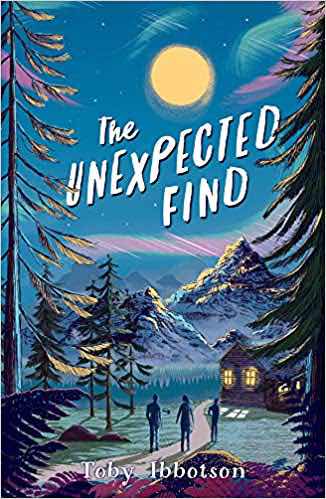
The Unexpected Find by Toby Ibbotson


Cover: Matt Saunders

In the Valley of the Quest one must change one’s state.’ (p 251)

Mother’s son

I do not generally think it is right or fair to identify an individual primarily in relation to their more famous parent. However, since Tony Ibbotson seems to have moved into writing specifically by following up the legacy of his mother Eva, it is perhaps at least partly justified here. 

The late Eva Ibbotson’s is certainly a name to conjure both affection and admiration from those interested in children’s literature - and indeed from countless young readers too. After her death, her son, Toby, helped to edit what was to become her final, posthumous title The Abominables.  He subsequently ‘wrote up’ a book idea his mother and he had shared before her death, and it became the delightful Mountwood School for Ghosts (Macmillan Children’s Books, 2014). Spooky comedy was one of Eva Ibbotson trademark genres, in deservedly popular modern classics like Which Witch? and The Secret of Platform 13*, and her son’s affectionate follow-up caught her style and spirit quite brilliantly, creating a truly enchanting read as well as a most fitting tribute. 

Unexpected and certainly a find 

Now Toby Ibbotson has finally written a children’s novel of his own, and in doing so shown himself to be an outstanding author in his own right. The Unexpected Find is exactly that, as a book as well as a title, and it is every bit as exciting as it is unexpected: a most intriguing and original amalgam of genres. 

On the one hand it is a compelling, exploration of the circumstances of two highly credible contemporary children, each, in different ways, neglected. Judy has been inexplicably abandoned by her single parent father, and at the start of the book is living alone on a canal boat, trying desperately to avoid being taken into care. William, a boy who appears to be on the autistic spectrum, is abused by his single parent mother, and escapes into a fascination with collecting objects from the past. A huge storm brings them together and starts what turns into a journey to the far north of Sweden in search of Judy’s missing father. This is actually where author Toby Ibbotson now lives, and the location and its lifestyle are quite wonderfully conjured. Joining these two in very dramatic and captivating adventure are a cast of evocatively drawn, if sometimes more enigmatic characters.

Nordic roots

Central to these is Mr Balderson, a strange old man who is first discovered sleeping in a coffin. He could perhaps be a Gandalf or a Merlin. However, here, with his strong Nordic associations, one eye, and a proclivity to wander, he suggests something more of an Odin/Wotan figure. There is also an ancient key found below a ‘lightning tree’, which hints towards Yggdrasil, the World Ash. There are other treasures, too, that could as easily belong to mythology as they do to our own world’s ancient past. This is not to mention Aristeas, the shamanic wanderer in the far North, here transformed into a camper van! And all are associated with ravens! What are we to make of all that?

The upshot is a very rich contemporary story, set largely in a landscape remote to the experience of most UK readers, but with residual earth-memories of the mythic, the metaphysical; a quest of classic fantasy providing a subtle metaphor, beneath a wild adventure, within a realistic narrative. And all of this is most compellingly evoked through wonderful language and effective multi-perspective storytelling. Empathetic characters, Nordic life and landscape, exciting adventure and encroaching myth. What more could you want? It works just beautifully, and I hope this will be the first of a number of books that continue to prove Toby Ibbotson is his mother’s son - but very much his own writer too. 


*She also wrote some superb adventure stories, like Journey to the River Sea.

Monday, 29 July 2019

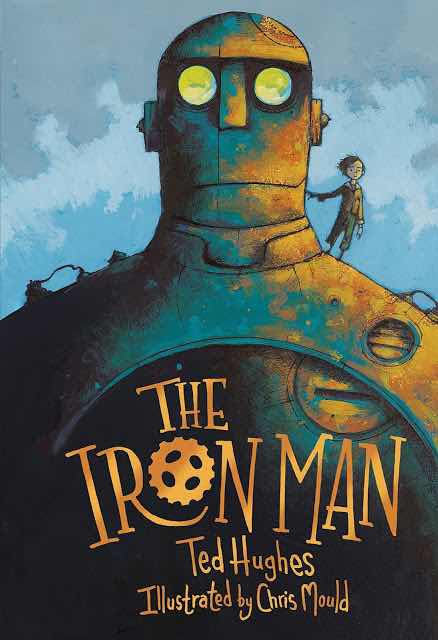
The Iron Man by Ted Hughes, newly illustrated by Chris Mould


Classic

The Iron Man is truly one of the all-time classics of children’s literature. I am generally no advocate of proscribed books for children, but this is one that I really would not wish any child to leave primary school without having encountered, at least read to them, if not read for themselves. Not only is it utterly special, and seminal, in both story and language, but it is also the ideal introduction to an author whose poetry I sincerely hope many will go on to explore and enjoy. Ted Hughes’ children’s poetry collections show just what high levels of word-craft, what resonance of meaning and what depths of emotion are possible, whilst still maintaining accessibility for young readers/listeners. Even some of his more adult poetry can speak rewardingly to a surprisingly young audience. He is a rare writer who can add immeasurably to our intellectual and visceral experience of being alive in our world. (Incidentally, I consider his book Poetry in the Making to be essential reading for all teachers of writing, alongside works by Sandy Brownjohn and Jill Pirrie - seek them out if you possibly can.)

Classic plus

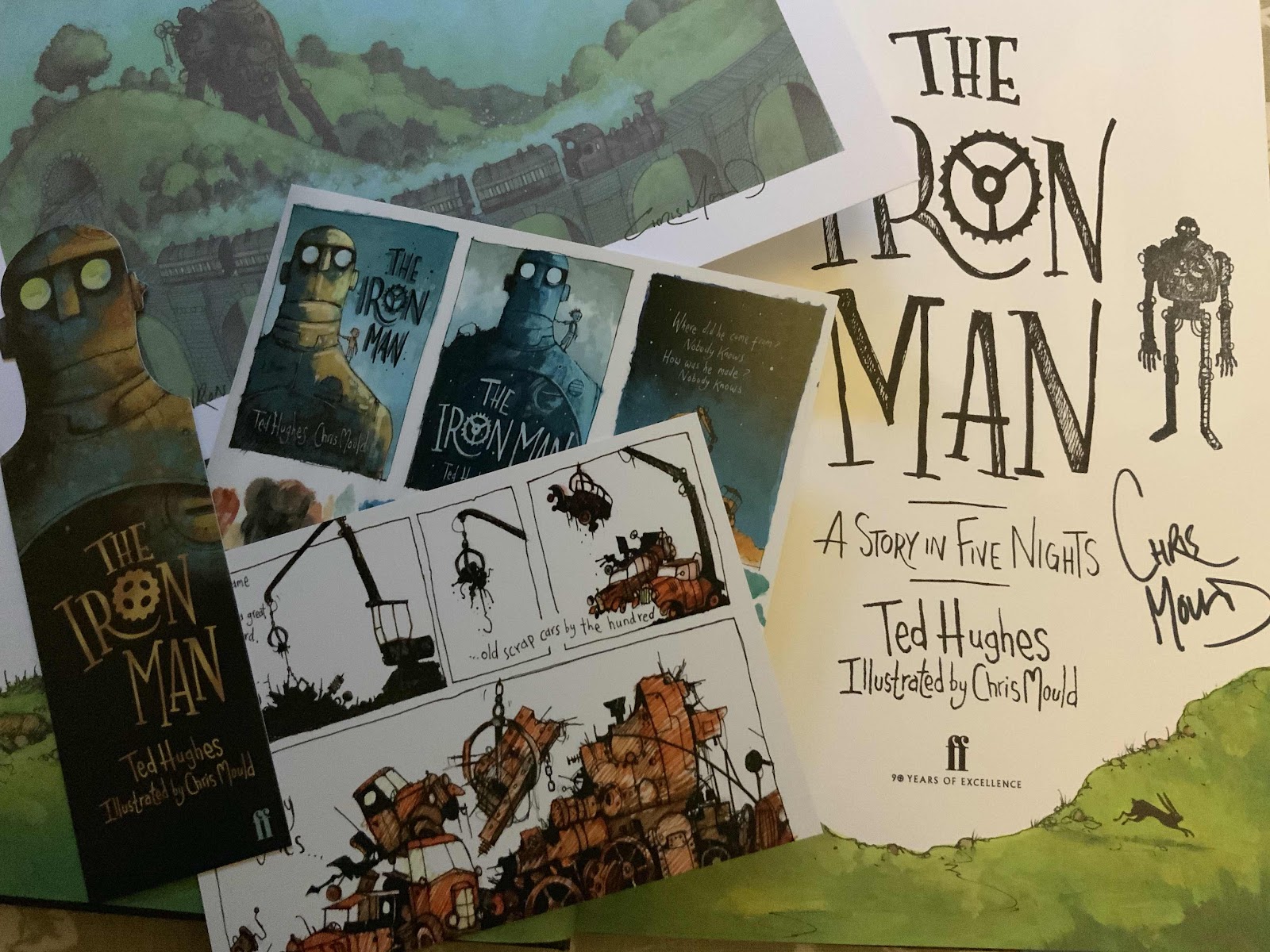
Now The Iron Man has been revived for new generations of children in a ravishing new edition with quite stunning illustrations by Chris Mould. His imaginative interpretation of Ted Hughes’ text augments the original in ways I would scarcely have thought possible, at once true to the tone and spirit of the story, whilst adding further levels of gripping engagement, drama, humour, pathos and sheer, exuberant artistry. Layout, line and colour are all masterly and the whole is completely irresistible. To have taken an existing masterpiece and added to it so extensively is an act of sheer brilliance for which we should all be grateful. Those who do not know Ted Hughes’ story should rush to access this version and even those who already know and treasure the original will find that Chris Mould has added more than enough to make this edition highly desirable for them too. I would put this new book into the same category as Robert Macfarlane and Jackie Morris’s The Lost Words, in that no KS2 classroom should be without it - nor many homes too. 

Classic double plus

For those who hurry, and know where to go, signed, stamped copies are also available, not to mention loads of lovely promotional goodies too. Chris Mould’s social media accounts will lead you to them.


Thursday, 11 July 2019

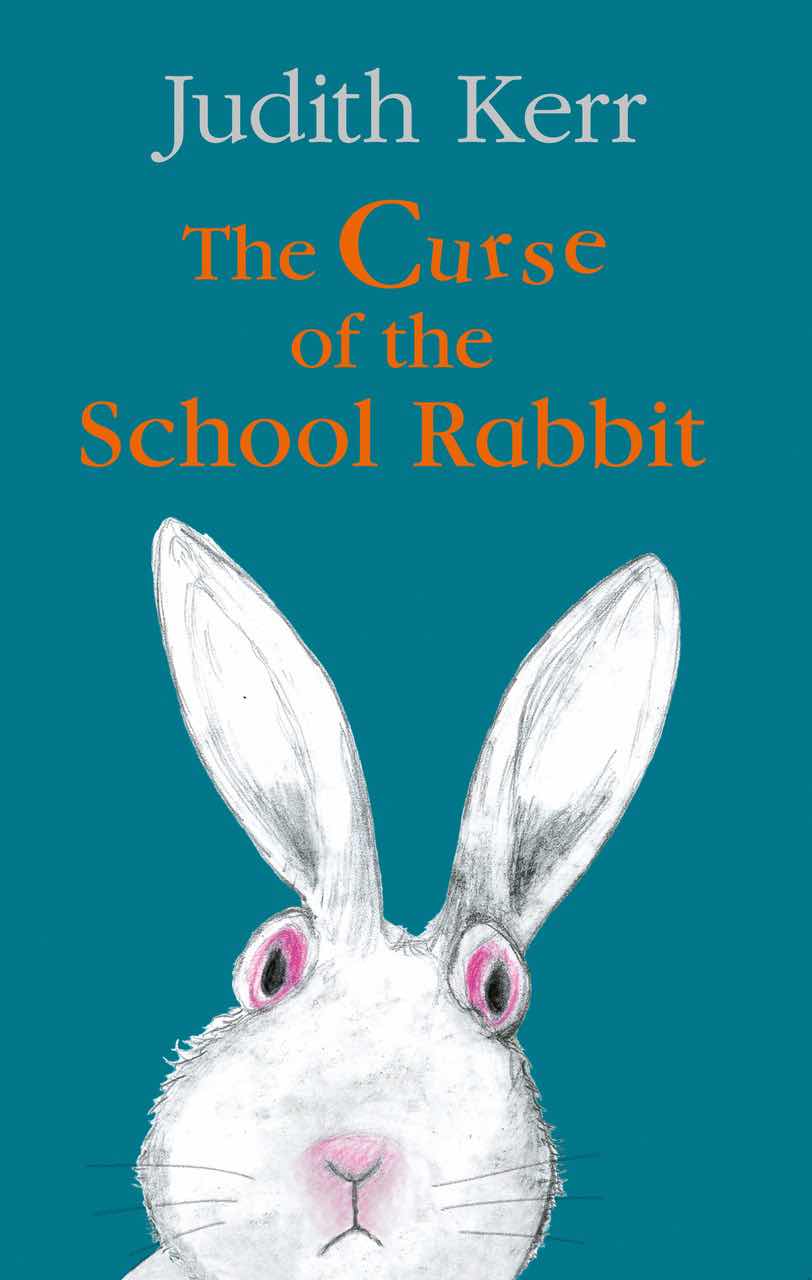
The Curse of the School Rabbit by Judith Kerr


Pink Rabbit

I do not usually review books for a children’s audience as young as this one’s (6-8 say?), but a final, posthumous publication from the pen (and pencil) of Judith Kerr, who died earlier this year, aged 95, is such a milestone in the history of children’s literature, that I cannot let it pass.

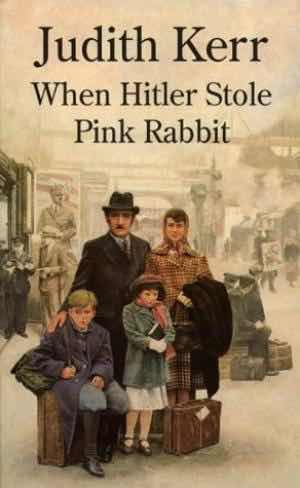
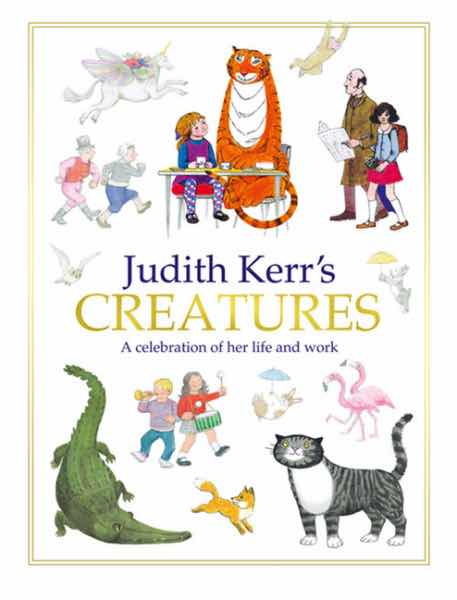
The Tiger Who Came To Tea is a thankfully irrepressible classic of children’s picture books, and some of the best of her many Mog titles are not far behind, with Judith Kerr’s  own illustrations every bit as charming as her stories. For me though, it is her longer novels, capturing in fiction the essence of her own experiences during and after fleeing Nazi Germany, that are her finest achievement of all. When Hitler Stole Pink Rabbit is not simply one of the best children’s book titles ever, but the story itself, has much the same qualities. Both encapsulate the power and poignancy of a child’s perspective on a period of our recent history that it is terrible to remember but vital never to forget. She devastatingly succeeds in capturing both the inhumanity and the humanity to be found in those traumatic times, without ever straying too far from what is accessible to a young readership. This is something that only a very small group of highly distinguished children’s authors have ever done.(Amongst these are John Boyne, Morris Gleitzmzn, Ursula Dubosarsky, Lois Lowry, Robert Westall and, more recently, Hillary McKay.)  Because of this, I rate her book, and, to an only slightly lesser degree its two sequels, as amongst the all time great works of children’s literature.


School rabbit

So I very much wanted her last book to be something special. And, in its own way, it is. This school rabbit may not be a literary rival to her much earlier pink one, but this new book is is a story with Judith Kerr’s wonderful, kindly, funny, charming, and oh-so-humane spirit suffused through every page. Although never stated, the tale, and particularly the author’s own captivating pencil illustrations, have a feel of the 1950s about them. And this is an old-fashioned story, in more than its setting, but then, when the writer, a survivor of the Holocaust days, is well over ninety years old,  I think she has a right to be old-fashioned, cozy. Her simple tale of a young child’s home life disrupted by the addition of Snowflake, the creature of the title, comprises a series of delightfully entertaining episodes. The said rabbit, on sabbatical from the classroom and ensconced instead in Tommy’s back garden, has a habit of causing minor mayhem, and peeing over people, with the former in fact often closely related to the latter. Judith Kerr  has a magical ability to capture many truths about children’s lives, hopes and fears, not in any terribly profound sense, but rather in terms of the quotidian domestic concerns which are actually the things that effect children most, and mean most to them. It is a rare talent, but one that I think she shared with another contemporary of hers, Shirley Hughes. The Curse of the School Rabbit is a story that I know my daughter would have loved, at the appropriate age. It is one that countless young children will enjoy now, and it is one that will be loved long into the future. The choice of front cover picture is perfect; it captures so much about the story inside. Those pink, caught-in-the-headlight eyes are so simply drawn but convey so much delightfully engaging and amusing expression. 

Treasure

The description ‘national treasure’ can be overused, but Judith Kerr was, and is, a treasure amongst children’s authors and illustrators. As the subtitle of the book below (published at the time of her ninetieth birthday) states, we must celebrate her life and work. The best way of doing that is to share her wonderful books with new generations of children, who will continue to find comfort there. Yes, they also need to be challenged by what our world has since become, and what it still should be. But sometimes old-fashioned is just what they need.


Wednesday, 3 July 2019

Why You Should Read Children’s Books, Even Though You Are So Old and Wise by Katherine Rundell


‘Ignore those who would call it mindless escapism: it is not escapism: it is findism. Children’s books are not a hiding place, they are a seeking place.’ (p 62)

Words to the wise 

Whilst I am on the subject of Katherine Rundell I cannot neglect mentioning this little book. Actually it is not so much a book per se as a published essay, so it is is a quick easy read, and strongly recommended for all adults, but particularly parents or carers and most especially teachers.

I have on numerous occasion advocated that one of the most important things teachers can do to help establish a reading community in their classes and schools is to read children’s books themselves. Only knowing children’s books well, and from personal reading experience, can teachers truly choose, read aloud, talk about and and recommend books to encourage reading for pleasure by their pupils. I also go on to say that any such  reading will prove to be a personal pleasure not a  professional chore, for the best children’s books have a great deal to offer to adult readers too.

Now Katherine Rundell explains why this is so with eloquence and infectious passion.  She also enunciates wonderfully why writing books for children is not any sort of inferior literary undertaking. Hooray to  that I say, as I humbly hope that many of my posts on this blog demonstrate,

Her contribution to this wonderful and vital cause is a true little gem. Read it. Read it. Read it . . . And then do as she suggests. 

‘Plunge yourself soul-forward into a children’s book: see if you do not find in them an unexpected alchemy . . . Refuse unflinchingly to be embarrassed: and in exchange you get the second star to the right, and straight on till morning.’ (p 62-3)

Friday, 21 June 2019

The Good Thieves by Katherine Rundell


Cover: Anna Morrison

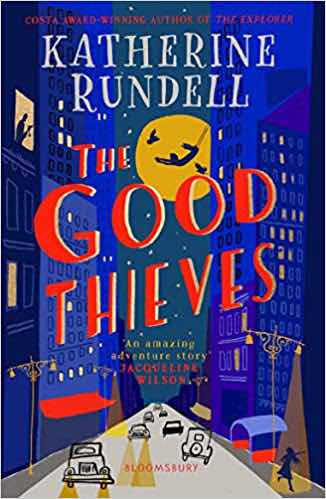
‘New York waited outside the window, stretching up to the sky like the calligraphy of a particularly flamboyant god.’ (p 8)

A sizzling start

Philip Pullman is quoted as saying, ‘(Katherine) Rundell is now inarguably in the first rank.’ I would not even think of arguing. 

A book that on page one includes the deliciously quotable quote, ‘It is not always sensible to be sensible,’ grabs attention immediately. Then you don’t need to read many pages of this, her new novel, to realise that you are in the hands of a very fine writer - and promised an absolute treat of a read. 

Vita, the young protagonist of The Good Thieves, is a dead shot with hand-thrown missiles; pebble or penknife, she can hit any target with astonishing accuracy. Katherine Rundell hurls amazingly fresh language at the page with the same deadly accuracy, and so hits the thoughts behind her words with telling vividness. There is true wit in this writing and a modest but sharp intelligence, as well as a joyful play with the potential of our language. Yet nothing is either portentous or pretentious. It makes her book spark with thrilling electricity page after page. 

‘Is selfastonishment a word? Because if not, I need it to be one now.’ (p 187)

New York, New York

However, that is not all that makes this novel so captivating. It does not take the author long to propel her characters, and with them her readers, into one of the most exciting and compelling storylines I have encountered for quite some time. This is like the greatest heist movies novelised for children.

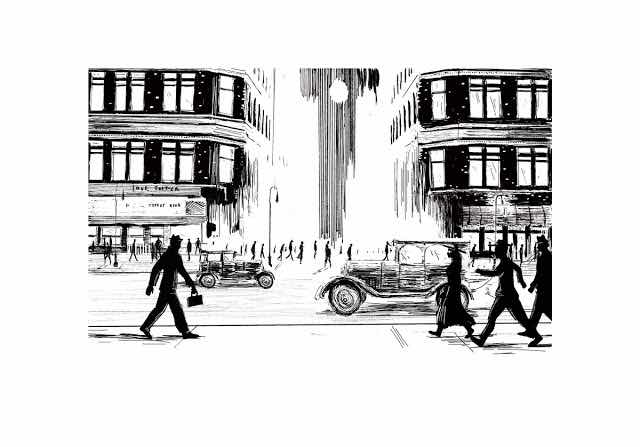
Part of the engagement comes from a superbly evoked setting of early twentieth-century New York. Here are the newly-built skyscrapers and the gridlines of bustling avenues, Grand Central Station and The Public Library, street vendors  and gangsters, prohibition and rampant capitalism, hotels for tycoons and the slums of the Bowery. It is all viscerally exciting and so vividly conjured as to enable the reader to experience the presence of the city in every episode. This feeling is also greatly enhanced by Matt Saunders’ wonderful chapter head drawings, themselves brilliantly evocative of both place and period. Amongst many gems, I particularly thrilled at his image of Central Park, which magically conveys a sense of space and calm amidst the turmoil of the never-sleeping metropolis.


Characters to die for, and live for 

Yet even more than its setting, it is this story’s young characters who bring it leaping off the page and into the minds and hearts of it readers. What a varied, original and engaging  bunch they are: Silk, an orphaned pickpocket; Arkady, an ‘animal-whisperer’ from an indoor circus (temporarily housed in Carnegie Hall, no less); Samuel, a black boy with aspirations to ‘fly’ a trapeze (or indeed anything from which he can swing); and Vita, an an English girl with a club foot, newly arrived in New York. She should by rights feel lost, but far from it, for she arrives  with a clear mission burning through every ounce of her being. Remarkably too, in a story about thievery that could carry a questionable morality, these young protagonists each bring a rectitude that not only balances the story firmly in favour of goodness but  also resonates strongly with important issues of our own times. Silk, hates the way poverty has forced her into dishonesty and desperately wants escape from her present life; Arcady despises the way his circus humiliates and tortures wonderful wild creatures, and seeks rather enlightened appreciation of the wonders of the animal world; Samuel bravely strives to fulfil his ambition despite being continually told that such paths are closed to those with his colour of skin; and, most of all, Vita is driven by deep love to do whatever is needed to right the terrible wrongs perpetrated on her grieving grandfather. 

‘Love has a way of leaving people no choice.’ (p 8) 

And even then, she makes choices that will not seriously hurt even those she hates:

‘To throw the knife would be death. . . She wanted nothing to do with death - nothing to do with finality, with endings, with the dark of it. She hated the man more than she hated any living thing, but he was living.’ (p 275)

Vita’s is a story for all who want to change the world for the better, whoever they are. It shouts loudly and clearly that those who may seem to have been given a raw deal in life, can actually achieve wonderful things.

More than . . .

This is the sort of book that I know I would  myself have enjoyed as a child, an all-absorbing, edge of the seat adventure, with a wonderful warm, resolution to make me feel that there was at least a part of life where everything was ‘all right’. It is just the sort of book that helped me survive the cross-country run that I loathed, the maths homework that I got all wrong, the ‘big boys’ who threw my school cap into the bushes. And that is no small thing. 

But no book that I read back then (probably a Malcolm Saville or a Geoffrey Trease) was anywhere near so well written as this, so rich in language and thought. And that is a big thing too.

Katherine Rundell’s story is full of warmth and wisdom:

‘Learn as much as you can, for learning is the very opposite of death.’ (p 16)

It embodies a  deep respect for life and a passionate belief in the potential of (young) human beings:

It is a book to inspire as well as to entertain royally. Today’s readers are incredibly fortunate to have such a writer. 


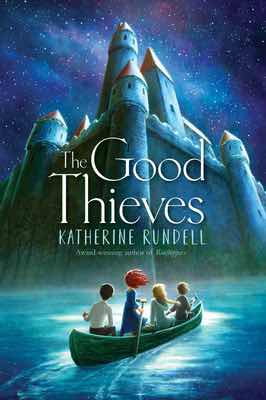
US Edition


Thursday, 20 June 2019

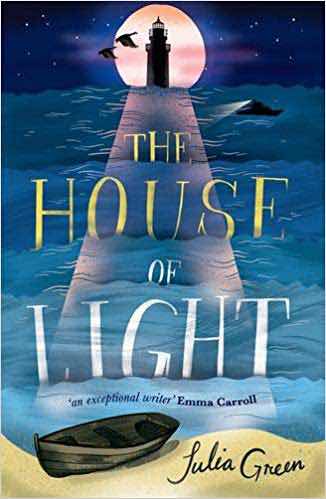
The House of Light by Julia Green


Cover: Helen Crawford-White

‘The sea never stopped. Wave after wave after wave, day and night, from since time began until time ended. Granada’s words came to her again. ‘Create a better world.’ That’s what they had to do now.’ (p 185)

Mastery of Children’s Writing 

I doubt it is possible to teach someone to be a fine writer. But it seems that it is possible to provide the opportunity to learn to be one. When I explore the background of contemporary children’s writers who particularly excite me, association with one of two writing courses seems to crop up with remarkable regularity. Both opportunities offer Masters in Writing for Children, although the two are located on opposite sides of the Atlantic. One is based at Hamline University in the USA, the other at Bath Spa University here in the UK, and each of them must be doing something very right to be growing so many wonderful children’s authors. 

Perhaps, though,  it shouldn’t be a surprise that the Bath Spa course helps so many fine writers to flourish, because its leader, Julia Green, is herself one of our finest contemporary children’s novelist. I greatly admired her last book To the Edge of the World (post April ‘19) but now I find her latest is even better. Her books appear uncomplicated, compared to those of many other children’s writers, and this one is no exception. Her language seems simple, with often short, telling sentences. Her narrative is straightforward and compact, although no less gripping for that. Her few characters are strongly and clearly drawn, with transparent thoughts and feelings. Her themes are lucid. Yet every word of her writing epitomises the ‘art that conceals art’. She can make her little say infinitely more that many other writer’s effusions.

Rowing to the light

The world of The House of Light is essentially classic dystopian, similar to that created by many other writers already, but Julia Green has no need to build her context through detailed exposition. Rather it is skilfully and subtly conjured through the lives of her protagonist Bonnie and the aging grandfather who had brought her up alone. Their subsistence living, gleaning a near-starvation diet from land and shore, together with the persistent  intimidating intrusion of over-regulation from ‘border guards’ is enough to paint a picture. Similarly the discovery of a small rowing boat and Ish, the ‘refugee’ boy to whom it belongs, are sufficient to prompt a terrifyingly audacious escape to a better life. The trio of girl, grandfather and boy fetch up on a tiny island with a long-abandoned lighthouse and there life moves on, as it inevitably must. The author’s handling of events is sensitive and compassionate, fully reflecting the maturing feelings of its young protagonists. The island and its house of light, bring them closer, too, to the wild, free beauty of nature. And that is also a wonderful thing. Julia Green’s images are potent, her descriptions vividly evocative. We come to know her characters simply but intimately - and to care about them deeply, even passionately.  So that when Bonnie and Ish eventually leave the island and launch themselves further into the unknown they carry us with them every oar-stroke of the way.

Hugely simple

Ultimately this is a book that needs to take its place with other children’s classics about escaping oppression and captivity: Lois Lowry’s The Giver, Morris Gleitzman’s Once, Sally Gardner’s Maggot Moon, Sonya Hartnett’s The Midnight Zoo. And it will. It is a title to bring consolation to any children who are coming to terms with the loss of a loved grandparent, as many will inevitably have to. It is a novel to embolden all who seek a better life, in any form. It is a simple song, but it is is huge in its simplicity. It is a hymn to the untameable, terrifying but uplifting beauty of our world. It is an anthem of freedom and the indomitably of the human spirit. It is for our time and all time. It is simply a wonderful book, a book of light.


The cover by Helen Crawford-White captures the elements of the story and their deep simplicity beautifully.

Tuesday, 11 June 2019

Hurricane Season by Nicole Melleby


Cover art by David Litchfield

‘Dark, angry purples and greys swirled in the sky as the rain poured down and met the ocean, which churned in shades of dark blue. . . It was like staring at a living Van Gogh painting. Fig walked to the edge of the boardwalk, squinting, wanting to see the impasto in those waves, the brushstrokes in the clouds.’ (p 237)

Educating for diversity 

I stand resolutely with the many parents, carers and other educators who believe we have a responsibility to help children grow as tolerant members of an inclusive society, happily accepting differences in background, ethnicity and sexuality as welcome aspects of a richly varied society. Our duty of care must include doing all we can to counter the influence of the stereotypes and prejudices that still blight that our current society. And if we cannot yet bequeath our children a completely better world, then we must at least open for them the possibility of building their own.

The books children read can provide one important route into developing an inclusive outlook. It has been said before that the best stories act as both mirror and window. They allow many children to see themselves there, and this can be a crucially supportive experience, particularly if they feel, or have been made to feel, different and inferior. To find, in a book, others just like them, presented in a positive light, is often both comforting and encouraging, helping to restore a positive self-image. Similarly children can learn, through fiction, to empathise with and come to accept people that they might otherwise have thought of as  different; to realise that differences are not to be feared but celebrated; to understand that ‘normal’ can and should be a wonderfully diverse concept.

Few better examples 

It is in this spirit, that I recommend US author Nicole Melleby’s Hurricane Season in the strongest possible terms. And yet I am able to recommend it not simply because it presents single-sex relationships, between females and between males, as a very positive  aspect of normal life, which it certainly does, but because it is a truly outstanding piece of children’s fiction on any count.

Hurricane Season is in many ways a truly beautiful book. It is beautifully conceived and written, beautiful in its cultural resonances, and deeply beautiful in its humanity. It is also a very harrowing read. But then it is one of those stories that, once you have read it, you are profoundly thankful that you did. In fact, it is not essentially about single-sex relationships, but about living with someone with mental illness. And that makes it even more important and special because children’s books like this one, bringing sensitivity and compassion to our  relationship with those suffering from mental health issues, are as rare as hen’s teeth. This is an inclusion issue for our society that shamefully lags behind even other deserving causes. 

Those we love, loved

Fig, the book’s vividly realised protagonist, lives with her single parent father, whose life is being devastated by a form of bipolar disorder. She loves him desperately and wants to help and support him despite her childish lack of understanding of what is going on. She lives in constant fear of them being separated by the social services to whom the case had already been notified by well-intentioned outsiders, and this permeates what are otherwise the normal, early adolescent concerns of an eleven year old schoolgirl. One of the very remarkable and powerful things about the novel is that the situation is always shared with readers through the thoughts and perceptions of Fig herself. Through this we come fully to experience the way her desperation to understand her father battles with her resentment at being shut out from his life. We learn about her situation, not through cold objectivity, but by sharing in an utter confusion and impotence, that is nevertheless permeated by deep love.

When Fig’s father, in due course, finds himself in a loving relationship with another man, Fig is initially resentful but works towards the realisation that this it is, in fact, helping all of them to move forward. As the partnership grows towards providing a new feeling of family for Fig, its positive role in making all their lives better is another of the book’s wonderfully integrated messages. That the author achieves this in a way totally accessible to her young audience makes it even more remarkable.

Hurricanes and starry nights

I have yet to mention, though, another of this novel’s greatest triumph, one that in my mind unreservedly elevates it into the category of fine children’s literature, and this is the way that iterative images and cultural parallels are woven through the narrative with consummate skill. First, there  is the theme of weather, particularly storms - the hurricane season of the title - which forms a powerful background of both actuality and metaphors to the turbulence of the tale. Even more striking, though, are the recurrent references to Van Gogh, his work, life, letters and, perhaps especially, his relationship to his brother Theo. These occur not only directly in Fig’s thinking about herself and her father, but subliminally too in chapter titles and other subtle references. It is all quite magically handled by this remarkable author.   

Complementing the story wonderfully, David Litchfield’s lovely cover illustration is to be warmly commended for cleverly referencing the Van Gogh connection, whilst still creating an image that captures the book’s unique feeling, and its accessibility to a children’s audience.


Some other strong recommendations 

I have recently enjoyed many other very fine books that incidentally introduce same-sex relationships in the way I think they should for children; that is, not as an issue, but as a perfectly normal aspect of a diverse society. Amongst special favourites are Piers Torday’s moving There May Be a Castle (reviewed here  Dec ‘16), The Marvels from the brilliant Brian Selznick (review July ‘15) and two delightful children’s books from Room author Emma Donoghue, The Lotterys Plus One (Review April ‘18) and its sequel, The Lotterys More or Less.