Although I have taken a break from writing up this blog for much of the last year, I have no more taken a break from reading that I could have taken a break from breathing. Amongst very many enjoyable reads, there were a small cluster of children's books that stood out head and shoulders above the rest. They are not necessarily the books that have received the most popular acclaim (although a few of them are), but, for me, they each combine quite outstanding writing with startling originality and something really important to say that could help our world flourish in the future.
‘The storied ones are powerful transformers and inventors of patterns for still possible flourishing.’ (Ursula K. Le Guin The Carrier Bag Theory of Fiction)
I call these children’s books, but they are mostly for older children and some stray into the category generally called Young Adult. Broadly, perhaps they are suitable for those from around 10 to 14, depending on interest and reading experience. However, I always think it dangerous to place narrow limits on age appropriateness. Books are books. As long as young readers have ready access to a wide range, they generally find the right ones at the right time, which can be both earlier and later than we might expect. Certainly every one of these novels is of a quality that really has no upper age limit.
So, here ‘in no particular order’ are my best of the best.
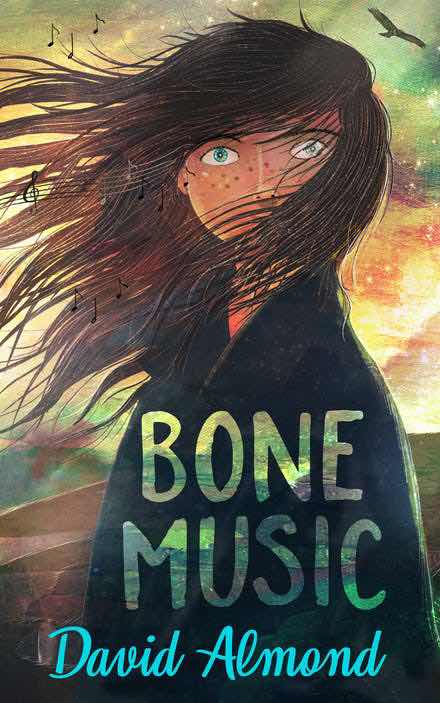
I consider David Almond one of our finest living authors, in any genre. Outstanding novel though it is, those who know his work only through Skellig, are missing a whole shelf of wonderful titles, built up over the past twenty-three years or so. To me, his masterpiece is the relatively recent The Colour of the Sun (see post from August ‘19), but his latest, Bone Music, comes close to being its equal, and is perhaps more accessible to somewhat younger readers. David Almond, like Alan Garner before him, is a deep explorer of particular landscape, landscape that includes both its terrain and its indigenous people, landscape that defines, indeed owns, both the author’s body and his imagination. It is a quality rare beyond price. Bone Music is, in many ways, the most overtly mystical of David Almond’s books to date, the most magical. But this is not the magic of Harry Potter. This is earth magic; the magic of the shaman; magic that links life and death, transience and eternity. This is a magic that grounds humanity in the very earth, but it is also the magic of the sky, the wind, the air. And the link between the two is music. Bone music. Through this latest book, David Almond has the courage to ask whether nature would be better off without us. A thought. No more. And his eventual answer is no - so long as the young can build, or restore, a better world than we have managed. A rewilding, not just of nature but of the human soul. ‘It’s no good rewilding the world,’ he says, ‘if we don’t rewild ourselves.’ (p 75) This wondrous book is a hymn of praise and thanksgiving - for those who are both ancient and young, for those who are both wild and quiet, for those who are the past and the present and the future. For those who change the world.
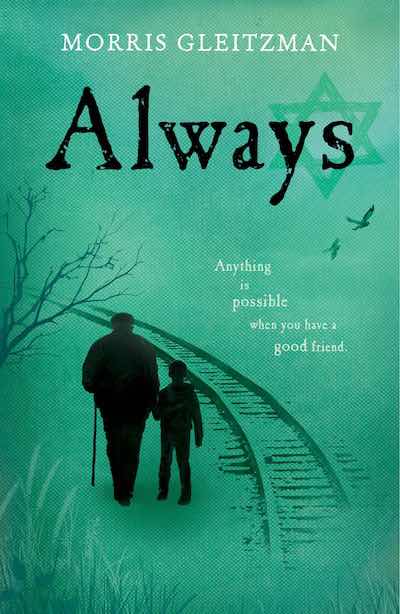
World War II has proved fertile ground for children’s writers and some of the very finest stories of the last seventy or so years have drawn tellingly on this traumatic time. Many wonderful novels from UK writers have featured evacuation and life on the home front, but some of the finest and most important books of all have come from authors sharing insight into the abomination that was the Nazi treatment of the Jewish people. One of the greatest of these is Morris Gleitzman’s Once. However, this particular work is even further distinguished by the fact that its author has followed the experience of his protagonist, Felix, into the war’s immediate aftermath and right through into its consequences for a very long lifetime. This has resulted in a whole stunning series of books with single adverb titles: Then, After, Soon, Maybe, and Now. I have encountered few, if any, other writers who can sympathetically convey profoundly moving and troubling experience through such seemingly simple yet compelling storytelling; heart-rending empathy meets a golden strand of hope. Now Morris Gleitzman has completed his sequence with a final title. It may well be possible to read Always as a stand-alone novel, but it is as the culmination of his ‘adverb’ series that its greatness lies. This final volume, moves on to deal with racism focused on black people. The author hits us in the face with one final, cruel, but inescapable reality, that the hatred and prejudice that drove the Holocaust is still present in our world. His story can feel melodramatic at times; I wish it were. Recent incidents of appalling racism at international football matches only confirm its underlying authenticity. Most importantly, however, Morris Gleitzman challenges all this ongoing horror with a wonderful truth: that those who fight hatred now are kin to those who fought it in the past. Together their lives throw a beam of hope into the darkness. This is an unmissable book and the complete sequence one of the most important in the whole canon of children’s literature; a story for all generations and all time.
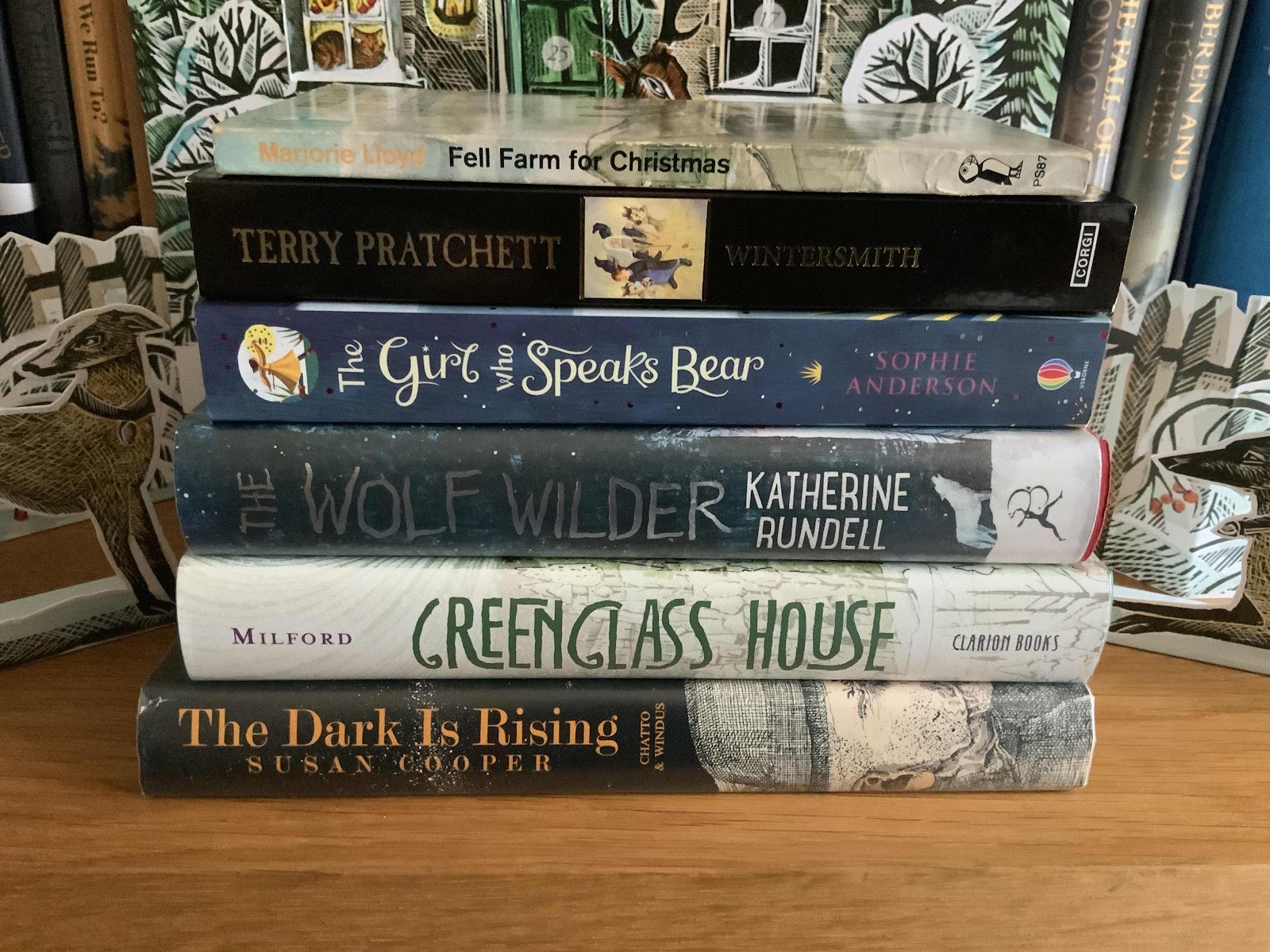
Any UK readers of children’s fiction who ignore the work of US authors are seriously missing out; some of the very best examples of the genre are currently being written across the Atlantic. One of my top favourite American authors is Kate Milford. She has now written a substantial number of fascinating novels, almost all complete in themselves, but also all with links to each other, sometimes direct, sometimes tangential. Together they are building up one of the most imaginative creations in children’s literature, a world that she collectively calls Nagspeake, with the most recent books identified as the Greenglass House stories. (See my reviews of May 2020 and earlier.) To that suite of novels she has now added The Raconteur’s Commonplace Book. Ostensibly a collection of stories, this actually pulls together as a complete work on a remarkable number of levels. It consciously echos classic works where travellers tell each other tales, but here the assemblages of persons (and tales) is in no way random, and even the book itself is ostensibly edited by a character in the overall narrative. It is all deliciously complex. A ravishing and completely riveting book in its own right, its stories are sometimes funny, sometimes disturbing, and often draw on legend, both real and imagined. They are even, at times, somewhat mystical, metaphysical, The whole is richly imaginative and hugely entertaining. Yet it is not in itself that this latest book’s greatest value lies. If all of Kate Milford’s diverse novels are spokes of the same wheel, then this book is the hub that holds them all together, even some of her earlier, mysterious Arcarne books. Those coming new to Kate Milford with this book are in for a delightful treat. It will, I am sure lead into exploration of a great deal more of the world hinted at here. But for those already who have already discovered much of Nagspeake, it will be the pursest joy. It does not answer all questions posed in the other books and some of its answers are as perplexing as the original questions, but I sincerely hope this just means there are more Nagspeake delights still to come, more links, more questions and possibly even more answers.
Another of my favourite US children’s authors is Anne Ursu. Her three most recent titles, Breadcrumbs, The Real Boy and The Lost Girl have each been singular, imaginative, richly insightful and challenging; major contributions to the canon of literature for young people. (See my reviews from Dec ‘19 and earlier.) Her latest book, The Troubled Girls of Dragomir Academy is generally rather more straightforward, and perhaps more widely accessible, but none the worse for that. In fact it is highly successful on two levels. First, it is a cracking good story. Set in a world of ostensibly ‘good’ sorcerers and ‘bad’ witches, it is one of the most original and engaging fantasies I have read in a long time. Protagonist Marya is summoned suddenly to the mysterious institution of the title. But this is far from any Hogwarts, more of a reformatory than a school. Together with other girls similarly labelled ‘troubled’, she seeks to unravel the mysteries of what the place is, why they are there and, indeed, what is going on in the whole country. This makes for a constantly intriguing plot as Marya gradually unearths secrets and even more gradually understands their implications, building towards a startling and wildly exciting climax. On another level, though, the whole story is an extended metaphor for societies where girls (and perhaps other individuals too) are denied the opportunity to fulfil their potential by men who cannot abide the threat to their own authority and power. Its feminism is strong and clear, but without ever being strident, and its ultimate message is hopeful without being naively optimistic. The book is affecting on both levels and is just the read to provide much needed encouragement and support to ‘troubled girls’ here, as well as in the States, and, perhaps even more pertinently at the present time, in certain other countries of our world too. However, many boys could also do to read it and would, I am sure, actually enjoy it as well as learning much. The author’s trademark iterative images give the book considerable depth, beneath its entertaining narrative. For example, the relationship between her created world’s tapestries and its history, is powerful and revelatory - and very pertinent to our own world, as, indeed, is the whole work.
Philip Reeve is not only one of our finest writers for young people, but he is also a very versatile one. Aside from many entertaining books for younger readers (often working with Sarah McIntyre), he has created two towering, but completely distinctive, masterpieces of speculative fiction for MG/YA, the Mortal Engines sequence and (my own favourite) the Railhead trilogy. There are also splendid stand-alone novels, including the rightly acclaimed Here Lies Arthur. His new book, Utterly Dark and the Face of the Deep, is again very different in feel from his others, although it shares with its predecessors both the strength of imagination and the quality of writing that are Philip Reeve’s hallmarks. Set somewhere in the early nineteenth century, a small but rich cast of characters living on a wild and remote remote island, act out the conflict between ‘enlightened’ ideas of science and reason and the powerful, elemental ‘magic’ of the sea. The writing is superbly descriptive, strongly evoking landscapes, weathers and moods. Much of the earlier part of the story feels lyrical and echoes the writing of the period in which it is set, without ever feeling in any way archaic. But, however gentle it’s opening, the story rapidly builds to a cataclysmic and hugely exciting sequence of climaxes. And, in the end, land and sea, reality and imagination, are both bound and unbound by a different quality of magic, human love. This is another treasurable addition to children’s literature.
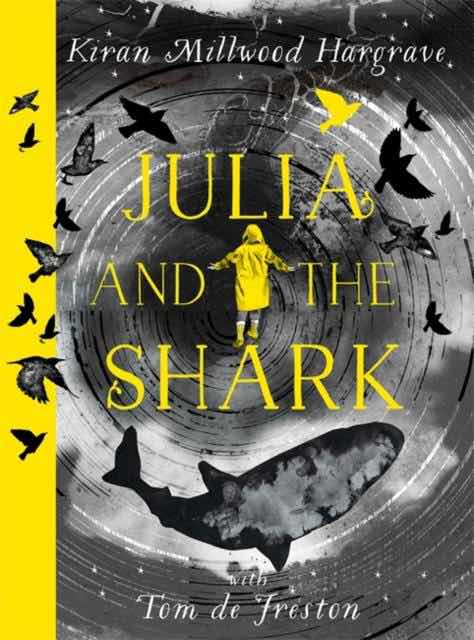
I love beautiful books as physically objects, as well as treasuring their content, and so I was initially drawn to Julia and the Shark, as I am sure many others will be, by the striking loveliness of the volume itself. Tom de Freston’s breathtaking illustrations are strewn across almost every page. His iterative images of starlings and sharks, often against greyscale swirls or sky, sea and storm, and with striking highlights of yellow, make this book quite stunning visually. The periodic interleaving of translucent overlays, which further grey out their neighbouring pages, only adds to the mesmerising effect. It does not take long, however, to recognise that Kiran Millwood Hargrave’s writing is equally special. Her apparently simple but deeply truthful capturing of the voice of protagonist, Julia, as she narrates experience in meticulous and poignant detail, is utterly compelling. Consequently, by the time inner and outer storms reach their height, the reader can identify fully with every nuance of the young girl’s emotion. The illustrations then become infinitely more telling as they are recognised for what they truly are, a totally integral element of the narrative. This is a brilliantly sensitive, deeply moving, and ultimately positive book about accepting others and learning to be yourself. Many books share a similar theme, but this symphony of images, graphic and verbal, is surely amongst the finest.
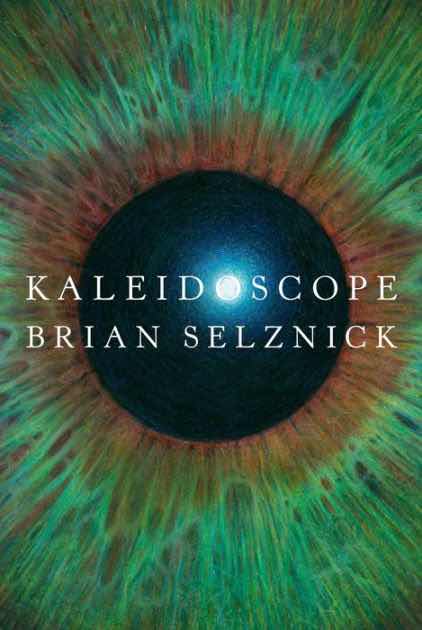
Brian Selznick is not only one of the finest children’s book illustrators around, but also an author of considerable skill. When he combines the two (as he often does these days) he displays an astounding ability to engage a reader in highly original narrative experience that communicates deep humanity. He has already made a definitive contribution to the international canon of children’s literature with his three hybrid text and graphic books. The first of these The Invention of Hugo Cabret, is already world renowned. His subsequent Wonderstruck and The Marvels, whilst attracting wide admiration, still need to be better know. I hold The Marvels to be the finest of all; a work of unspeakable tenderness. And now, in Kaleidoscope we have something slightly different, whilst still encapsulating all that is essentially Brian Selznick. Again there is the combination of the author’s own images and text, though now presented as a fractured narrative that reflects its title; a myriad of story fragments; disparate images in words and pictures, like the faceted reflections of a kaleidoscope. And the author leaves those pieces for the reader to fit together, responding in their own particular way to the countless possibilities. Very much in tune with recent times, the lack of a coherent storyline makes this a rather more challenging read than its predecessors. But I believe many sensitive and committed young readers will be up for it. We too often underestimate them. All children have had friends, or longed for them. Some will have lost loved ones, or know cutting loss in other ways. And shimmering across this book’s disparate views are images of a close friend, James, seemingly lost. The glimpses of James are not consistent. They are split and reflected across time, across memory, across imagination. James can be a school days companion, an imagined friend, a conjured genie, a dream, a ghost, a character in a tale. Yet James’s reality is there for each of us to find. One of Brian Selznick’s great talents is in drawing faces. This time, however, he does not draw James’s face with his pencil, but leaves it for us to glimpse in the shifting multi-mirrored images of his kaleidoscope. But, however we see it, we will find in it love, we will see heart-rending loss and somewhere, within and beyond time, we will see hope. It is another very great book, wild certainly, dangerous perhaps, but transcendently beautiful.
Some books are great because of their complexity, their richness, their intricacy, but others can be great because of they are simple, or at least deceptively simple. Dragon Skin is one of these. Karen Foxlee is a very talented Australian author, one of a number of wonderful children’s writers from that continent. Sadly books published in Australia are difficult to get in the UK, but we are fortunate that Karen Foxlee’s children’s novels have also been published here Her first masterpiece for this age group, Ophelia and the Marvellous Boy, was brought out by Hot Key Books and the heart-rending Lenny’s Book of Everything (one of my Books of the Year 2019) is published by Pushkin Children’s, as is this, her latest. And Dragon Skin is another absolute gem of a book. For starters it gives a vivid and evocative picture of a mining town in outback Australia and of the life of a child growing up there. But Dragon Skin is far more than this. Bereavement, and the way a child deals with it, is a recurrent theme in Karen Foxlee’s books and it features again here. Ten year-old Pip has suddenly lost Mika, the boy who has been her very close friend for two years, and is struggling to cope without him. The often highly entertaining, and touching, story of their friendship is interleaved with the narrative of her most recent few days without him. But Pip has other huge problems too. Her mother is in an abusive relationship, as indeed, it appears, Mika’s mother has been too. The author uses the novel to explore how deeply children are affected by such abominable home situations. Yet even with these twin themes, Dragon Skin is not in the least maudlin or depressing. Karen Foxlee’s genius is to communicate trauma and deep emotion with a light touch. She treats Pip and her situation with profound sympathy, but also a good deal of humour, and captures her young voice perfectly. However, Karen Foxlee understand boys well too. Her conjuring of the overtly resilient, but inwardly vulnerable Mika is equally brilliant. It is just the behaviour of some men that appalls her - and quite right too. All of this is told through the ‘fantasy’ of rescuing and adopting a baby dragon, a potentially clichéd idea, but which is here handled with masterly effectiveness. Despite dealing responsibly with some very real horrors, Dragon Skin is touchingly simple and simply very touching. It is also, ultimately, supportive and encouraging. It will be more accessible for younger children than many of my book choices this year, although this certainly does not imply that it should only be read by the very young. It may be a short, simple book, but it is ‘Sky-huge. Galaxy-huge. Universe-huge,’ (p 318).
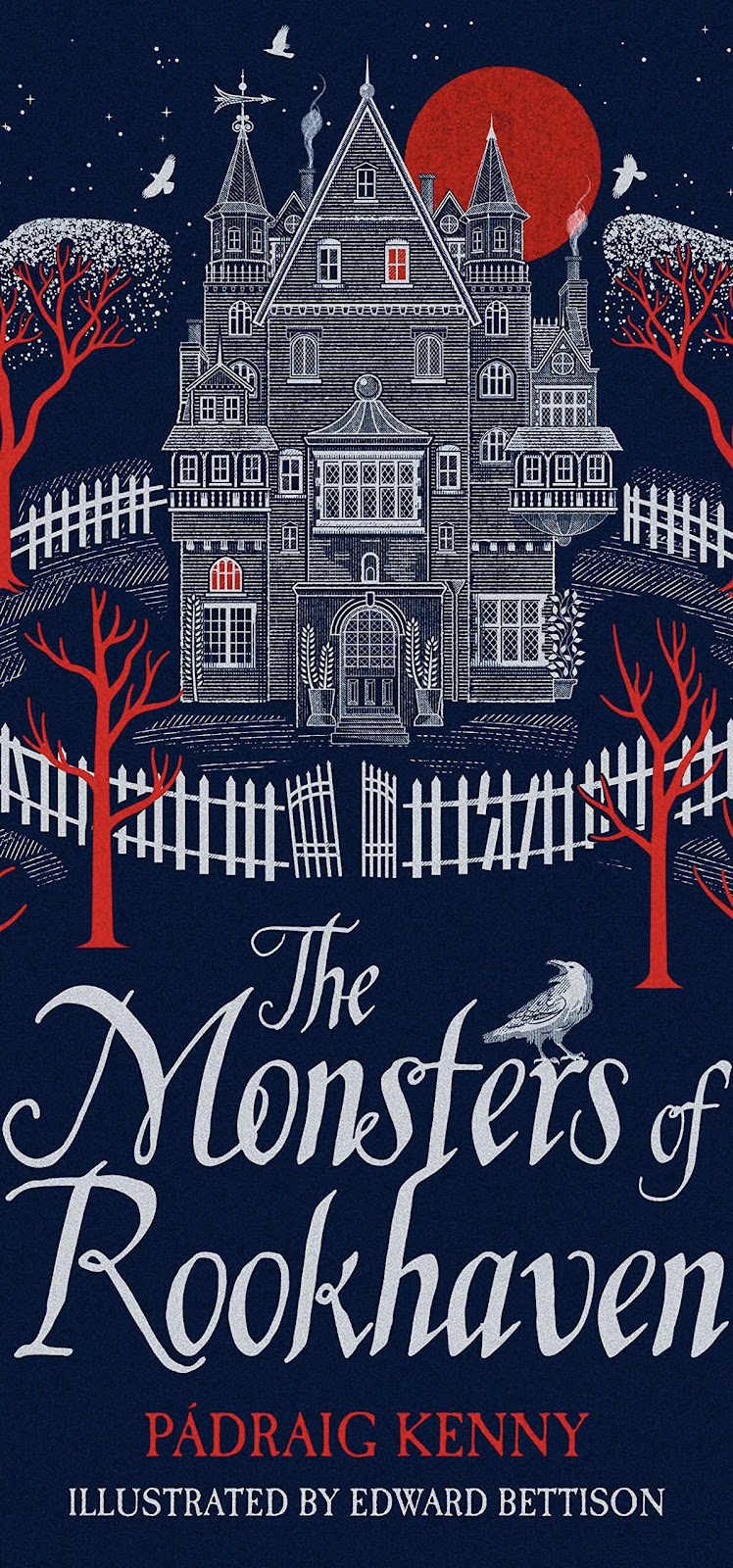
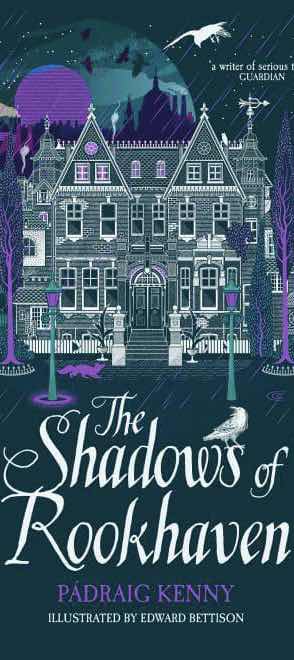
Last year’s new book from Padraig Kenny, The Monsters of Rookhaven, is a highly original and hugely enjoyable novel that delivers a whole ‘family’ of weird and gruesome monsters but also manages to be far more thoughtful and sensitive than this subject matter suggests. (See my review from Nov ‘21.) Now we have The Shadows of Rookhaven to follow on. It could well have been that a second Rookhaven book had less impact. To those who have already read the first, the fascinating scenario and characters are already familiar and quite a few surprises and shocks have already been sprung. However, there is no second best about this sequel. To half-human Mirabelle, and other key characters from the first book, Padraig Kenny adds a riveting new main character, Billy, also ‘misbegotten’ like Mirabelle. The plot here is, if anything, even more compelling than in the first book. I don’t think I have been so heavily invested in a story since living through the appalling prospect of ‘intercision’ in Northern Lights. The electrifying word-painting and multi-faceted storytelling, switching swiftly between several perspectives, adds considerably to the depth and complexity of this thrilling, sometimes shocking, narrative. Again several thoughtful and thought-provoking themes lie under the story, issues around the rejection or acceptance of outsiders, around mortality and loss, around family the importance of forgiveness. As with the first book, Edward Bettison’s dramatic and telling images, and Rachel Vale’s outstanding design, are so powerful that they can only be considered integral to the book’s overall quality - and its stunning impact. This is another piece of remarkable literary creativity and skill. However, there are crucial aspects of the story, not least those concerning Mirabelle and the disturbingly enigmatic monster known as Piglet, that gain their true effectiveness only in the light of what emerged in the first book. Despite significant new elements, this is very much a continuing story, so I am going to cheat just slightly and count the two novels together as one of my books of the year. Anyone interested in the very finest of recent fiction for young people should read both.
The only reason I have not included Alan Garner’s Treacle Walker in this list is that I am not at all sure that it is a children’s book. (Although it may be for some.) It is really beyond classification. However, it is a very great book. (Review November ‘21.)
Finally, my choice for Children’s Debut of the Year would be The Ash House by Angharad Walker. (See my post from November ‘21.) My Adult Book of the Year is Bewilderment by Richard Powers; as well as being a fine novel, it has a great deal to say to anyone concerned with raising or educating children. My book quote of the year is from The Giant’s Almanac by Andrew Zurcher: ‘It is only by seeing through the eyes of another that we may avoid dying while we are still alive.’ That is the alchemy of reading books. Base metal into gold.