Here are the occasional reflections of a joyful traveller along the strange pathways of fantasy and adventure. All my reviews are independent and unsolicited. I read many books that I don’t feel sufficiently enthusiastic about to review at all. Rather, this blog is intended as a celebration of the more interesting books I stumble across on my meandering reading journey, and of the important, life-affirming experiences they offer. It is but a very small thank you for the wonderful gifts their writers give.

Tuesday, 3 October 2017

The Lost Words by Robert Macfarlane and Jackie Morris


A huge book

This is not the kind of book I generally blog about. Although it is a children's book, it is not even fiction, let alone 'magic fiction'. Is is subtitled A Book of Spells, but it is not, I imagine, one that would be found in the Hogwarts library. 

Nevertheless, The Lost Words just cannot, should not be ignored. It is a huge book in so many ways. It is hugely important, profound and hugely beautiful. In fact it is jaw-droppingly, soul-achingly beautiful. It is the work of two hugely talented people, who see, think and feel in hugely special ways. It is also just huge. 

The book is, in fact, physically too big to be terribly practical. But practicality is emphatically not what it is about. Its presence, its impact, its genuine awesomeness would not be the same were it any smaller. Some things emphatically should not be contained and are cruelly diminished if we try. 

Expectations exceeded

Recent years have seen the publication of many outstanding non-fiction books for the adult market featuring detailed, personal observations on the natural world. At the very forefront of this trend has been Robert Macfarlane. His books* are revelatory in terms of seeing the world around us afresh and he is arguably one of our finest contemporary writers, in any genre. 

Artist Jackie Morris is the creator of some of the twenty first  century's most iconic and stunning picture books**,and her large, close-up images of animals linger long in the mind. Her skill is outshone only by her sensitivity and  compassion.

So when it became clear that these two were to collaborate for the first time on a children's book, my expectations were high. But not high enough it seems. The combination of his writing and her art has turned out to be a splendid addition to the canon of great children's books. I will be most surprised if it does not prove a seminal publication. 

Spells and poems

The book's prefacing words say that Robert Macfarlane's contributions are 'not poems but spells'. The import of this is clear. The author intends these 'spells' to conjure for children the names of some of the indigenous plants and animals which they have lost, or are in danger of losing. I don't actually think this loss applies to all our children. Amongst today's young people are to be found some of our most passionate conservationists and our greatest hopes for the future. However it does apply to many, for whom their lifestyle, the games they play, the technology they (over)use, the books they read (or, tragically, don't read), separate them from any closeness to nature and the ever-changing pattern of seasons. Even more children, I fear have lost any sense of awe and wonder for the natural world and it is in restoring this that these spells will be most effective. They are very potent indeed. 

However, despite protestations to the contrary, and even though they may not be verse as such, these pieces are poems as well as spells. Indeed they are poetry in the best sense and of the highest calibre. They use patterns of the richest and most intense language to evoke awareness of profoundly important thoughts and feelings. They illuminate life. In fact, not, I think,  since Ted Hughes has there been a collection of such fine and important nature poems for children. And these have the advantage of being rather more accessible to young people, without any less measure of deep awareness, sensitivity, resonance or sonority. These spell-poems beg to be read aloud to children and by children, to be sounded and savoured, to be word-sung. They are to be learned and learned from, to be grown with and grow by.  

In them readers will be enchanted by, amongst many others, the 'bickering, snickering' magpie; the conker that cannot be crafted, commanded, or engineered, but made only by a tree; the ancient fern 'furled, unfolding and fanning'. They  are spells of beauty to which as many children as possible need to fall victim. 


Spreading art

However, the words, wonderful as they are, are only a part of this book. Jackie Morris's art spreads through it in lavish fecundity, complementing, extending, enriching the spells. In fact 'spreads' is a very appropriate description for each subject, each individual plant or creature, is allowed three enormous double-page spreads. 


The first of each trio of pages instigates the spelling by conjuring the name from letters strewn across subtle traceries. Each is a hint, a foretaste of  what is to come: a stand of delicate grass heads, a stave of telegraph wires, the embryo outline of a weasel, the meandering ghost of a stream. Even here the variety of imagination and subtly of artistry is outstanding - and enormously evocative. 

On each second double spread, the left-hand spell is offset by a right-hand page where a detailed image of the plant or animal itself  is  highlighted against a ground of applied gold leaf. Each picture is a ravishing illumination of the words. There are distant echoes of medieval manuscript in the pairing, and the impact is stunning. 


The final spread of each trio presents a vast canvas with more naturalistic context. These breathtaking pictures gain added impact from their scale and come a long way towards bridging the gap between seeing a reproduction and looking at an original work of art. Each one a combination of watercolour detail and wash, their beauty needs to be seen not described. Here, amongst other marvels, are an owl-flown woodland, its bluebell carpet evoked only by its distinctive hue; a mesmerising murmuration of starlings; a heron surveying it watery domain from the hide of an evocative old willow. Please do not let children miss out on this wonderful gallery of nature art, to be found between the covers of a book. 

A gift for teachers

As a former teacher, I would have given my eye teeth to have this book in my classroom (probably to use around Y5 or Y6). Just reading and knowing its  spell-poems would model so much about language use: how effective alliteration can really be, when it is not gratuitously forced; how potent is truly apt vocabulary choice; how strong acrostics can be when used for real communication rather than as an  imposed exercise; how real poetry for children can be so much more than the rhythmic rhyme  to which 'children's poetry' is too often confined. The book's art work could teach so much about reading pictures, both in terms of closely observing detail and of responding to overall impact. 

Many schools do an excellent job of inspiring children with a passionate commitment to important global conservation issues. However exploring the nature on our doorstep, once the staple of Primary education, seems to have declined somewhat.   This book could help considerably in a vital rebalancing. 

A gift for children

Apparently this book has been described in some social media posts as 'too beautiful for children'. This is nonsense as well as being horrendously patronising. Children often respond to beauty more fully and directly than many adults. They are perfectly capable of valuing and treasuring beautiful things. They need some beautiful things in their lives They need things that they can value and keep long and carefully. 
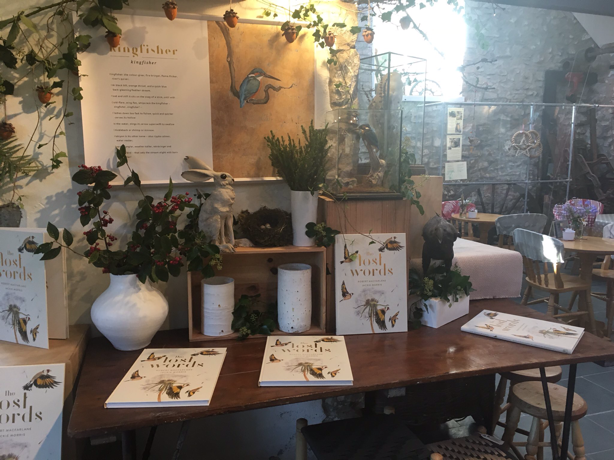


This book has a recommended retail price of £20.00, which some may consider expensive for a children's picture book. My response would be that there are precious few real treasures to be had for such a sum, apart, of course, for that completely free treasure, the wonderous world around us. This book will cast its spell over children in such a way as to open minds, ears and eyes to that wonder. I can think of few better presents to give to a child or grandchild. 

This book may send children off to look out for the plants and animals it represents.  But it will do more than that. To see a kingfisher is undoubtedly a glorious thing. But perhaps that kingfisher does not actually need to be seen. Just to know that it is there makes the world a more wonderous place. To be able to name it, to know it as 'halcyon',  to see its 'flame-flicker' in the minds eye - and to know that it is truly there somewhere in the world. Our world. That knowledge is the real gift of 'lost' things that Robert Macfarlane and Jackie Morris give. 

Notes:
*Mountains of the Mind, The Wild Places, The Old Ways, Holloway, and Landmarks as well as a delightful essay, The Gifts of Reading. 
** Including, Something About a Bear; The Snow Leopard; The Ice Bear; One Cheetah, One Cherry; The White Fox and The Seal Children (N.B. There are stunning new large-format editions of The Snow Leopard and The Ice Bear, recently out from GRAFFEG, which would also make superb treasures for children. There are signed copies around too, but look for them in independent, 'real' bookshops. )

Tuesday, 26 September 2017

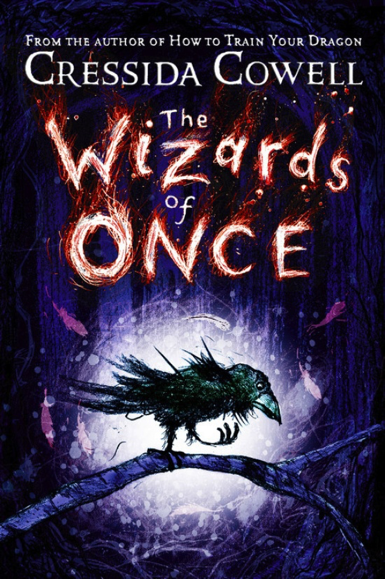
The Wizards of Once by Cressida Cowell


The (not very) old dragons

Cressida Cowell is a phenomenon of current children's publishing. Deservedly so. Her How to Train Your Dragon books have done more to support and encourage children along the road to becoming enthusiastic, independent readers than scores of other authors put together. An artist  as well as a writer, she has exploited a vital area, helping to bridge the gap between the picture books and full prose fiction. Her books are complete novels, but so copiously  illustrated with drawing, diagrams, 'hand written' notations and the like that the graphic elements become fully integrated into the storytelling; as much a part of the reading experience as the printed text.  With the addition of bright, lively covers, this does much to make then both attractive and accessible to young readers. 

She is not the first or only author to adopt this aproach* but she does it supremely well. And not only does she engage and entertain hugely but she also contributes a great deal to many children's growth and development. Her drawings are sketchy and childlike**,  often apparently haphazardly placed and accompanied by scrawled 'handwriting'. This does much to support creativity by giving licence to spontaneity and imperfection,  even to mess, banishing insecurity and inhibition. As one who was until very recently heavily involved in primary education, I know that her stories have inspired many children to write, draw and even create their own 'books'. 


Yet there is far more to Cressida Cowell's works than their format, splendid though it is. She is one of a select number of authors who understand perfectly what young children most enjoy in a book. She hits their sense of humour on the button, and indulges it extensively. Her enormously likeable heroes have more than enough flaws and foibles to make them easy for children to identify with. She creates ridiculous and entertaining characters with equally ridiculous and entertaining names, yet still makes them totally credible in their context. She keeps her stories relatively simple and straightforward, yet tells them with zest, never short on action, excitement and suspense.

The (very) new wizards

In short, her How to Train your Dragon books are not at all bad. However***, she has now written rather a lot of them. So it is especially welcome to see her launching off in a new direction with her latest offering. Particularly so when that new offering is as special as The Wizards of Once. 

First off, it needs to be said that this book will not disappoint her innumerable existing fans in any way. It has every single one of the wonderful attributes of her earlier series. In fact it has them in spades. This said, it seems churlish to expect even more on top, and we probably wouldn't. But that is exactly what Cressida Cowell gives us here.  She clearly hasn't run out of spades yet. 

Introducing her new 'Wizards', she moves her writing onwards and upwards in ways that are both surprising and delightful. In switching from  a world of Vikings, pirates and dragons, to one of wizards, witches and warriors, she seems to find new riches in both that world and in herself as an writer/artist. In exploring deep magic (and its potential loss), in conjuring the ancient forest and its many creatures (both wonderous and terrifying) and in opposing them with a new  'iron' order of rationalism (and military aggression), she subtly plumbs the resonances of old beliefs and archetypal images. And even if young readers are little conscious of such matters, their potency remains. Within this high adventure , she subtly finds humanity with all its vulnerability and enigmas as well as its potential.  Can this be done in a book for young children? Can it be done in a funny, exciting, engaging, popular, successful book for young children? The answer is clearly 'yes'. And The Wizards of Once shows how. 

Heart amidst the humour 

Cressida Cowell has sneaked in amongst her funny, 'sketchy' drawings, one or two much more sensitive 'realistic' images. There is a stunning drawing of the heads of two wolves; the images of Crusher, the thoughtful giant, are amazingly powerful, especially the one which shows him amongst the treetops, contemplating the stars; the hands that hold the injured sprite, Squeezjoos, are not those of a cartoon character, but delicately and touchingly human. The same feeling of sensitivity and thoughtfulness creeps into the writing too, without ever detracting from the excitement of the narrative. There is a beautiful passage when the giant lifts Wish, one of the story's heros, into the treetops, and the really quite long section describing the 'Song of Lost Magic', as heard in the dungeons of the Iron Fort, is just superbly affecting. 


This a story that pulls at the heart strings as well as triggering the adrenaline. In fact, at one point it is in danger of stopping the heart altogether. It treats of human relationships and the importance (and danger) to life of free, imaginative magic. It raises issues and asks questions, without necessarily giving answers or even explaining the questions themselves. It even flirts with metafiction and post-modernism when it intrudes the role of an unidentified narrator into the storytelling itself.  In the midst of their laughter and excited involvement in the story, will young readers be terribly aware of any of this? Possibly not. Will it affect them, cause them to pause for thought, live with them long after the book is finished. Almost certainly. 

Wizards of (more than) once

Without ever losing the qualities that have made her books so deservedly popular, very gently (and cleverly) Cressida Cowell leads her young readers into something deeper, something richer, something even more magical. In doing so,  her contribution to children's literature follows exactly the same path. She is a true hero of current children's fiction. Her books are a gift and children, parents, carers, and teachers should all be deeply grateful for it.

The close of this book clearly sets us up for more to come. Joy indeed. Bring it on. 

Then, at the end of this rather special story, there is a poem. It is a rather special poem. It may not be as simple as it seems.  It may just be magical. You must find it for yourself. In fact you can only find it for yourself. You must find the time when we were wizards. Once. 


Footnotes:
(I would write these in very scrawly handwriting except that my blogging tool is not that versatile.)


*For example writer Geoffrey Willams and cartoonist Ronald Searle very successfully used a similar approach in creating the Molesworth books back in the 1950s - books which could perhaps be said to be the precursors of Tom Gates and the Wimpy Kid (as well, of course, of a whole stack of extortionately expensive notebooks).
**Of course it takes a great deal of artistic skill to create this impression and still communicate as effectively as she does. 
***Alas, poor authors, always that 'however'. 


Sunday, 17 September 2017

The Murderer's Ape by Jakob Wegelius


A queue jumper 

I must apologise to all the other (possibly wonderful) books that have been waiting patiently on my reading pile for a while now. This one jumped the queue. 

For starters,  a strong recommmdation from Philip Pullman is hard to ignore and he is quoted as saying of this: 'I don't know when I last read a book with such pure and unalloyed pleasure.' I often give only limited (if any) credence to book jacket hype, but this seemed to have a ring of genuine enthusiasm. Then, as soon as I picked the book up and opened its pages, it struck me as one of the most beautiful and intriguingly attractive volumes I have held since . . . well, since Thornhill actually (and that wasn't very long ago) but then that book itself was quite exceptional. The two incentives together made The Murderer's Ape irresistible and I started reading before I put it down again. That I finished it before going back to reading anything else is testament to this book being far more than an entrancing cover. 

Charmingly quirky

In fact it turned out that entrancing is an excellent description for the whole story.  I have noticed that children's stories from continental Europe often have a quirky element, less common in those originally written in English.*
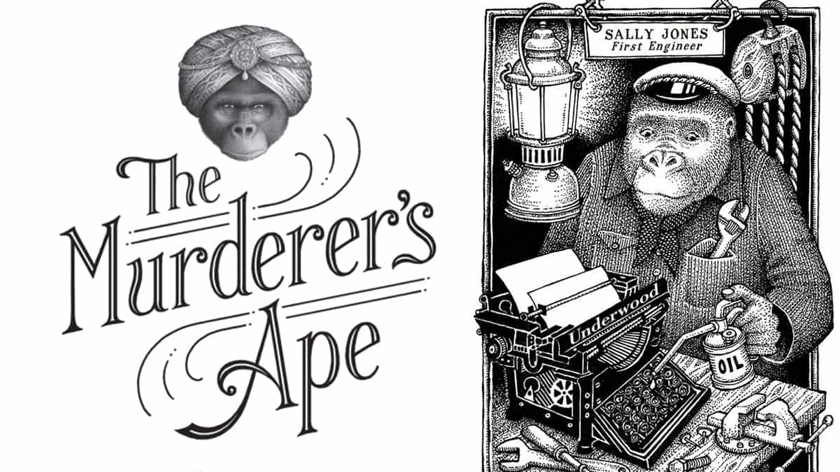
I do not mean this as a negative. Quite the contrary. It tends to give them what is, for an English-speaking reader, delightful freshness and inordinate charm. Here we have a story with a gorilla as the main character, indeed the eponymous narrator.  She is Sally Jones (all one name, not two, despite appearances!) and is not only intelligent and literate (although she cannot speak) but a skilled artisan and talented engineer. She lives amongst a cast of otherwise totally human characters and the rest of her world seem to accept her presence and nature, often without apparent surprise or question. This odd situation is never really explained or justified, yet it is presented as so much a given of the story that we as readers happily accept it too. The situation itself becomes very much a central element of the book's allure. 


The long and the short of it

The whole narrative too has a rather different feel from many of our contemporary children's books. There is a tendency these days to try to hold children's interest either with lashings of silly humour, or with a pell mell torrent of highly dramatic action.  Although The Murderer's Ape  has a good deal of both humour and incident, these are couched within a lengthy, meandering narrative, more reminiscent in some ways of Dickens. It leads the reader through many episodes and involves them in journeys across oceans and continents (Asia as well as Europe)  whilst gradually working towards its resolution. It is not afraid to linger and fill in detail of each interesting and different episode along the way. And this is far from being a bad thing. What it does is allow the reader time and opportunity to get to know the characters really well and consequently to care deeply about what happens to them. When things are going well, we are happy to wallow in pleasures along with the story's loveable protagonists. When they are going badly we are keen to turn pages in the hope that our friends will come through to better times. The story's setting in the relatively recent past (between the two World Wars of the 20th century) sheds interesting light onto many aspects of  social and political history  (particularly the development of transport) whilst still feeling relatively easy to imagine and identify with. 

For a children's book, it is fairly long and will require young readers with at least a degree of reading stamina. Yet it continually feels too short rather than too lengthy. The version we have here must, I think, be an excellent translation; its prose is always comfortable to read and (despite one or two instances of US spelling/usage) convincingly idiomatic. Its short chapters propel the reading forward and, even if it's grip is not vice (vise?) like, it is nevertheless completely engrossing and compelling.


Endearing characters

This results primarily from the fact that the book's greatest strength of all lies in its characters, who we come to know so well. A few are wicked and corrupt,  as the story demands,  others develop goodness as a result of what happens in the story itself, but its protagonists are wholeheartedly good, decent people (plus, of course one good, decent gorilla). They continually demonstrate real concern, kindness and loyalty. As readers, they are people (!) we care about and are pleased to spend time with. We desperately want things to turn out well for them and are immeasurably warmed when they do. They are, I am sure, also characters with whom parents and teachers will be delighted for their children to spend time. The Murderer's Ape may not be a deep and meaningful book, like some I have recently reviewed,  but it is the epitome of reading pleasure. It will give rich, entrancing, heartwarming entertainment  to many, I know,  for many years to come. 

A gem in the turban 

The book is considerably enhanced by the author's own copious very skilled and engaging illustrations. Like the best, they do not stifle or supersede the reader's own imagination, but help considerably in drawing us into the world and time of the story. They will, perhaps, be particularly helpful to many children in providing rich, detailed images of places they do not directly know. The depictions of Lisbon are especially evocative.  

There is no better way to describe this book than to say that it is truly and deeply enchanting. It is a gem in the turban of children's literature and will provide its readers with one of their strangest but most enduring fictional frienships. 

We should once again be grateful to Pushkin Press for bringing us not only a sumptuous volume but another children's fiction jewel that most of us could never have accessed in its original language. It is similarly available in the USA from Delacorte Press.


Note:
*Dave Shelton's decidedly quirky A Boy and a Bear in a Boat is a notable and very wonderful exception. 

Monday, 11 September 2017

Where the World Ends by Geraldine McCaughrean


A great writer

Another diversion from my 'magic fiction' theme to recommend a book that is magical in so many other ways. 

There are many stars in the firmament of children's literature but, in stellar terms, Geraldine McCaughrean could lead the Magi to Bethlehem. 

For over thirty years now her enormous contribution to children's literature has been acknowledged by numerous accolades and awards. Over this time, she has written an amazing number of different books. By this I mean to emphasise not the quantity of her books (although there have been many) but their difference, each from the others. In her novels for older children, she has never been drawn into writing series fiction or even to much in the way of sequels or sequences. Each of her books is a world created and imagined anew. Several are masterpieces in their own right. 

As she has developed as a fiction writer, she seems to have honed more and more finely three quintessential qualities: a amazing power of imagination, a sublime mastery of language, and a true genius for storytelling. Nowhere does each of these shine out to more devastating effect than in her latest older children's novel, Where the World Ends.  

It is essentially a read for teenagers; it often references the budding romantic/sexual interests of this age group, although it is never explicit in any way. However, it does not fall easily into what many would consider the 'YA genre'. It is accessible to any relatively sophisticated readers looking for more than just light entertainment or an emotional wallow. It is, in every sense, literature for young people. But that does not mean it is heavy or dull. Far from it. It is a deep, enriching and hugely engrossing story. 

A true story

The novel is based around a true incident from 1727 when a party of men and boys from the remote Scotish archipelago of St Kilda were ferried  out to an even more isolated rock, the 'Warrior Stac', and abandoned there for many months. Their expedition was to harvest sea birds for meat, oil and feathers, a regular part of the islanders' meagre living and, indeed, a practice the lasts remnants of which have which have survived into our own times, much to the consternation of conservationists. Their fowling involved days of perilous climbing on sheer rock cliffs above a churning sea, whilst hard living in so called 'bothies', which were in fact no more than clefts in the rock face. Isolated as they were, the small group of this particular fowling trip had no idea why the boat that should have returned to collect them never arrived, but the situation in which it left them, for many months, was obviously dire. 


What imagination 

Some might mistakenly think that to 'borrow' a story like this is a rather unoriginal and uncreative route into fiction. Not a bit of it. Geraldine McCaughrean has an awesome talent for imagining the lives of others, for putting herself into their skins, getting inside their heads, and through this, taking her readers there  too. And she is able to conjure not only the place and situation, but the period too. This is a truly remarkable feat. Asked to imagine what it was like for those left on Warrior Stac, many of us could probably come up with a few crass generalisations for how the boys felt:  worried, hungry, cold. But Geraldine McCaughrean imagines every detail of almost every moment, incident after incident, development after development, over days, weeks and months. She can imagines every action, thought and feeling, every delight, shock, disappointment, hurt and anger. She can relive for us every step, almost every breath, every hand and foothold on the vertical cliffs of the Stac. She imagines not only how anyone might have felt, but how the people of that place and from that time in history would have thought, felt and reacted. And she imagines it with such a rich amalgam of outer detail and inner truth that we believe not only that it could all have happened in that way, but that it must have happened, indeed did happen in exactly that way and no other. 

What mastery of words 

In and amongst this, Geraldine McCaughrean's command of language has developed into something masterly. Never less than effective, she often turns a phrase or moulds a sentence that sends shivers down the spine. Her images are frequently so fresh and vibrant that they galvanise your own imagination like an electric current. They not only flash up the most  vivid pictures, but spark layers of meaning and resonance. Her language feels new minted. Often it is said of the very best performers of a well-known piece of music, that they make the listener hear it afresh. This writer makes you hear the English language in ways you have never known it before. Yet it is always fully in service of her content. Through it, she constantly evokes the period as well as the people, place and situation. Whilst never artificially 'historical' her language, in dialogue and beyond, is always fitting to the thought of the period, never jarringly anachronistic. 

What storytelling

She is a consummate storyteller too. Largely through the thoughts and experiences of her young  protagonist Quilliam (Quill), she weaves a tale that is utterly compelling throughout. It is a story to surprise you, shock you, amuse you and disturb you.  It will stay with you long and perhaps return now and then even after you think you have forgotten it. Quilliam will always be someone you once knew. You may remember him when you see seabirds flocking around a cliff, hear them screeching, smell them. You may think of him when you watch storm waves ponnding a rocky shore, or wake in the night to the shock of lightning and the lashing of rain.  You may recall his story if you ever see an abandoned croft on a bleak, remote island. His story will affect you deeply and wash around the shores of you mind like the eternal sea itself. But it will leave you richer for Geraldine McCaughrean shows one further wonderful characteristic. Through this,  and many other of her books, she mines a profound humanity. 

What richness of human understanding 

Her book is not a simple one and nor are her characters. She eschews easy ideas of good and bad. These people are human beings in the fullest sense,despite their limited experience of a world wider that St Kilda. They are ambiguous and ambivalent. True, one boy in particular represents a particular selfish and bullying nature, and the men, do not, in the main come out of the situation as well as the younger characters. There is selfishness aplenty as might be expected in such extreme circumstances, where survival is paramount. Religion comes out particularly badly, too, or at least its more negative aspects do: self-righteousness, cruel prejudice and hypocrisy. Yet this is not altogether a Lord of the Flies scenario; there is much human kindness and cooperation too. Sometimes, 'The fowlers simply had in mind to care for each other, being the only people in the world left to care.'  Quilliam, above all, shows again and again that he is rather more angel than monster - but  also that he is far more deeply and richly human than either. 

Where the world ends, story survives 

And to top all this, Where the World Ends also celebrates the power of story. If religion is its nemesis, then story is its hope, its survival.  Quill is a natural storyteller. His upbringing may not have left him fully literate or particularly eloquent but, at least in the experience of those around him, he tells a good tale. Several times on Warrior Stac he proves that, even when there no remedy for hunger, sickness or exhaustion, a story can actually make things better. It can keep people alive. But even this is not simple. He comes to realise,  through Davie, the youngest of those stranded with him on the Stac, that believing in stories has consequences. But much in life has consequences, the good as well as the bad. And sometimes bad stuff happens. We just have to survive it. 

At the end of the book it is quoted that:

'After the world ends, only music and love will survive.'

For Quilliam it may have been true. But for us there is something else too. There is story. Through Geraldine McCaughrean, Quilliam's stories survive, as does his own (even if it is an imagined one). She is one of those rare writers whose stories help our world to survive, and do so anew with  each wonderful book. 

Wednesday, 6 September 2017

The Eye of the North by Sinéad O'Hart

P

Welcome 

It is always exciting to welcome a new author to the wonderful world of children's fiction, especially when their first book provides as much present entertainment and future promise as does this one. 

Leaping protagonists 

The first word that comes to my mind in describing The Eye of the North is zestful, with exuberant not far behind. This zesty exuberance is perhaps best seen in the characters of its two young protagonists. Emmeline (Em) is a feisty, intelligent girl who might have been something of a conventional heroine for such books had she not been brought up to be full of suspicion and fear for almost everything and everyone. This insecurity, verging on paranoia, gives her character an endearing and highly entertaining twist. Indeed her relationship with her satchel (something approaching Lyra's attachment to her daemon) is one of the story's highlights. It something of a security blanket for her but also turns out to be a bag of tricks which she can use in most surprising ways. 

Set against her, is a ragamuffin of a boy with an enigmatic, and possibly murky, past who goes only by the name of Thing. However he is cocky, amusing, resourceful and above all confident in a way that complements Em beautifully. Having never had a friend before, he also turns out to have a passionate loyalty and commitment to her which singles him out as very special. 

These two characters leap off the page as strongly as they leap on the books striking jacket. They are hugely likeable, very easy for the reader to identify with and hold securely together a story in which they each play an equally prominent role. 

Rollicking narrative 

Another great strength of the book is this writer's ability to structure and tell a story. Her use of languageis skilful   enough to paint strong pictures without long and tedious descriptions Her zest shows again here.  She piles on incident after exciting incident, in a veritable  cresta run of a storyline , yet still continually builds tension and excitement in a masterly way.  The pace of the story is fast and furious. Sinéad O'Hart's  division of the narrative line, for much of the book, between her two protagonists also adds to its strength and the final climax is truly edge of the seat stuff. 

I found I had more problem, however, with the plot itself, or perhaps it was with the failure of the world created to settle into sufficient consistency of reference to fully establish its own logic. The author draws story elements from a wide and eclectic number of story sources and genres. Much of the core plot, where a super villain with aspirations to take over the world is pitted against an esoteric organisation known as the 'Order of The White Flower', has a strong flavour of James Bond, Indiana Jones or Robert Langdon (although it never strays away from appropriateness for its MG audience). She then adds in elements of steam punk, a fantasy 'Northwitch', horses remnant from an ancient mythology, the 'Kraken' and, amongst other things, some reference to the issues of global warming. Of course mixed genre is perfectly possible and here, because of the book's other considerable strengths, it does work - just about. But, in honesty, there is something of a feeling of 'throwing everything in' which teeters on the verge of unsettling confusion. 

Promise aplenty

Nevertheless this is a book which can be warmly recommended to children looking for a rumbustious, high-octane adventure with hugely likeable protagonists. 

Sinéad O'Hart obviously has much writing ability, a lively imagination and a lot of heart. If, moving forward, she can harness her many talents to the creation of a world with slightly more original integrity then she should continue to develop as a fine children's writer. I am confident she will. 

A book to enjoy now and a writer to watch in the future. 

Friday, 1 September 2017

The Explorer by Katherine Rundell


A very special writer

Here is another brief digression from my usual 'magic fantasy' theme, but for good reason. Even as an avid reader, it is relatively rare for me to be totally captivated by a book, from the first page to the last. But I was with The Explorer.

Katherine Rundell is developing as a very special kind of  writer. There are a number of children's authors, some of them highly popular, who make a career of continually writing variations of essentially the same book. Others become involved in writing series titles or at least books that end up constituting trilogies or quartets. There is absolutely nothing wrong with this and the group contains many of our finest writers for children. Others effectively specialise in a particular style or genre of book.  However, there are a small number of outstanding children's authors who generally write one-off books, each one very different in character and content. These writers establish highly deserved followings not by producing more of the same but by their consistent quality of writing and imagination over many different offerings. One author who comes immediately to mind  as having achieved this over many years is the wonderful Geraldine McCaughrean*. Katherine Rundell is now firmly establishing herself as a writer of exactly this ilk too. 

A very different book

The Explorer is a very different book, and a different feeling book, from any of The Girl Savage (USA: Cartwheeling in Thunderstorms**), Rooftoppers or The Wolf Wilder. But, just like these other titles, its sheer quality of writing, and the reading pleasure it offers, shines out like a beacon. A Katherine Rundell beacon. 

This time, what this fine writer has produced is very much  a 'classic' adventure, if continually striving for survival can indeed be called an adventure. In The Explorer three children, Fred, Con and Lila, burdened (often quite literally) with Lila's five-year-old brother, Max, are stranded together in the midst of the Amazon jungle, following a plane crash. Now, this type of scenario is not completely original as a fictional plot. In this case, though, the subsequent events are rather closer to an adventure that the Swallows and Amazons might have pretended to have than they are to those of the Lord of the Flies choirboys. Nevertheless, when Katherine Rundell's young quartet face all the problems of finding food and shelter, making fire, and avoiding dangerous creatures, it is very much for real. They must survive for long enough to find a way home, as well, of course, as finding a way of getting there. 

There are many superlative qualities in her book which bring these perhaps predictable scenes vividly and engagingly to life. Not the least of these is the strength and credibility of her young characters. Although it emerges that each has a fair few 'issues' in their upbringing, it is clear that they are all very bright, literate and articulate children. They may be naive and immature in many ways, but they are completely unique individuals whose thinking and language is often highly sophisticated, at times almost adult. This means that their continual bickering and banter is a constant delight. They can be witty and sarcastic, surprising and shocking, but are always richly endearing. 

Also quite beautifully brought to life is the way their relationship develops. Without heavy exposition  but rather through their actions and interactions Katherine Rundell brilliantly reveals the group's gradual evolution from virtual strangers, who cooperate only to survive, into a tight-knit group of loyal and trusting friends who, in totally appropriate ways, show real love for each other. 

Then, when, around half way through the story, the children meet ' The Explorer', the book makes a further lurch towards greatness. Here, again, there is little underlying originality in the storyline of an old curmudgeon who gradually develops gruff affection for young charges with whom he has been unwillingly landed. However, the character is so skilfully drawn and the developing relationship so subtly and poignantly painted, that the whole emerges as one of children's literature's finest and most memorable stories.   In its different way, this is every inch on a par with Goodnight Mister Tom. 

There is also one further main 'character' in The Explorer. It is the beautiful, awesome, dangerous, fragile Amazon jungle. The whole book is a paean to one of our world's most important wild places. And a fine thing too. 


Wonderful words

Equally remarkable is the stunnngly crafted and startlingly imagined language with which this whole story is told. The quite breathtaking quality of writing itself begins with the opening lines and just goes on and on. As a retired primary school teacher, it makes me long to return to a classroom just to be able to immerse children in the wonderful effectiveness of its deceptive simplicity. Examples abound. Here is just one:

'The fire seemed to breathe in, and then exhaled a cough of flames. Max whooped. Lila held out a sheaf of twigs. The fire caught at them, made five burning fingers, ate them whole. It belched upwards. 

'More!' Said Max. . . 'Feed it more!' '

The Explorer also embodies important themes and messages. In human terms, it teaches that true courage is about being frightened and still doing something anyway, that there are more important things than fame and recognition  and that true exploration does not require a trip to the Amazon. In environmental terms, it presses home the importance of wild places and the damage that intrusive humans can do both to the places themselves and to the indigenous people who live(d) there. These messages too have been said before and in many ways. Yet they do need to be communicated afresh to each generation, indeed to each yearly cohort of children. The subtle and  and effectively communication of books such as this will, I am sure, convince many young people of their importance far more effectively than any amount of crude preaching. 

A book so well written, and with such articulate, witty characters inevitably abounds in quotable quotes. I particularly loved it when little Max attempts to tell The Explorer what to do and receives the withering repost:

'I applaud you decision to move commandingly through the world, but you have vulture poo in your hair, which dents your gravitas.' 

Delicious. 

A very special book

More than anything this is a book with heart. There is no maudlin sentimentality here, just a great warmth and depth of human feeling, on the part of both the author and her creations. Her small number of main characters are essentially good people. They are not simple ones, for people are not simple. Nor are they flawless ones, for people are not perfect. However, despite ther constant insecurity, their frequent superficial selfishness, their quibbles and quarrels, they are fundamentally good at heart. Yet any thoughts that this would make them uninteresting story characters is gravely mistaken. These are people you come to care about deeply, just as they come to care about each other. 

In the end all turns out well for them. The tale's resolutions  are certainly not achieved easily, for life is not easy, but they are simply, thankfully and warmly happy. Which is exactly as every reader will wish for them. This is a feel good book in the very best sense. 

The writing of The Explorer is masterful in every aspect, language, structure and content. Its text could easily stand alone. Even so, Hannah Horn's lush, intricate illustrations, which creep across and around the dust jacket and so many pages, help to reinforce its jungle setting quite magically. The whole volume is indeed most beautifully produced, to stunning effect.*** 

On finishing the book, one just wants to say to Kathleen Rundell, and the to the whole team behind its publication: Great job.Thank you. 

'I liked it that it might be all right to believe in large, mad, wild things.'

This is one of those rare books which will become a memorable part of childhood for countless children for many years to come. That makes it the strongest possible recommendation for all KS2/MG teachers too. 


Notes:
*I have her latest, Where the World Ends, on my reading pile and hope to write about it soon. 
**This is a much better title, by the way. 
***A hardback well worth buying in this format for its aesthetic as an artefact, as well as for its considerable potential as a valued treasure in the future. 

Tuesday, 29 August 2017

Shadow Magic / Dream Magic by Joshua Khan


Entertaining finds

Here are two great finds for children's fantasy. They are wonderful books. And these ones really are for children (US 'Middle Grade'); so many 'high' fantasies stray into Young Adult territory. UK readers may need to seek them out though. Despite their London-based author, they don't seem to be too widely known here yet. They are, however, very  successfully published in splendid editions in the US. 

I am generally very sceptical indeed of book blurb which offers a successor to Harry Potter. But although these magic fantasies are quite different from J K Rowling's stories, I do agree that they will have something of the same appeal to much the same audience. They are hugely entertaining, completely enthralling, exciting and  endearing in equal measure. ,

Fantasy with a twist

They have many of the classic ingredients of high fantasy, small warring kingdoms of a broadly 'medieval' nature, scorcerers and warriors, lords, princes and princesses, fantastic beasts (occasionally doubling as magical pets), a displaced waif adopted as an 'apprentice', evil plots and even more dastardly villains. The main twist this author brings is that Lily, one of the very likeable young protagonists, is heiress to a kingdom of dark sorcery, rather than the usual champion of 'the light'. This gives plenty of scope for a world of wicked magic, zombies, bats, crumbling, haunted castles and the like,  although, as appropriate for the young audience, it all has rather more in common with Disney or the Adams Family than with Denis Wheatlley and the occult. It is the source of as much humour as horror. However, even though she is now ruler of Gehenna, following the recent murder of her parents, Lily is forbidden from learning sorcery because of being female. However, feisty young thing that she is, you can't see her abiding with that rule for too long. 

Lily is complemented by a young male character, Thorn, rescued from slavery by the kingdom's 'Executioner', Tybirn, and brought to her court, for motives only much later to become apparent. Thorn is a down-to-earth, likeable lad, and their unexpected developing friendship is one of the book's many joys. A trio of young protagonists is completed by K'leef, a poor little rich boy (with a magic of his own) who is currently being held hostage from a neighbouring kingdom. Together they make as utterly charming a cast of 'heroes' as I have found in this type of story for a long time. Then there is the 'pompous, arrogant, bullying and entirely moronic' prince from the neighbouring kingdom, who Lily is supposed to marry to cement a peace treaty Well, feisty young thing that she is . . .  Enough said I think. 

And a mystery too

Around these young people and their engaging world, Joshua Khan weaves a zestful, rumbustious tale that constantly trills, delights, and terrifies. As Lily herself in some senses represents 'the dark' , this cannot be the usual high fantasy plot to overthrow the powers of darkness, instead this first book is more of a murder mystery. It is something of a who-done-it in terms of the killing of  Lily's parents, an attempt to poison Lilly herself, and other equally dastardly deeds. As an adult reader, I actually cottoned on quite quickly to where the plot was leading. But I don't think many younger readers will. To them, the final revelation will come as a surprising and indeed a shocking one. 

Together with the theme of Lily asserting herself  as a girl (quite right too) and Thorn and K'leef finding something of their role in life, this is just about as rich and rewarding a read as most children could wish for. Oh, and did I say entertaining, exciting, enthralling and endearing? I surely should have.


Strong sequel 

Second books in a series can sometimes feel a bit of a disappointment, a rather pale repeat of the first. However, here, Joshua Khan cleverly exploits the potential without falling into any of the bear traps. His young protagonists are already beginning to feel like old friends, but he continues to develop their characters and relationships well. Similarly, he succeeds in developing his world, giving readers more of what they enjoyed so much the first time around but without the storyline feeling in any serious way repetitive or predictable. In fact I found even  more humour in this book and the darkness has become even darker, more ghoulish, although, still never seriously disturbing. 

In this episode, Lily, our young ruler of the Dark Kingdom continues to develop her (forbidden) powers as a sorcerer. As a consequence she has 'let through' countless undesirables, zombies and worse. Worse than zombies? On yes. Believe me. Far worse. She still needs her friendship with loyal commoner, Thorn, very badly. 

This story too is bursting with shocking incident and exciting action. It is an unrelenting and involving page-turner, a delightfully entertaining read throughout and exactly the sort of book that will engage and delight countless young readers, as well as hooking in many potentially more reluctant others. If it is not quite Harry Potter (what  could be?),  then it is probably as good a substitute as those with no Hogwarts left are likely to find. 

Seek them out

Which makes it altogether mystifying why these hugely entertaining young reads, by a London-based writer, are very successfully published in the US but don't as yet seem to be so widely known over here. 

It sometimes feels to me that there might be a degree of prejudice around against full-blown fantasy and in favour of books that deal with 'real life', with 'issues'.

If so it is seriously misplaced. Of course 'real life' books have a vital place in the children's canon. However, fantasy is an exploration of imagination, and that is just as much a part of our human make up as our ability to cope with the everyday. Fantasy nurtures and expands the imagination and imagination is the core of all the Arts, as well as of many other fields of endeavour. Indeed it is the essence of all creativity. And much fantasy does in fact deal with profound human issues too;it is just that it does it through metaphor, through distanced narrative, rather than facing them head on. It still leads to learning through vicarious experience. It is just that that experience is dressed in images. 

All story is powerful. All story is fundamental   We should beware of valuing some of its manifestation more than others. It can lead to an imposition of our own ideas of what is correct, what is best, over the breadth and depth of provision which allows children to discover for themselves what it is that they want and need. 

And do we require anything more than young Potter to demonstrate both the potency and popularity of fantasy for huge numbers of young readers, here in the UK as well as in The States?

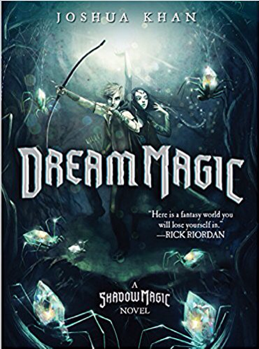
The good news is that #3 in Joshua Khan's trilogy, Burning Magic, is due out next Spring, over there at least. Oh, and by he way, the splendidly handsome US hardbacks are considerable enhanced by Ben Hobson's striking illustrations.