Here are the occasional reflections of a joyful traveller along the strange pathways of fantasy and adventure. All my reviews are independent and unsolicited. I read many books that I don’t feel sufficiently enthusiastic about to review at all. Rather, this blog is intended as a celebration of the more interesting books I stumble across on my meandering reading journey, and of the important, life-affirming experiences they offer. It is but a very small thank you for the wonderful gifts their writers give.

Wednesday, 22 August 2018

Where Shall We Run To? A Memoir by Alan Garner


'I saw how the roads joined and made one big road, and I could ride from our house anywhere, to my great-grandad at Tamworth, if I wanted, and all the way to the sea.' (After being given a cyclists' map, in 'Bike', p 149)

Footnote 

In many respects this post is something of a footnote to the one I wrote in June (see First Light: A Celebration of Alan Garner).

However that may not give an altogether fair impression of the importance (and quality) of this latest title. Alan Garner, now well into his 80s,  has not published an original new book since 2012*.  Until now that is. So the arrival of  Where Shall We Run To? has to be remarkable, another milestone in the career of an author who changed radically our understanding of what children's literature can be, and who changed it incalculably for the richer. He is a writer who forged much of what children's fiction has since become in the furnace of his remarkable imagination, his intelligent insight, and his deeply grounded awareness of heritage. So even  though he has not written anything that could remotely be called a children's book for more than forty years now, any new book of his still has to be a remarkable event. And such it is. 

What Where Shall We Run To? is not, is a new masterpiece - at least not on the level of earlier, stronger contenders for this particular accolade. But that does not prevent its being a sparkling little gem, and a most welcome addition to his oeuvre. Perhaps, in this respect, it is something of a footnote too, albeit far from an inconsequential one. 

Childhood on The Edge

The book itself recalls a number of episodes and incidents from Alan Garner's childhood, before, during and just after WWII. At the end are also a small number of further 'updates'. Told with superficial simplicity and directness these anecdotes are not presented in strictly chronological order, but together build a picture of his life, temperament, personality and preoccupations over the period until he leaves what we would now call 'primary' school, having passed a scholarship to Manchester Grammar.

What these vignettes are, more than anything is, compellingly vivid. This is primarily because, Alan Garner does not appear to be reflecting in retrospect, but rather captures the voice and mind of the child he was. He see again through his own much younger eyes, he understands only as he understood then, he notices only what he noticed at the time. He relives each moment of school, home, hospital, air raid practices, excursions, simple joys and minor traumas as the boy he was then. So we relive each moment with him. 

Weathercock


Of course, being Alan Garner, such simplicity is deceptive and the skilled hand of a great author still guides the writing. Carefully, cleverly he builds his mosaic of incidents into a complex picture of being, belonging and becoming.

At heart, the importance of this little book is not so much the particular incidents it recalls - but in what lies behind and beneath them Through everything, runs Alan Garner's iterative theme of family and place, and of the inextricable link between the two. That his predecessors have lived in and around Alderley Edge for generations , that they know it's landscape and have indeed helped form it. They not only tell its stories but live them. All of this is integral to who Alan Garner is and what he writes. It coloured his first book, it colours this one, and it has coloured almost everything in between. 

In one story, Alan and his father: 'climbed onto the Rock** . . . People had skrawked their initials in big letters in the soft part, dozens and dozens and dozens of them. But my father said my grandad. . . cut his whole name in Real Writing, the only Real Writing anywhere on the Edge. . . My father didn't know where it was, but he knew it was there. One day, I found it and showed him, and he was that pleased he took his cap off.' (p 111)

In essence, this little memoir can perhaps best be looked on as a post-script to the Stone Book Quartet***, now extending that saga of the author's Alderly-dwelling family through to himself, to his own childhood. 

And for any who doubt that this was at least part of his intention, there is unmistakable reference back to Mary riding the weathercock in The Stone Book:

'The weathercock was bright gold because my father had gilded it fresh after the war ended. The steeplejacks had lowered it down for him, and I sat on its back. I hadn't thought it was that big.'  (p 166)

Running 

Ultimately his book brings an end to Alan Garner's past, and opens up a future which is nevertheless built, inescapably and invaluably, upon the foundations of that past. Alan leaves his 'artisan' heritage by going on to Grammar School. But of course we know that he was to remain an artisan at heart; he just grew up to make in the medium of words. 

He closes the main body of his memoir:

'John and I held hands and ran. We ran from the playground, jumped over the brass, and were out; out under the sky and the white fluffy clouds with the gold and the glint of the weathercock burning to the wind.' (p 178)

His title for this book says much of the rest. It is an ending which heralds a beginning, whilst still celebrating a continuity. Like all Alan Garner's writing it is unfettered possibility grounded in long belonging. Roots are not chains; they nurture new leaves. 

That Alan Garner grew to be an outstanding runner is well attested in First Light. This new little memoir is a book that every admirer of his writing will want to read, and come to see as not so little as it seemed. 

Although not specifically a work for children, I think many will be fascinated by his evocative stories. It is also a book that teachers will find useful if their class is studying the UK in WWII. Some of the vividly written vignettes will certainly help to bring to life something of the experience of children living through those dark days. 


Notes:
*His 2016 collaboration with Mark Edmonds, The Beauty Things, is fascinating and illuminating reading, but is based on conversations between the two, conducted over a number of years, and cannot really be considered an original Alan Garner book as such. 
**Castle Rock, part of The Edge itself. 
***In my view, this quartet really is a strong contender for being considered his masterpiece. 

Friday, 10 August 2018

The Lost Magician by Piers Torday


'Life wasn't golden or perfect, he knew that now.'  (p 68)

More than it seems 

Piers Torday has himself indicated that his new book is something of a homage to C S Lewis' Narnia. It is however, far more than just this. It is an enormously clever and important addition to children's literature which uses this reference to explore themes and reach depths that children's books of that immediate post-war period rarely if ever did.

The book opens with intriguingly enigmatic, although possibly sinister,  information about a secret project the  aim of which is claimed to be to 'to end human conflict, once and for ever.' It is an important hint that what is to follow might not be exactly what it appears. 

However, what  does immediately follow is the most wonderful pastiche, not only of the Lewis books, but of the whole world of earlier 20th century children's 'adventures', from Nesbit,  through to Blyton and beyond. This story is set just after, rather than during WWII, and the four Hastings siblings, Simon, Patricia, Evelyn and, youngest, Larry, who are packed off to remote country house owned by a mysterious 'professor', are almost-but-not-quite the Pevenseys. The send up is in no way mocking; rather it is deeply affectionate, even reverential. It is is nevertheless both immensely clever and highly amusing. The language, style and sentiment of the 50s are all caught quite beautifully, yet the twinkle in the author's eyes is evident in almost every sentence. As someone who was steeped in just this era of children's books in my own younger days, I found myself smiling and chuckling throughout the opening chapters 

'Then (Simon) swapped the magazine for a pack of playing cards from the ottoman. "Right, you two. If we aren't to have our tea, then we are jolly well going to have some gin rummy." And he began to shuffle.' (p 9)

There are nods to other particular books too.  You can even play 'spot the reference'.

'Larry continued up the stairs, Grey Bear bumping behind him.' (p 10)

I did wonder whether these things might be lost on young readers, but there are many bright, sparky  children out there who will I'm sure 'get it' and not be put off by what might otherwise  seem just a very old-fashioned opening. It will almost certainly help, though, if they have already read at least The Lion, the Witch and the Wardrobe  and preferably also a few other 'classic' children's books from before and just after WWII. Although this pastiche segues reasonably quickly into much more of a complete reimagining of the Lewis book, this applies to the rest of the work too. 

Children of war

It is not long before the book starts  to show more of its depth. Just when you begin to fear the story focusing on young Larry's first discovery of a magical library is becoming too twee for words, the author not only switches the focus to his sister, Evie, but darkens its colours chillingly by introducing her haunting memories of wartime London. 

'Some things were much harder to explain. Like that day in Maguire Street. After the bomb. What she saw lying in the road in front of her. What she saw again and again, every night, in her nightmares.' (p 40)


Unlike many of the actual children's fictions of the 50s, not far below the surface of this superficially cod version, is the grim reality of the war that has just ended. For these children, London in the Blitz, with its persistent fear and its horrendous sights, was no dream. To Patricia, as well as to Evie:

'It had all been horribly, horribly real. And the proof was her, how she now thought, spoke and acted. Like a grown-up.' (p 67)

And Simon is affected too:

'You could be the fastest runner in the school, like him, but no one could run fast or far away enough to escape a war. . . . Even when you thought it was over, and you thought you had survived, you felt a pain in your chest, and there was a monster incubating inside. ' (p 68). 

Larry's bear may be an echo of Pooh, but it is actually 'Grey Bear', indelibly coloured with the ashes of the Blitz. Unlike the essentially naive and innocent Pevenseys, Piers Today's children have already had something of their childhood taken by the war. They have each had to find an accommodation to horror; Larry escapes into stories and fantasy, Evie obsessively seeks answers, Patricia has had to learn to be older than her years and Simon has developed a coldness, a hardness of heart:

'The sun's out . . . and all the Germans are buried under rubble or dangling from a rope, so ---'  (p 69)

In stark contrast too, whilst the discovery of Narnia happens in the context of a game of hide-and seek, the Hastings children are driven into their fantasy land to escape the shocking invasion of the old house by armed troops. The juxtaposition of militaristic aggression with fairies in tree houses, and the constant tension, in what follows, between Enid Blyton tweeness and the real horrors of warfare are uncomfortable, but importantly challenging. They reach in towards the heart of what this book actually is. 


Read and never read

The fantasy world, which the Hastings children enter, through the books of a magic library, is 'Folio'. The library may once have been that of  the titular Lost Magician, and the  children need to find him. However, they soon become embroiled in a futile war between characters representing fiction and others representing facts. Over both, looms the even more sinister threat of those who 'never read'. It is a telling parable for our our time, and carries important messages for the children (and adults) of any time. Yet, at its height, the Folio story is every bit as exciting and compelling as many a more straightforward fantasy.  There is delightful humour too, not least from a laconic rainbow unicorn - a cross, as it were, between Rainbow Bright's Starlight and Marvin from Hitchhiker's Guide. 

However it is the interplay between actual war and fantasy war that is one of the book's most interesting and compelling themes. The treatment of a randomly met assortment of highly recognisable fairy tale characters as wartime combatants, victims and refugees (including, significant appearances by Tom Thumb and Goldilocks' The Three Bears) seems initially incongruous, but as the story develops it all becomes strangely and disturbingly powerful, as if an Alan Ahlberg book had been graphically illustrated by a WWII war artist. Can victory in one world really bring peace to the other?

In many ways, the narrative development of The Lost Magician closely echoes that of The Lion, the Witch and the Wardrobe. But is its author simply 'writing a new story over the old' (p 189) ? No, he is himself more of a magician than that. Piers Torday shows here how something old can be turned into something totally fresh and provocative, without in any way diminishing the original. It is not a replacement for, or simply an adjunct to, the C.S.Lewis book , but an important complement to it. This reimagining serves to throw the contrasts as much into focus as the similarities  The differences are important, so recognising them is important too. 


Narnia, not Narnia

Even though many children read and enjoy it simply as the fine fantasy that it is , and do not necessarily take much account of the Christian allegory that is its true essence, The Lion, the Witch and the Wardrobe is as much of its time as The Famous Five. The Pevensey children are basically 'nice'  (apart from Edmund, who learns to be nicer); their fantasy adventure is essentially simple, good v evil, with good triumphing thanks to Aslan. PiersTorday's child characters are more 'real', deeply affected by the world in which they have grown up; the issues of their fantasy adventure are both less simplistic in themselves and more immediately  related to the children's world, and our own. 

Additionally, in another contrast to its illustrious predecessor, girl characters are, here, just as prominent in the action as the boys. There are messages too that encourage boys to 'dare to be different'*, which in itself is no small thing.  

'What would his father say? Larry wasn't a pansy. He meant . . . he wasn't any old pansy. He was the brightest, bravest and most glorious pansy on a flying rainbow unicorn, and he was going to show them all.' (p 255)

Piers Torday succeeds in giving his tale a very classic children's fantasy structure. But then that is because The Lion the Witch and the Wardrobe, which it echoes, is perhaps the archetypal children's fantasy of them all.  However this book fully deserves to stand alongside its classic predecessor as the 'Return to Narnia' for our own times. It will be a particularly welcome addition for those who revel in the celebration of imagination, the promotion of reading and the value of libraries. 

Of our time, for our time 

Yet there is rather more to The Lost Magician even than this. The framing segments, extracts from that security file concerning the intriguing but rather sinister 'Magician Project', continually mystify the reader, not least because of their feeling of incongruity with he rest of the narrative. By the story's close, however,  they have added another crucial layer to the book and shaken the reader out of any feeling of  Narniaesque coziness. Even though living in Folio has apparently helped the Hastings children forget the  traumas of the actual war, even though they have earnestly been seeking the magic that would secure a peaceful future, the world to which the they return . . .  Well, no spoilers. Suffice to say that the shocking ending adds another level of true, if deeply disquieting, importance to an already fine book. 

In his Last Wild series,  Piers Torday pitted a world of rampant technology and aggressive acquisitiveness against that of nature; here he explores the threat that much the same world (our world?) poses to literacy in general and fantasy in particular. He has much of great resonance to say about it too. Those who have hailed him as one of our foremost contemporary writers for children are not far wrong. 

And let us all desperately hope that the lost magician really is still there, looking out from his (or her) library window. 


Note:
*See my review of Stories for Boys who Dare to be Different, from April 2018.

Wednesday, 8 August 2018

The Turning by Emily Whitman


Illustration Vashti Harrison

'Hail creation. Wave-riders, shore-striders, sung by the Moon into being!' (p 74)

Turning a tale

It is August already and my list of contenders for 'Books of the Year' is getting gradually a little longer. Here is one that absolutely must be added. It is a book for the young reading connoisseur, leisurely and lyrical. Its atmosphere and images are often breathtakingly beautiful, a story that fires the imagination and grips the heart. It takes you swimming with seals, surging, twisting and diving through the wild oceans, then hauls you onto rocky shores under a cold and magical moon. 

The Selkie legends are found most commonly in the folklore of the remote Scottish isles, but have counterparts in other northern sea-strong cultures too. These stories seem to have a particular pull and potency for both writers and readers. A fair few children's books have a Selkie theme or influence, covering everything from simple retellings of the traditional stories to adaptations and complete reimaginings. They range, too, from pictures books and children's novels into YA fantasies, and, indeed, into many adult books. However, I have come across no finer example than this one. It is truly magical. Like the Selkies themselves, it manages at once to be about characters so human you weep for them and creatures of the ocean, that are familiar and yet so completely other.  You swim with them, wild and free in the vast ocean, and rest, peaceful, with them on the pebbled strand. This book's magic is the magic of nature as much of myth, of the sea, of the sky, of the waves and of the wind. Like the pull of the tide, its magic is that of the moon. 

Longing for turning 

The Turning is a tale which hangs childhood on the cusp, on the shoreline between land and sea, between reality and dream. It is the first person narrative of Aran, a boy born to a Selkie mother and human father. Although he has lived  his full life with his Selkie clan, in the ocean and on its margins, he is for the present fixed in human, 'longlimb', form. He yearns desperately for the arrival of his his seal pelt, the 'turning' which will allow him to become his full Selkie self. Later, finding himself abandoned to a strangely unfamiliar life on land, he  gradually learns that there are some wonders, as well as horrors, involved in being human.  Finally, a soul-wrenching crisis forces him to face who he truly is and wants to be. 

Moving and turning

The true wonder of Emily Whitman's book is that, in her hands, this apparently simple story becomes completely involving and deeply compelling. She tells it in translucent, magnetic prose, and captures the thoughts and feelings of Aran  so convincingly that the reader is swept through the waters of her story on a tide of compulsion. Our need to know what will happen to him is every bit it as strong and desperate as his own need to understand who he truly is. 

Not since I first read Michelle Magorian's Goodnight Mister Tom, do I remember developing quite such an intense emotional empathy  with a young character. I truly lived through this story with Aran. I shared his thrill in swimming the cold ocean (even though such an activity would have no appeal at all in my own life). I joyed with him in a first true human friendship. I quaked inwardly at the dreadful turn of events which devastated his life and ripped his dreams apart. 

Turning inside out 

There have indeed been many children's novels about Selkies. There have been even more about a young person's journey towards finding their true self. There can have been few of either more affecting than this one. It is a work of rich imagination and superlative language, a very fine novel indeed. 

If you want Aran's story to be just a story, it can be. If you want it to be more, it can be about every child who longs to belong, but fears that they do not. It can be about anyone who has two identities, two lives, which are both their true self. In a way we all live where the sea meets the land. As the author says at the conclusion of her final note: 'We've all got the ocean inside us. beautiful, mysterious, and untamed. Like Aran we are two everythings.'  Why else do we so often wish to spend our precious holidays sitting on the shore? 

It is a truly beautiful book; one that I cannot commend highly enough. 

Although there are indeed many times when you can't, and shouldn't, judge a book by its cover, there are also times when you can. This is one of them. The story's etherial loveliness, its hope and its desperate longing, its familiarity and its otherness, its duality and its wholeness, are all caught quite perfectly in Vashti Harrison's mesmerising cover art. Moon magic.  If you love the outside of this book, you will love the inside too, and vice verse. 


'Stories were places where two worlds met, swirling around each other like ribbons of foam.' (p 224)


I hope this American author's wonderful new addition to the canon of children's literature will be published in the UK very soon. Meanwhile any extra effort needed to get hold of the lovely US edition will be richly rewarded. 

Tuesday, 31 July 2018

Dark Sky Park: Poems from the Edge of Nature by Philip Gross


Differently magic

Here is another temporary departure from my usual focus of 'magic fiction'. But I make no apology. I have always been a lover of poetry, both as an individual and as a teacher, and I would like to celebrate the work of Philip Gross, one of my all time favourite writers of poetry for children.* 

Instead of magic fiction then, this is a post about the magic of language, incantations with a different kind of power, spells of being and of being aware. Children need and deserve more poetry, especially when it is of this quality - poetry proper, rather than simply 'children's verse'. 

A poet and a hill

I have now followed the writing career of poet and author Philip Gross, collecting all his publications, over the course of more than twenty five years. I have had a very particular reason for doing so (over and above his simply being a wonderful writer). Even though I am sure he will have long forgotten it, he visited our school for a day way back in 1991, when I was a Primary headteacher in Lancashire's beautiful Ribble Valley. After starting his visit by reading and discussing some of his poems with our children, he and I took a group of them off on an expedition to climb the nearby Pendle Hill. As we climbed, we periodically stopped, took notes and made sketches that tried to capture our experience. On return to school, Philip led a workshop where the children composed a group poem about the climb. Later they wrote individual poems too (see below) and I combined them, with their drawings. into a booklet called 'The Poet and The Hill', which we distributed to parents and the local community. We were all thrilled that Philip Gross also contributed a poem of his own to our little 'publication'. I still remember that day of walking and writing with children as one of the highlights of my teaching career. 

Over many years since, and with many cohorts of children, I have shared Philip Gross' poems to inspire and stimulate, which they certainly did. My favourite, and most often used, collection remained his first book of children's poetry Manifold Manor, although I also made extensive use of The All-Nite Café and Scratch City. All contain quite splendid, if sometimes challenging, material for sharing with children, and some of his poems even come with exciting suggestions for follow-up writing. I think these older books can all still be tracked down, with a little effort, and I warmly recommend them, alongside his subsequent writing. 


Dark Sky Park

Now he has a new collection out, Dark Sky Park. Of course it is too late for retired old me to use it in classrooms, but if I were still teaching I certainly would. These 'poems from the edge of nature' are a treasure trove of  language and condensed thought, imagery and fresh insight. Amongst its pages we are asked to think about the importance of seeing in the dark; of 'seeing' things far too small for us to see at all; of extremes and freaks of nature and of many things we may otherwise just overlook. If, like me, you have never even heard of a tardigrade, then this is the place to meet it. 

As ever, Philip Gross' poems are challenging, in thought and in language, but they remain accessible once mind and ear are tuned to his idiom. In this new book they are made even more approachable by copious illustrations from Jesse Hodgson, by turn entertaining, illuminating and arresting - and sometimes all three. Philip Gross himself helps too by adding occasional notes of  information and context.  Together with the poems themselves, they help us see nature in fresh, vibrant ways and could do much to set children on a path of writing too. However, crafted as they are with consummate skill, if these poems did no more than open ears to the flow and patterns, the power and potency of language, then that would be no small thing. 

mud worm    blood worm
flood worm borne on waters boiling
liver fluke and tape worm
and the maggot and the leech
wire worm   fire worm
dire wyrm and dragon coiling
rag worm and lugworm
making pockmarks on the beach 

(from Worm Dreaming)

If  you want a longer example of what I mean, just try reading aloud A Tardigrade by any other name on page 30-31. It is word-music of a truly enchanting kind. It is also a most potent invitation to write (whether about some alternative creature, or about yourself) as well as a cornucopia of ideas as to how you might go about it. 

I know that many teachers have recently drawn wonderful things out of children in response to Robert Macfarlane's and Jackie Morris' superlative 'Lost Words'. Quite different, but not totally unrelated, Dark Sky Park could, perhaps, provide rewarding, directions to move in next. 

Building children

I ask Philip Gross to forgive me if I close this post, not with one of his own poems, but with one written by a ten-year-old in response to that day back in 1991. 

We walked and walked
Up the hill
Over the cattle grid
I picked up a stone
Over the stile
Through the field
Up the steep path
To the summit
Put the stone down
Pendle Hill
Five inches bigger

Dylan**, Year 6


I hope that Dylan, the human being, ended up just a fraction bigger too. Exposing children to poetry, like that of Philip Gross, can be a challenge, but it grows them little by little. In time it can build mountains. 


Notes:
* He writes for adults as well as children - and sometimes for either, or both. 
** Dylan, I'm sorry that, after so long, I have no way of contacting you, so, in the very unlikely event that you come across this, I really hope you don't mind me sharing this amazing writing by your long-ago self.

Friday, 27 July 2018

The Frozen Telescope (The Uncommoners 3) by Jennifer Bell


Uncommon indeed 

Here is an update of my post from June '17.  I lauded Jennifer Bells's new children's fiction sequence then - and my enthusiastic recommendation still applies, but now threefold. This wonderful 'entry level' fantasy trilogy has reached its third title.  

The Uncommoners  continues to provide escapist entertainment of the highest order for children who are starting on what will hopefully be a lifetime of reading novels. These books will certainly help them on that road. It is an exciting journey and these are exciting books. This author has no pretensions to be profound or 'relevant', but rather to provide young readers with engrossing escape into magic and imagination - and that she does quite superbly. And what a riot of fanciful invention, what gripping writing she brings to the task. She takes many of the best conventions of children's mystery/adventure/fantasy stories and refreshes  them with a  charm and vigour that is simply delightful. In this, she provides a wonderful complement to the many children's books that deal with real life 'issues'. Both are important, but if children are to learn to read for pleasure, they crucially need books like this into which they can escape and feel magical, at least vicariously. Such books are part of life's rich pattern and indeed help to make that pattern richer. 

Uncommonly exciting

Now that she has reached The Frozen Telescope, Jennifer Bell's quirky world of everyday objects with magical powers, has developed far greater complexity. The original setting of Lundinor, the 'undermart' below London, where such uncommon objects are traded, has now expanded to encompass similar hidden realms below other major cities, most prominently New York. The 'souls' trapped in uncommon objects have emerged as belonging to a vast army of 'the dead', many seeking the reunion which will allow them to become 'the departed'. There is also a secret society of spies, a missing sister to be found, and objects of particular power to be located and used. That is as well, of course, as the whole world to be save from the evil machinations of 'the Dirge'. Wow! How much more page-turning excitement can be squashed into a story? The answer is quite a lot. And the climax is, well . . . duly climactic. 

Uncommon and Extraordinaire 

Illustrator Karl James Mountford contributes not only another arresting cover, with a lot more intriguing detail to be found than initially strikes the eye, but again enhances the feel of the story quite wonderfully with his many in-text vignettes. 

Inevitably, this conclusion of a trilogy is not the place to start. Readers will need to have a good grasp first on all that has gone before. But for those many who are already into this world 'big time' (and there are, deservedly, hoards of them) the arrival of this final title will be an absolute joy, and bring with it not one iota of disappointment. 

I see that these books are already being translated into other languages, and so they should be. This trilogy is destined, I'm sure, to join the likes of The Faraway Tree, the Narnia books, The Borrowers and  Half Magic as a much-loved classic of children's fantasy, enduring through generations. 


Sunday, 22 July 2018

Night Flights by Philip Reeve


'It's a town-eat-town world.' (p 120)

Engines restarted 

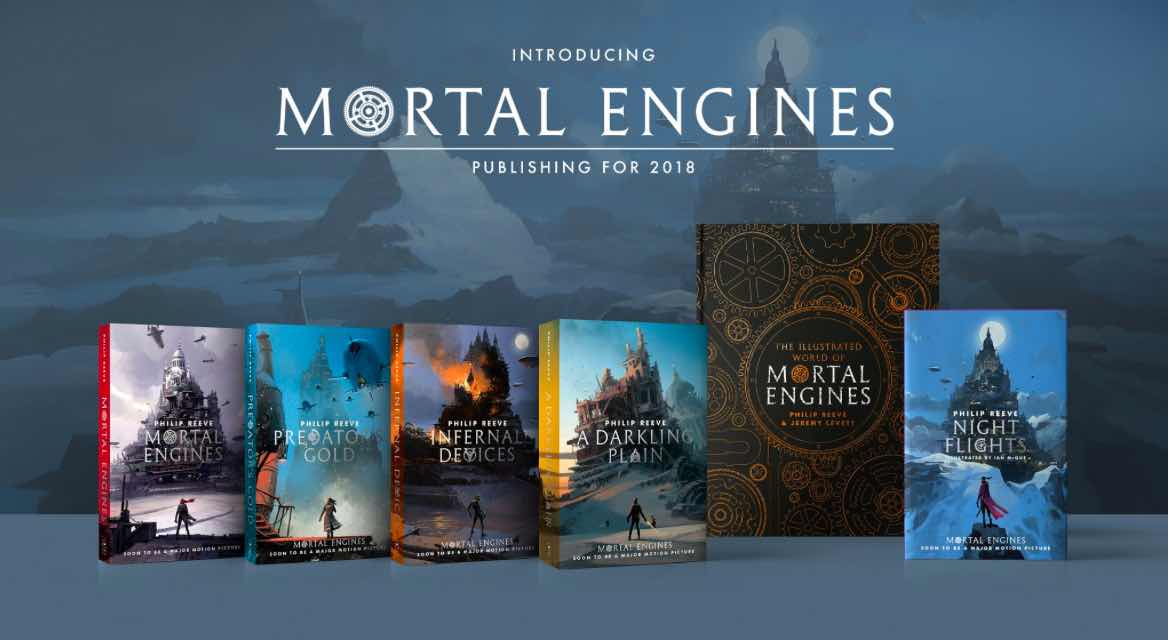
Fans of Philip Reeve's Mortal Engines* sequence will warmly welcome this new volume. And I most certainly count myself amongst that huge number. For any who don't know them, these SciFi-fantasies originally published between 2001 and 20011 and still very much in print, are amongst the most imaginative and thrillingly entertaining of children's speculative fiction from the early 21st Century.

New stories for familiar worlds

Over the years, many famous authors have added short stories to the main volumes of their highly successful fantasy creations, right from Lloyd Alexander (almost 50 years ago now) through to Philip Pullman and Sarah Green. Most of these addenda allow us fascinating extra glimpses into the relevant worlds. They often provide illuminating insights into incidents and lives not revealed in the main works, without actually recapturing anything like the stature and power of the full novels. This is very much the case with the three additional stories about the world of Mortal Engines that now make up Philip Reeve's Night Flights. Their main focus is aviatrix and spy Anna Fang. Whilst she is  not exactly an insignificant character in the main books, those novels do not principally tell her story, and what we know about her life before the events of Book 1 comes only from hint and inference. Night Flights fills in much of this gap, as well as making us aware of a few other significant precursors to later events. As such, it makes a valuable and welcome extension to readers' appreciation of the whole sequence. 

Something old, something new 

In fact, of the three stories that make up this latest volume, the central, and longest, one, is not completely new. In an earlier version and under the title Traction City it was published in the UK back in 2011, half of a special 'World Book Day' offering. 


However, this is not just a reprint The present version, retitled Traction City Blues, has been substantially edited and in some parts completely rewritten. It now has a much clearer focus on Anna, showing how she grew through the experiences its events and characters provided. The preceding, completely new, story reveals how she escaped her early life of slavery and took to the 'bird roads'. The third one, also new, is is a further adventure which adds yet more to our understanding - and hers. 

The life lessons which she learns, like the societies through which she moves, are not always easy and comfortable ones. These stories are part of a life that has made her hard as well as soft, that have made her who she is - the remarkable and fascinating Anna Fang. 

Philip Reeve's use of language is of his trademark high standard, viscerally engaging and emotionally affecting. Every now and then, too, flashes of an impish authorial humour, particularly in the naming of people and places, add an extra little frisson to the telling. 

Haunting images, beautiful book 

These three main tales are held within a framing narrative, not a story in itself, but linking them to each other and, in a delightful way, to what readers of the full series already know is to follow. Philip Reeve is such a fine writer that he does in miniature here what he does superlatively in his more recent masterpiece The Railhead Trilogy**; he creates a whole that is far more than the sum of its parts. 
  
In fact this little book is much more even than its words. It is a most handsome volume in every sense. The original Traction City was illustrated by the author himself. Philip Reeve is a talented artist as well as a writer, so the 2011 World Book Day publication remains well worth seeking out. However Night Flights is also a magnificent triumph for its current illustrator, Ian McQue, whose superb greyscale images add enormously to the new volume. Many of his larger spreads are breathtaking, particularly in the wonderfully detailed and evocative portrayals of this world's fantastic cities and airships. He captures 'spacescape'  and atmosphere beautifully too, as well as characters and action, both dynamic and chilling. My favourite of all his depictions is the portrait of Anna herself which appears on page 73. It seems to capture both her outer bravura and inner, often well hidden, vulnerability - Anna to a T. 

Added to the welcome stories of Anna Fang's background, its illustrations, and indeed its overall fine design, make Night Flights, a quite wonderful book to have and to hold. 


Note:
*It was formerly given the series title Predator Cities in the US, but in the most recent editions seems to have reverted to the original, Mortal Engines, presumably because this is the film title. 
**See my review on this blog from May '18. 

Monday, 2 July 2018

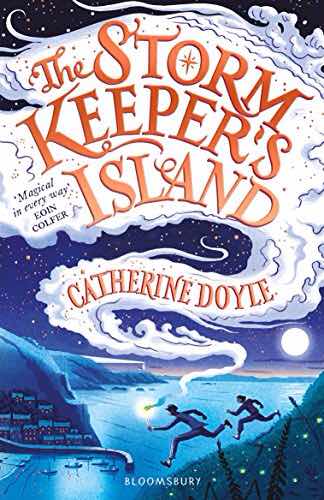
The Storm Keeper’s Island by Catherine Doyle


Cover illustration Bill Brag, lettering Patrick Knowles

'. . . places can be just as important as people. . . they can have the same power over you if you let them.' (p 4)

Quotable notable

Sometimes a book offers up so many delectable quotes that I agonise long over which to include. It is often a sign that it is a great book. The Storm Keeper's Island does. And it is. Occasionally, but only very rarely, I come across a book that I just know is one that deserves to join the canon of 'classic' children's literature. This is such a book. However, thoughts of potential status should not distract from the fact that it is is a totally gripping read, and ultimately a very affecting one. 

This is a story firmly grounded in an actual and particular place, the wildly beautiful island of Arranmore (Árrain Mhór) off the northwest coast of Ireland. Catherine Doyle, herself rooted in the place and its myths, develops a story of an evil Sorcerer, Morrigan, buried deep in the island, which is now protected by the mysterious and elusive 'gifts' of her benevolent counterpart, Dagda. At the same time, the human role of 'Storm Keeper' is being passed through generations. The holders do not only embody those 'gifts', in some strange way, but have, over time, captured particular instances of weather, in the form of numerous wax candles. In these candles are held all the layers of time that have built up the island's climate, its character and history. For example the author writes of one such candle:

'It was sheets of freezing rain and the burnt shriek of lightning striking sea. It was peril and adventure and terror and hope all rolled together, and it was unapologetically pungent. ' (p 159)

 It is all wonderfully imaginative, yet completely credible in its own context, and hence enormously potent. 

Layers of time and meaning

This book has much in common with those of Alan Garner and Susan Cooper, in that it unpacks the strata of time encapsulated in a particular place. In this case its remote, wild island embraces sea as much as land, weather and sky as much as earth and history. However, for all its depth, its layers of magic and myth, time and place, The Storm Keeper's Island, is not obscure or inaccessible. It is also wildly, stormily exciting and completely enthralling. 

The magic here is rendered all the more credible (or incredible) by its juxtaposition with vividly drawn contemporary characters, centring on rival siblings Fionn and Tara. They are completely convincing, often in conflict with each other, or even  themselves, and yet the layers of myth are as much acted out in these children as they are in their island location. Fionn and his sister must work through the inherited battles of previous generations, enmities and loyalties, the ambitions of contemporary islanders, and the traumas and tragedies of their own family. Reality and magic become the mirrors and metaphors of each other, each 'storm', and each magic candle. both the externalisation and the internalisation of conflict and resolution that is richly resonant. In this, The Storm Keeper's Island reminds me of Alan Garner's The Owl Service, although Catherine Doyle's book is less obscure, more accessible to young readers, whilst ceding nothing in depth of mystery or magic. 

What is it about the Irish?

I don't quite know what it is with Irish writers and the creation of wondrous poetry and prose in English, but there just has to be something. Aside from all the long and fine legacy of Irish writing in the past, we have relatively recently had children's fantasy writing of staggering brilliance from Dave Rudden, as well as from Matt Griffin and the late, and much missed, Nigel McDowell. All distinguished by breathtaking language. 

Perhaps it should come as no surprise then that one of the many remarkable features of Catherine Doyle's stunning writing is her use of language. Hers is language that digs into meaning much deeper than the words she spreads over the page. It delves below the surface of characters and locale, island, cottage, sea and chimney smoke. But what we discover  in its depths is not simple or blatant. Its secrets are hinted at. rather than laid bare, revealed by inference, rather than  exposition. Its power is not in exuberance on elaboration but in the superbly chosen word, original, surprising in its context. She creates images that illuminate, sometimes with a flicker of candlelight sometimes with the electric brilliance of lightning. 

'(Fionn) wanted his father to be unchained from the lifeboat at the bottom of the sea. . . All his life it had dwelt in the sliver between his soul and his heart - where desire dissolved into impossibly.'  (p 43)


No more sandwiches 

The Storm Keeper's Island has already been called Book of the Month, and this time those who have tagged it have got it so right. But it is and will be more too.  It could well be a Book of the Year, of the decade, and on. Catherine Doyle's is one of the most devastatingly exciting new voices in children's fiction that I have encountered in a long time. 

As the story has promised all along, this book turns out to share a major theme with so many other children's fantasies: an ordinary boy who is chosen as the special one to lead the defence of his world against the powers of darkness. It is the narrative of his coming into power. 

'Being a guardian of this wild and ancient place would mean learning snowstorms instead of long division, composing rainbows instead of acrostics.' (p 147)

Yet Fionn is not quite a Harry Potter or a Percy Jackson. He is far more. His story is deeper, richer  and more genuinely dark. It is linked to the power of an island, to the power of the elements, both to place and to the resonance that lies within us all as human beings. His story is a great fantasy, and is surely the opener of an even greater fantasy sequence. Its completion looks set to be one of the children's book events of the (hopefully) not-too-distant future. 

For much of the book,  Fionn is afraid of the sea and its storms. He does not believe he has the courage to take up the challenge the island offers him. 

'He was not brave . . . When everyone else was in Helm's Deep, he'd be back in the Shire, making a sandwich.' (p 45)

But on Arranmore he finds a new self as well as an old self, an ancient self, yet still an entirely contemporary self,

Even into the storm. . . Especially into the storm. 'You just have to walk . . . Will you walk with me?'

It is an invitation from his grandfather to Fionn. It is also an invitation from Catherine Doyle to every potential reader. 

Leave off making sandwiches and accept it.