Here are the occasional reflections of a joyful traveller along the strange pathways of fantasy and adventure. All my reviews are independent and unsolicited. I read many books that I don’t feel sufficiently enthusiastic about to review at all. Rather, this blog is intended as a celebration of the more interesting books I stumble across on my meandering reading journey, and of the important, life-affirming experiences they offer. It is but a very small thank you for the wonderful gifts their writers give.

Tuesday, 29 August 2017

Shadow Magic / Dream Magic by Joshua Khan


Entertaining finds

Here are two great finds for children's fantasy. They are wonderful books. And these ones really are for children (US 'Middle Grade'); so many 'high' fantasies stray into Young Adult territory. UK readers may need to seek them out though. Despite their London-based author, they don't seem to be too widely known here yet. They are, however, very  successfully published in splendid editions in the US. 

I am generally very sceptical indeed of book blurb which offers a successor to Harry Potter. But although these magic fantasies are quite different from J K Rowling's stories, I do agree that they will have something of the same appeal to much the same audience. They are hugely entertaining, completely enthralling, exciting and  endearing in equal measure. ,

Fantasy with a twist

They have many of the classic ingredients of high fantasy, small warring kingdoms of a broadly 'medieval' nature, scorcerers and warriors, lords, princes and princesses, fantastic beasts (occasionally doubling as magical pets), a displaced waif adopted as an 'apprentice', evil plots and even more dastardly villains. The main twist this author brings is that Lily, one of the very likeable young protagonists, is heiress to a kingdom of dark sorcery, rather than the usual champion of 'the light'. This gives plenty of scope for a world of wicked magic, zombies, bats, crumbling, haunted castles and the like,  although, as appropriate for the young audience, it all has rather more in common with Disney or the Adams Family than with Denis Wheatlley and the occult. It is the source of as much humour as horror. However, even though she is now ruler of Gehenna, following the recent murder of her parents, Lily is forbidden from learning sorcery because of being female. However, feisty young thing that she is, you can't see her abiding with that rule for too long. 

Lily is complemented by a young male character, Thorn, rescued from slavery by the kingdom's 'Executioner', Tybirn, and brought to her court, for motives only much later to become apparent. Thorn is a down-to-earth, likeable lad, and their unexpected developing friendship is one of the book's many joys. A trio of young protagonists is completed by K'leef, a poor little rich boy (with a magic of his own) who is currently being held hostage from a neighbouring kingdom. Together they make as utterly charming a cast of 'heroes' as I have found in this type of story for a long time. Then there is the 'pompous, arrogant, bullying and entirely moronic' prince from the neighbouring kingdom, who Lily is supposed to marry to cement a peace treaty Well, feisty young thing that she is . . .  Enough said I think. 

And a mystery too

Around these young people and their engaging world, Joshua Khan weaves a zestful, rumbustious tale that constantly trills, delights, and terrifies. As Lily herself in some senses represents 'the dark' , this cannot be the usual high fantasy plot to overthrow the powers of darkness, instead this first book is more of a murder mystery. It is something of a who-done-it in terms of the killing of  Lily's parents, an attempt to poison Lilly herself, and other equally dastardly deeds. As an adult reader, I actually cottoned on quite quickly to where the plot was leading. But I don't think many younger readers will. To them, the final revelation will come as a surprising and indeed a shocking one. 

Together with the theme of Lily asserting herself  as a girl (quite right too) and Thorn and K'leef finding something of their role in life, this is just about as rich and rewarding a read as most children could wish for. Oh, and did I say entertaining, exciting, enthralling and endearing? I surely should have.
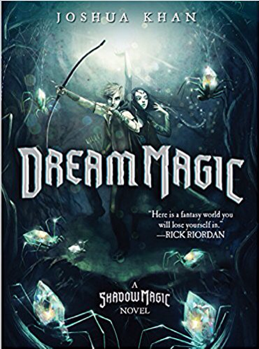


Strong sequel 

Second books in a series can sometimes feel a bit of a disappointment, a rather pale repeat of the first. However, here, Joshua Khan cleverly exploits the potential without falling into any of the bear traps. His young protagonists are already beginning to feel like old friends, but he continues to develop their characters and relationships well. Similarly, he succeeds in developing his world, giving readers more of what they enjoyed so much the first time around but without the storyline feeling in any serious way repetitive or predictable. In fact I found even  more humour in this book and the darkness has become even darker, more ghoulish, although, still never seriously disturbing. 

In this episode, Lily, our young ruler of the Dark Kingdom continues to develop her (forbidden) powers as a sorcerer. As a consequence she has 'let through' countless undesirables, zombies and worse. Worse than zombies? On yes. Believe me. Far worse. She still needs her friendship with loyal commoner, Thorn, very badly. 

This story too is bursting with shocking incident and exciting action. It is an unrelenting and involving page-turner, a delightfully entertaining read throughout and exactly the sort of book that will engage and delight countless young readers, as well as hooking in many potentially more reluctant others. If it is not quite Harry Potter (what  could be?),  then it is probably as good a substitute as those with no Hogwarts left are likely to find. 

Seek them out

Which makes it altogether mystifying why these hugely entertaining young reads, by a London-based writer, are very successfully published in the US but don't as yet seem to be so widely known over here. 

It sometimes feels to me that there might be a degree of prejudice around against full-blown fantasy and in favour of books that deal with 'real life', with 'issues'.

If so it is seriously misplaced. Of course 'real life' books have a vital place in the children's canon. However, fantasy is an exploration of imagination, and that is just as much a part of our human make up as our ability to cope with the everyday. Fantasy nurtures and expands the imagination and imagination is the core of all the Arts, as well as of many other fields of endeavour. Indeed it is the essence of all creativity. And much fantasy does in fact deal with profound human issues too;it is just that it does it through metaphor, through distanced narrative, rather than facing them head on. It still leads to learning through vicarious experience. It is just that that experience is dressed in images. 

All story is powerful. All story is fundamental   We should beware of valuing some of its manifestation more than others. It can lead to an imposition of our own ideas of what is correct, what is best, over the breadth and depth of provision which allows children to discover for themselves what it is that they want and need. 

And do we require anything more than young Potter to demonstrate both the potency and popularity of fantasy for huge numbers of young readers, here in the UK as well as in The States?

The good news is that #3 in Joshua Khan's trilogy, Burning Magic, is due out next Spring, over there at least. Oh, and by he way, the splendidly handsome US hardbacks are considerable enhanced by Ben Hobson's striking illustrations. 

Sunday, 27 August 2017

Thornhill by Pam Smy


For Brian Selznick fans

Over the course of his three recent children's books, The Invention of Hugo Carbet (2007), Wonderstruck (2011) and The Marvells (2015), brilliant American artist/author Brian Selznick has essentially developed a new form of graphic novel for this audience.  Although his are indeed graphic novels in a very real sense, they bear little resemblance to the comic book styled publications that usually define this genre, of which there are many fine examples. Nor are they exactly like the wonderful textless narratives from masters such as David Wiesner and Shaun Tan. Indeed, there is no sense at all in which these are 'picture books' in the accepted understanding of that term, partly because they are in every way full-length, rich and complex novels, and also because the pictures are not merely illustrative of the text, but an alternative narrative device in their own right.  Instead, in Brian Selznick's books, substantial  sequences of textless, double-spread images carry whole sections of the narrative. However, these are then interspersed with other purely prose passages which either continue the pictures'  narrative, or provide a different but complementary one.  Brian Selznick's stories are wonderful and the way they are told is quite breathtaking. The finest of the very fine trio is, in my view, the latest and most complex,  The Marvels. (See my post of September '15.) However, they are all wonderful and together one of the most significant, imaginative and enchanting of recent contributions to the canon of children's literature.  If you don't know them,  you should read them yourselves and then certainly introduce them to as many children as possible. They will learn a whole new way of reading and appreciating fiction. 

Now a UK author/artist, has taken up the considerable challenge of this particular narrative format and produced an equally stunning contribution of her own.  Pam Smy has adopted a similar image/text approach to the Brian Selznick books, but her content is very different and both her graphic and writing styles are distinctively her own. She is also immensely skilled in both areas. 

Wonderful prose, stunning pictures 

Even if her book comprised the extant prose alone, it would be a remarkable achievement. This narrative elucidates the thoughts and feelings of a 'disturbed' girl in a 1980s orphanage, the titular Thornhill, already an old and run-down institution. The deceptively simple but very effective writing captures her voice perfectly and the diary account  of her situation and treatment gradually reveals her true and complex personality quite magically - and disturbingly. 

However the interwoven, complementary story told through the images is equally strong. This recounts how a second girl, this time living in 2017, and not without issues of her own, discovers the story of the first. The pictures convey her narrative with perfect clarity, but are as much about atmosphere and emotion as they are about incident. The striking, greyscale images, strong, simple, yet often subtle too, capture both of these most tellingly and this narrative format cleverly lures the reader into a different, but equally potent, quality of imaginative involvement. 

But of course it is ultimately the interrelationship of the two narrative strands which makes Thornhill most original and effective . Less is often more here and the fact that much is revealed, in both words and pictures,  by implication rather than direct exposition, renders it even more potent. This radically different way of  reading fiction is utterly compulsive, richly involving and deeply affecting. It is a truly life-enhancing book. 

More than a ghost story 

I do not think it is much of a spoiler to say that Thornhill is a ghost story; this is strongly telegraphed by the style of its images, not to say by direct pictorial reference, at one point, to Susan Hill. As such, it becomes spine-tinglingly chilling as the narrative develops   However, at heart, this is not so much a story about ghosts as one about very real children. In fact it carries a profoundly important message about humans and humanity , which, I am sure, will reach countless readers through its compelling storytelling. It is a compassionate book about compassion; about the importance of accepting others for who they truly are, not what they appear to be. With obviously heartfelt passion, it speaks of the importance of sharing our love with those who seem to make it hard for us to do so; with those who may appear not to want our love, to need it or perhaps, even, (from our position of 'superiority') to deserve it. 

Somewhere in Cambridge lives a remarkable little household of artist/authors.  Pam Smy's husband is Dave Shelton, creator of the delightful  A Boy and a Bear in a Boat, one of my all-time favourite books in the entire universe of children's literature. Now Pam Smy's own, very different, but equally exciting, book has come along to join the greats. 

What, no dust jacket?

I have only one regret about the physical presentation of Thornhill. My issue, I suspect, lies not at all with the author but with the  publisher. Its interestingly impressed boards notwithstanding, it is a crying shame that such an important and special contribution to children's literature has been issued without a dust jacket. Its lack sadly takes the edge off what is otherwise a beautifully produced volume, worthy of its content. 

Tuesday, 15 August 2017

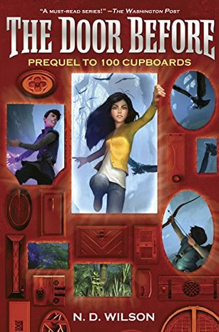
The Door Before by N. D. Wilson


The sequel prequel 

Authors give themselves a problem when they decide to return to add more to a fantasy sequence they have previously considered finished. It happens quite often - and I don't think it is always just a desire to capitalise on earlier success. I suspect writers sometimes miss their characters and worlds just as much as their more avid readers do. But when a story has already been conclusively rounded off; when the world has already been saved from ultimate evil; when, as it were, the One Ring has finally been cast into the Crack of Doom, what can happen next that isn't anticlimactic? 

Of course some writers adopt the 'Return of Sherlock Holmes' approach, claim that the 'Reichenbach Falls' didn't happen the way you thought, and just carry on, regardless of how contrived it feels. Fortunately few reputable authors are so blatant. A much more common and acceptable solution is to keep the same  world but move characters on a generation, so that new young protagonists can face fresh challenges. However the solution that a remarkable number have come up with is to make their sequel in fact a prequel; to fill in missing back story, rather than continue beyond what is already a pretty conclusive end. This is the approach which N. D. Wilson has adopted in his recent addition to the 100 Cupboards sequence, which he wrote between 2007 and 2010. 

Up with the best 

The Cupboards trilogy (100 Cupboards, Dandelion Fire, The Chestnut King) is a 'classic' of children's fantasy, if one can use the term for something written as recently as 7-10 years ago. Let's, perhaps, settle instead for the charming oxymoron 'contemporary classic'. 

With so much larger a market, combined with a particular transatlantic appetite for the genre, the US publishes far more children's fantasy than does the UK. It can, therefore, sometimes be difficult to sieve out the nuggets. However the best of American writing for children is amongst the finest writing for children in English. Period. And this fantasy trilogy is certainly well up there. 

Portals aplenty

These books of N. D. Wilson's offer a highly original take on the well-established idea of the 'portal fantasy', the 'wardrobe' door that leads to another world. This is primarily because his numerous cupboards offer so many such portals, with a multiverse of fantasy worlds behind them. Even though all 99 potential worlds* are not actually exploited, the many that are, and the interconnections between them, give the story real interest. Even greater perhaps is the interest in the relationships of protagonist, Henry, and his 'family' to the worlds beyond the cupboards. 

The books have many strengths. Not least is a delightfully dry humour which permeates, especially in the 'real world' sections of the story. Added to this is the author's wonderful skill with language, where words and phrases are often used quite magically to conjure images of people and places and to evoke effecting thoughts and reactions. This language is never 'fancy' but rather communicates directly and powerfully with the reader.  It is truly masterful. Another strength lies in the way N. D. Wilson eschews heavy up-front exposition, but rather lets the story unfold in the telling. He allows the reader to piece together what is happening, often echoing protagonist, Henry's own gradual realisation of the import and implication of his situation. In fact the human story is often as interesting and engaging as the high excitement and action of the fantasy world encounters, and that too is an important part of the tale's fascinating hold. Not, of course, that there aren't chills and thrills galore in the unfolding fantasy itself, which grows from small beginnings to earth-shattering climax. 


Seek them out

The Washington Post is quoted as saying this is a 'must-read series'. I do not always agree with book cover hype, but on this occasion I emphatically do. Fans, for example, of the early Narnia stories, will love these cupboarded worlds,  It is also a series which many parents and teachers will, I'm sure, feel comfortable to share or recommend. Despite its witches and nightmares, it is a sequence that is, at heart, homely and wholesome. Further, it achieves this without being preachy in the way that, say, the later Narnia books are. It is hard to understand why 100 Cupboards has never been published in the UK. True, the narrative is grounded in very specific US culture and customs, but, after so much exposure to American movies and TV, most young readers will relate to this readily enough. Even where they don't, there is both stimulus and enjoyment in teasing out occasional,culturally unfamiliar references. It is an important part of learning to live in a global society. 

Seek these books out. It is not too hard. Whilst I am a strong advocate of patronising local (preferably independent) bookshops whenever possible, we should be grateful to the Internet for giving us easier access to such titles. 


And what happened before?

In the light of all this it was with both excitement and nervousness that I opened The Door Before. Would it complement and extend, or just detract from the fine and essentially complete trilogy that already exists?

Reading it rapidly blew any concerns right out of the water. In the interim, N. D. Wilson has grown himself from a notable writer into one of very considerable distinction. Indeed , I would not hesitate in  saying, one of real greatness. If 100 Cupboards is a classic children's fantasy, then The Door Before is children's literature of the finest calibre. 

As a book it is strange, disturbing,  enigmatic. Its masterly language is crafted and controlled, but buzzing with originality; it's often poetic, but never flowery. N. D. Wilson has never been an over-emphatic writer, his storylines never crudely explicit. But now he has honed his skill with even greater subtlety. His narrative emerges and grows organically in the readers' understanding. And it is a thrilling, deeply involving process. Small details coalesce into major themes. Heightened senses create and define experiences. Characters are discovered rather than described. It is like Alan Garner (somewhere, perhaps, between Elidor and The Owl Service,)but with, of course, a distinct American accent. It is simply quite magical to read. 

As with 100 Cupboards, this is a skilful blend of 'reality' and fantasy, but here seepage of the one into the  other rapidly becomes a leak and soon a torrent. Because principal protagonist Hyacinth has special abilities, she, in fact, belongs to both elements and inextricably links them. Their intertwining is soon complex and enthralling. The one dreams the other, precipitating nightmare in every sense. Images are rich and potent at the same time as action is fast and furious. 

The human and the inhuman

Here are both wounders and healers. The book's human characters are rich and subtle. Its protagonists are endearing, and also complex. They are, well, human. Hyacinth is not Supergirl, zooming off to do right. She is a little girl, brave and caring, but often lost and confused too. 

In contrast the story's stereotypes of evil are boldly archetypal. Eyeless and seeing only through those of her scabby cat,  its Witch-Queen of Endor is everything of The White Witch, The Snow Queen, or The Wicked Witch of the West, but with a real presence of putrid evil  She is malice personified. The passage where she draws on her (stolen) power to create the tree doors is one of the most gruesomely compelling I have read for a long time. Her dependence upon the life force she sucks out of others provides the most potent of images. The fungus 'gollums' are the epitome of manipulated menace, and her other minions, wolves, wizards, blade-slaves and ravens add terror to the marauding host. This is fantasy at is classic best, reinvented through the pen and imagination of a very fine writer. Like Tolkien, he presents an image of ultimate evil without actually defining it, so that it can represent whatever a reader sees it as. Like Pullman, he sometimes draws on Biblical symbolism, but as an image rather than a precept. Powerfully,  Hyacinth becomes Moses cast adrift on the Nile in a rush basket, abandoned, only so that she can later return as saviour of her people. Other potent archetypes are drawn in too, not least the morally ambiguous Green Man, a power of nature that is both regeneration and destruction.  

Then there are the trees. Cupboards and doors are made of wood. Wood is from trees, trees with their ability to 'wrap,the years around them in ringed layers.' They 'stretch branches into cousin futures, plunging roots into sister pasts, binding every leaf into one story, the only story. the story that began. the story that cannot end, because it can never stop growing.' Trees are the very heart of the mystery here. 

A door, a metaphor 

100 Cupboards treats with the ultimate defeat of evil. The Door Before is about its unleashing on the world, about the opening of doors that are best not opened. But it is perhaps not a first ever unleashing, and we know that the binding at this books conclusion is not the last. This is a cataclysm and a resolution that repeats through time, over and over. And there is always a price to be paid. By Hyacinth or by the world of 'The Order'? 

Do not read this prequel first. It is a true sequel. Like those few works of fiction which successfully tell their story backwards (Sarah Waters' devastating The Night Watch comes to mind, although it is categorically not a children's book), its greatest power lies not in finding out what happens, but in already knowing what will follow. Here it holds a consolation, but also a warning. What is ultimate? The end of each tree ring does not define the girth of a growing trunk. This one can never stop growing. So the story cannot end.

In fantasy in reality; in fiction, in life; all worlds are one world. 

And anyway, it is always good to save the best until last. 

That said, with a writer this fine, his other books must be of great interest too. So I have every intention of adding his trilogy The Ashtown Burials to my reading pile as soon as I can. And come on UK publishers. Our children deserve more ready access to as fine, important (and hugely enjoyable) works of children's literature as these. 


Note: *Not 100? No. Read the books. 

Wednesday, 2 August 2017

Dragon Rider: The Griffin's Feather by Cornelia Funke


Great works with a wonderful German accent

Cornelia Funke is undoubtedly one of the greats of contemporary children's fiction and it is splendid to have another writer from continental Europe* amidst this eminent company. She brings something of the whimsical quirkiness and fairy tale darkness of a different tradition into the wonderful mix. There are at least faint echoes, I find, of the likes of Michael Ende and even Erich Kästner in her writing, and certainly more than a little of the Brothers Grimm.  Even in translation, there is sometimes, too, a slightly different rhythm and cadence to her rich language that is thrillingly and refreshingly engaging. 

Of course her wonderful Inkheart trilogy now deservedly stands as one of the seminal works of children's fantasy. Her later MirrorWorld (Reckless) sequence, darkly imaginative and disturbingly enthralling, is also quite remarkable, although for a much older readership. The fact that it is centred in the most overtly 'fairy' of all her worlds does not make it for little children, quite the reverse. These fairies are sensual, sexual and spiteful; for maturing teens only. In contrast, an early work, The Thief Lord, remains one of my favourites; it epitomises what I think of as her enchanting European oddness and is set in beloved, breathtaking Venice. It is certainly worth seeking out for any keen and adventurous child reader. 

And now a Dragonrider sequel

Dragonrider, for younger readers still, was actually written before any of these, and was her first full length novel, although the current English translation was only published in 2004. It is a charming flight of fantasy in many senses. So now it is excellent to have an even stronger sequel, The Griffin's Feather - and one with an important environmental theme too. These are not, I think, her very finest works, but they are delightful in themselves and just the thing for younger fans of fantasy adventure and loveable 'fantastic beasts'. This latest would make a great read-aloud for KS2 too. 


The author's own illustrations are an enchanting added bonus. 


*Note: Although Cornelia Funke now lives in the USA, she still writes in German 

Monday, 17 July 2017

Masterwork collaborations from CHRIS RIDDELL


This very recent publication from author/illustrator Chris Riddell is, in itself, not really either a children's book or a fantasy, although it is closely related to both. It is a visual notebook of the two years he has just completed as Children's Laureate. However, is an absolute joy of a book and warmly recommended to parents and teachers, especially all you 'woolly liberal lefties' out there; it strewn with his political cartoons from the Observer. It is a veritable treasure trove to dip into for wit, wisdom, enlightenment, inspiration, quotations, ideas, amusement, or simply to lose yourself in his amazing worlds. 

The reason this book is here, though, is that its acquisition has motivated me to reflect on some of the real  gems of children's fantasy literature with which Chris Riddell has been involved in recent years. 

Illustrating Neil Gaiman

One of the truly great pairings of 21 century children's literature has been Chris's as illustrator of fantasy author Neil Gaiman.  


Amongst other outcomes this has resulted in two quite stunning picture books, Odd and the Frost Giants and The Sleeper and the Spindle. However calling them picture books might confuse any who (mistakenly) associate such productions only with young children. These two books are certainly not for the very young. They are sophisticated works of considerable literary complexity and richness. The first is a fantasy adventure drawing on Norse mythology and is largely the lighter toned of the two, although not without its own touches of darkness. It is also not without considerable tension, excitement, enchantment - and imagination. Chris Riddel's delightful and copious illustrations are the ideal complement. The second is more of a fairy tale, borrowing traditional elements, but merging these with both reimagination and original invention. Like real fairy tales though (not the Bowdlerised retellings) is is often dark and disturbing. However,  it is also funny in parts and overall hauntingly beautiful. Again Chris Ridell's illustrations are the perfect match. These ones are subtly different in style, almost at times reminiscent of Aubrey Beardsley. They are haunting. In both these books text and pictures are very special in their own right. Yet it is the two together, with neither dominating, but each complementing, indeed extending, the other, which make these quite superlative editions as enriching as works of literature and as they are beautiful as physical volumes. 

Novels enriched

Chris Riddell had also fairly recently illustrated each of Neil Gaiman's full-length children's novels, again quite superbly. His additions are truly illuminating. 


My favourite is Coraline, for which he illustrated the 10th anniversary edition in 2012, probably so because it is the finest of several very fine Neil Gaiman works. This is such a classic and much-admired work that it needs no recommendation from me. Its simple, important and wholesome message about bravery underpins the multiple layers of resonance of the very best of dark  fairy tales. Suffice it to say that any who have somehow missed out should rectify their  omission of one of children's literature's deserved icons. Nor should any who know it only from the 2009 animation neglect the book itself. The film may be special in its own terms, but it is a rather different experience from reading the book as written, principally for two reasons. Firstly the Coraline of the text comes across as a very realistic, very human girl. It is easy to identify with her boredom and perceived parental neglect, as well as with her strong personality and sharp mind. The doll-like figure of the film just does not capture this. Even more vital however is the power of the book's language. The text has an elegance of prose, aptly simple and potently effective, which is just masterly. (Quote: 'The Sky had never seemed so sky; the world had never seemed so world. . . Nothing, she thought, had ever been so interesting.') This is an ideal and superbly affecting read-aloud book for the right audience. (Please see note 1.) Unlike the filmic images, Chris Riddell's drawings compliment the text magnificently, adding to, rather than supplanting, the reader's imagination. I think the button eyes of the 'other mother' become even more disturbing in the light of these pictures. 

Other Neil Gaiman books which Chris Riddell has magically illustrated also fall into the must-read category. The outstanding and highly entertaining The Graveyard Book, is perhaps somewhat less darkly disturbing than its title and setting might suggest. The drawings fully catch its spine-tingling spookiness and it is essentially good hearted. Similarly the many qualities of the delightful younger children's novel Unfortunately the Milk, again justly award-winning, are perfectly caught and extended in Chris Riddell's integrated illustrations. 

Although diverting now from my Neil Gaiman heading, I must also mention here that the Chris Riddell illustrations added to the 2016 edition of Frances Hardinge's masterpiece The Lie Tree, have exactly the same effect of turning a wonderful text into an even more sumptuous one, both as literature and as artefact. 

Fantasy par excellence

His work in illustrating the words of others notwithstanding, and despite some excellent books for younger readers which he has also written himself (his Ottoline series and his Goth Girl books are both well worth exploring for those of appropriate age), Chris Riddell's towering contribution to contemporary children's fantasy is his collaboration with Paul Stewart in creating The Edge Chronicles. 


This is a vast series of fantasy quest adventures set in the vividly imagined world of 'The Edge', a land 'jutting out into the emptiness beyond, like the figurehead of a mighty stone ship'. In style and substance it is rather more akin to Terry Pratchett than to Harry Potter, although, unlike most of the Discworld books (please see note 2), this is primarily for children. As befits its young audience, this lacks Terry Pratchett's satire, and even his dry wit, however the Edge Chronicles are also very funny at times. More pertinently, though, they effervesce, burst, explode with the most delightfully wild, wacky and original invention. Their imagination almost literally knows no bounds, and in that they are one of children's fantasy's greatest creations. 

Whereas many fantasty worlds are based on some variation of our own, at least loosely related to some historical period or other, the wold of Edge is supremely and originally imagined, a world unlike any other with its own totally improbable geography, history and science. Similarly, whilst it has some 'human' characters (and hugely likeable its protagonists are too) many are creatures with little origin beyond their creators ' fertile imaginings. The whole is pure, ebullient joy. Nor are the stories without  engaging invention  . They are gripping page-turners all with action and excitement in almost every chapter. Exactly what is needed to keep young readers reading. 

Chris Riddell is coauthor of these works, not simply illustrator and I suspect his numerous and wonderfully evocative drawings, maps and diagrams are as much a part of the creative process as they are a response to it. The words are not any second fiddle either though. At best stylish and always effectively communicative, they partner superbly with the illustrations to carry each story forward. Of course Paul Stewart must be given equal credit for these brilliant creations. This is clearly a partnership of rare genius. 

The original body of  Edge Chronicles was created between 1998 and 2009 and covers the exploits of several generations of characters through different periods of Edge history, creating overall a vast integrated saga. It developed into three chronological trilogies and a concluding volume, although they were not written in this order. These now comprise the Quint, Twig and Rook trilogies, followed by The Immortals. There are a number of spin-off stories, too, mostly written for World Book Day, but these have now been incorporated into the latest editions of the main books. 

Any of these individual books could be read as a one-off and would provide huge entertainment. However it is the creation of the epic saga of The Edge Chronicles as a whole that is particularly special. In the rich, complex entirety of its mind boggling inventiveness it is one of finest gems of children's imaginative fantasy fiction. Period. 

After publication of The Immortals in 2009, the authors seemed to have concluded their epic (apart from some online stories). However I am delighted to say that they are currently in the midst of adding a new sequence, The Cade Trilogy. The first two parts are now published, but we await the final one, The Descenders. I would hope to write more about these as soon as I have caught up with this latest incarnation. 


Note 1: I know that a good number of teachers now read this blog and I would not wish to mislead anyone into upsetting young children. Some of Neil Gaiman's books are dark and disturbing. You do need to read first any you are considering using or recommending . You know your children and will be able to decide whether they can cope or not. Most will. In fact they will revel in his weird imaginings and find them 'good frightening' not 'bad frightening'. However a few may react differently. 

Note 2: The Tiffany Aching sequence is a highly recommended exception (see my post from April '17) and there are a few others. 

Sunday, 9 July 2017

The Secret of Solace, The Quest to the Uncharted Lands by Jayleigh Johnson


Overdue catch up

A couple of years ago, I very much enjoyed The Mark of the Dragonfly, the first book in this US-published sequence. I somehow missed the second book when it came out, though, and was only prompted back to the series by the very recent appearance of its third part. However I have caught up with both sequels now - and I am mightily glad that I did so. An interesting mix of fantasy, post-apocalypse and sci-fi, they continue the imaginative flair and gripping storytelling of their predecessor and are well-worth seeking out by older children and younger teens. (Please see my post from March '15 for more details.)


Moonlocket by Peter Bunzl


A most welcome trio

I have recently found three new  writers who are reinventing what might be called the children's 'adventure story' for a new generation, each one in a different but very special way. At a time when children's bestsellers are so dominated by comedy, they are to be welcomed most warmly. Of course, to be be  entertained by often rather farcical and scatalogical humour is a characteristic of childhood. All credit to the books which meet this need. Nevertheless children also need the opportunity to become totally immersed in engaging and exciting story and these three emerging fiction sequences provide that wonderfully. I posted here in June '17 about two of them, Abi Elphinstone's Dreamsnatcher trilogy and Jennifer Bell's The Uncommoners. Here is the third. 

Victorian clockwork

Peter Bunzel's deservedly popular debut Cogheart, has now been followed by an equally entertaining sequel Moonlocket. Both are set in a fantasy version of Victorian England, involving some aspects of classic 'steampunk' but with the delightful addition of clockwork as what might punningly be termed a key energy source. This world is populated not only by humans but by wind-up androids, 'mechanicals', and indeed by 'mechanimals' too. Malkin, the 'pet' fox of protagonist Lily and her adopted brother Robert, is indeed one such - and a delightful and entertaining addition to their small band he is too. The storylines of both books involve high adventure of an intentionally melodramatic kind, peopled with dastardly villains, fiendish plots, hidden secrets, enigmatic clues, and high adrenaline chases and confrontations. They are classic derring-do, reminiscent of the cliff-hangers of the past. However, they are emphatically children's books too and, although the action is tense and thrilling, it is never graphically violent or disturbing. 

Robert's story

Whilst the first book is essentially Lily's story, this second features Robert far more prominently. It centres on his need to find his true mother, following the tragic death of his much loved father. However, alongside this, Lily still needs to prove her worth to her own father, and to herself too. In fact the humanity of its main child characters adds much to the high adventure of its storylines The emotional journeys they experience, alongside their villain chasing, are engaging and often very moving. The books manage a good deal of humour too. Peter Bunzl throws in many a pun and witticism along the way and his stories are all the more entertaining for it. For example, in this second book, the real name of the villainous thief, known as Jack of Diamonds, is Jack Door. At one point Robert teases the clockwork fox with, 'Malkin, you're so easily wound up.' You get the feel I'm sure. Children will love it. 


Escape into adventure 

In terms of their offering vicarious adventure, these books could be described as Enid Blyton for contemporary children. Ms Blyton may not have been a great literary stylist, nor was her imagination particularly fecund, but she did understand supremely well what it was that the children of her day wanted and needed in their reading. In all her most iconic series, The Famous Five, The Secret Seven,and the Adventure  books themselves (Valley of . . ., Circus of . . ., etc.), she created likeable characters with whom readers could readily identify and gave them exciting adventures, the like of which her audience were highly unlikely to experience themselves.  Her books allowed children to escape temporarily from their everyday lives and to forget  themselves in story. They provided dangerous thrills within the safe comfort of familiarity, securely bound within the covers of a book. For some they also allowed children to discover 'friends' of a quality and intimacy they did not otherwise have. Her books were less about children finding themselves as about children losing themselves. They were essentially escapist. But, within reasonable bounds, that is no bad thing at all. 

Not always the best years

It is romantic myth to think that all of childhood is idyllic; a myth created, I suspect, largely from the nostalgia of those who have long left their own childhood behind. Sadly, for far too many, much of childhood is traumatic, seriously affected by family conflict, breakdown or tragedy. For many others it is stressful. Bullying, school issues, social and peer pressures are amongst difficulties all to real. And even when blissfully free of these, whole periods of childhood can, frankly, be dull, humdrum, routine. It is enormously helpful for many children to loose themselves for a while in a diverting book. Of course it is also important for them to read stories in which they can learn about life, in which they can come to know themselves and others better. But they need to be able to escape from their everyday reality for a while too. And as long as it doesn't become obsessive, or delusional, then I believe it is a healthy and helpful survival strategy, an aid, not a hindrance, to growth and development. This is just as important now as it was in the days of Enid Blyton, perhaps more so. The advantage for today's children is that they can indulge in temporary respite from reality through far superior and imaginative fiction like these Cogheart Adventures. 

Adventure plus

Books by Abi Elphinstone, Jennifer Bell and Peter Bunzl are most valuable editions to the contemporary children's canon. They offer the highest quality escapist adventure and a lot more besides. They also feed the imagination, engender empathy and understanding and immerse young readers in an enriching language experience