Here are the occasional reflections of a joyful traveller along the strange pathways of fantasy and adventure. All my reviews are independent and unsolicited. I read many books that I don’t feel sufficiently enthusiastic about to review at all. Rather, this blog is intended as a celebration of the more interesting books I stumble across on my meandering reading journey, and of the important, life-affirming experiences they offer. It is but a very small thank you for the wonderful gifts their writers give.

Sunday, 28 April 2019

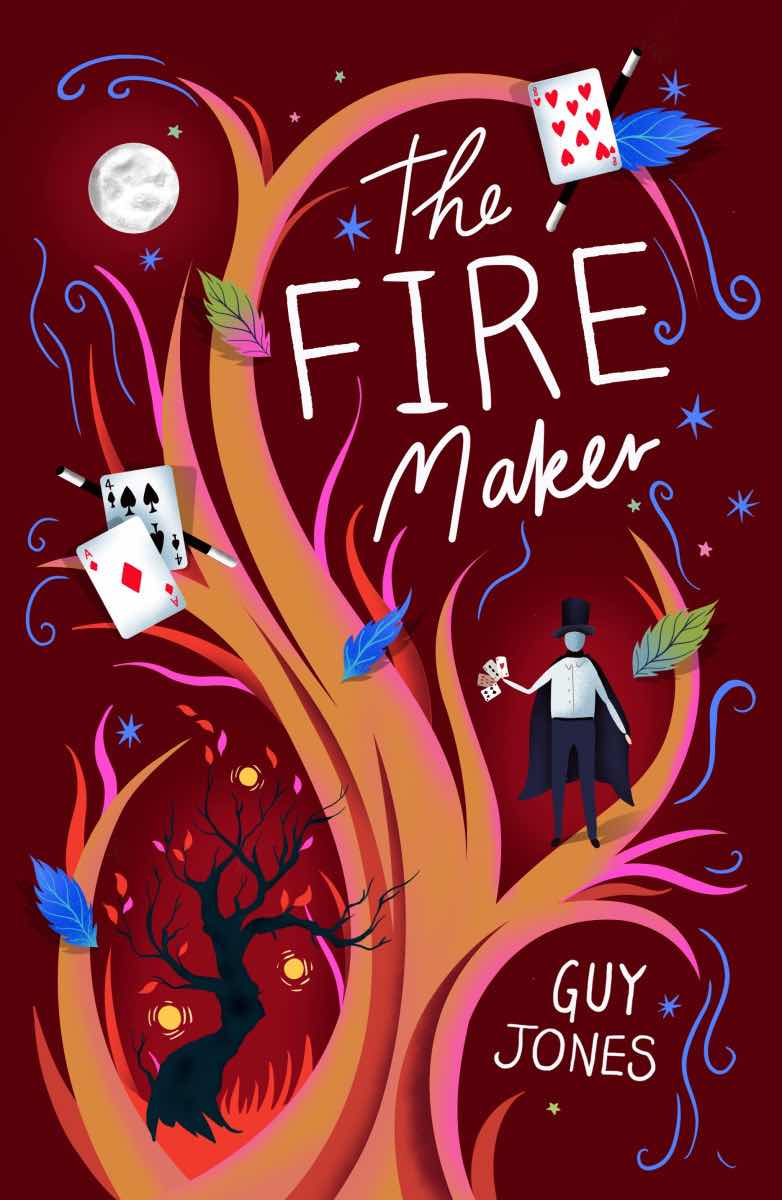
The Fire Maker by Guy Jones


Cover: Helen Crawford-White

‘Strange how the extraordinary and the ordinary separated themselves and lived side by side. Strange how quickly the unbelievable became almost, if not quite, normal.’  (p 90)

A childhood of magic

Alongside reading piles of books, I spent a good deal of my childhood leisure time practising magic tricks. I think it all started with a Christmas present of a ‘David Nixon Magic Set’. (David Nixon was the Dynamo of his day, but not quite as dynamic. Magicians weren’t in those days.) Like many other youngsters, I guess, I used to imagine being able to do real magic instead of just parlour tricks. A little later I discovered Paul Gallico’s wonderful (but now, sadly, neglected) The Man Who Was Magic* and it became one of my frequent re-reads. Little wonder, then, that I am attracted to books about magicians, and couldn’t resist this new one from Guy Jones. It turned out to be a real find. 

Initially the storyline, about a boy from a split family, bullied at school and neglected by his work-obsessed father,  feels a little deja-vu in terms of children’s fiction. However this is significantly offset by the author’s use of skilfully evocative description and his very sensitive and highly credible handling of the thoughts and emotions of protagonist, Alex. It is also good for others to see that ‘middle-class’ children, of which Alex is clearly one, are not in any way immune from life’s traumas.

However, it is the introduction of ‘real’ magic, into Alex’s aspirations as a stage magician, that truly brings this narrative to life. The discovery of a trio of fire-magic ‘jinn’, together with their ancient keeper, plummets the story into dramatic and engrossing action. And whilst the juxtaposition of actual magic and real-life complexities could have been an uneasy one, it is not so here. The catalyst of fantasy only enriches this tale of fractured family, lost friendship and childhood dreams. 

The magic of childhood

Guy Jones turns out to be no slouch in constructing an engaging narrative, and he succeeds in springing a number of  intriguing twists. Indeed there is one major surprise which even I, as a very seasoned reader of such books, didn’t see coming, a rare phenomenon indeed.

In the end, this is a novel of no little depth, of thought as well as of feelings, and the issue of how much children need to use external magic to be special, when they have a particular natural magic of their own, is well explored - with a satisfying resolution. 

Although the recent prominence given to strong girl characters in children’s fiction is important and timely, in a current publishing scene where such girls protagonists predominate, it is a welcome balance to have a novel with a central boy character, especially one of imagination and sensitivity. Not that The Fire Maker lacks a strong girl character too. In fact, whilst many other books also feature pre-adolescent boy-girl friendships, this one is handled with particular insight and originality. 

This is a book that will, I’m sure, ignite many an imagination, as well as showing that others can find growing up difficult too. A neat trick. 


Note:
*Although I am pleased to see that his delightful Jennie, another childhood favourite, is still around in some bookshops. 

Friday, 12 April 2019

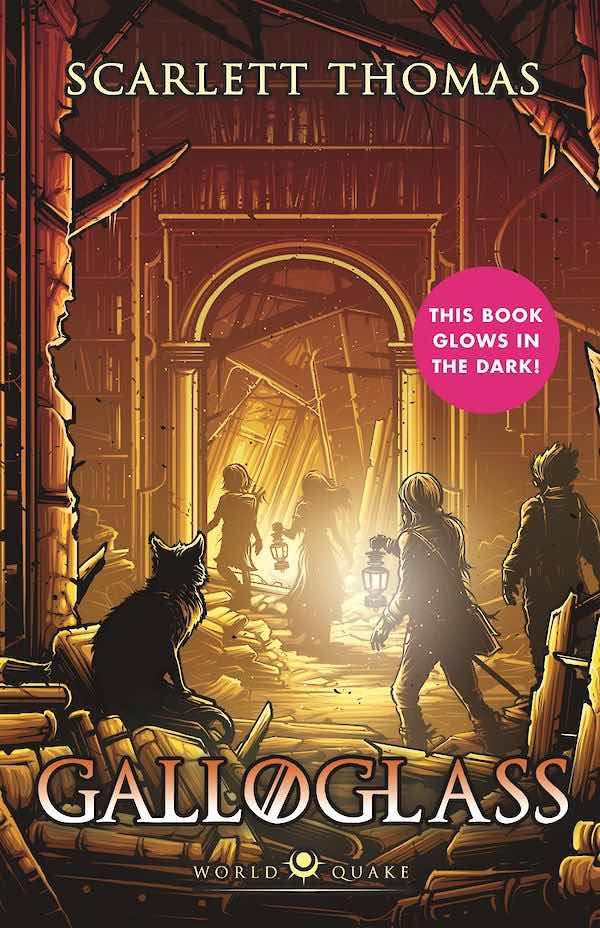
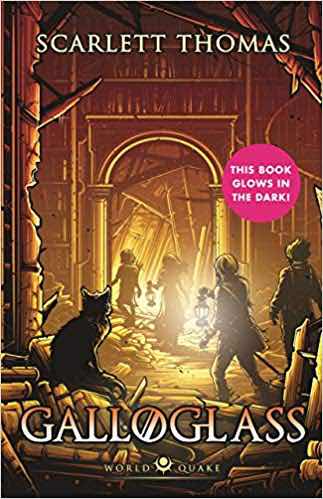
Galloglass (Worldquake Book Three) by Scarlett Thomas


Cover: Dan Mumford 

‘Applying stories to life - or vice versa - is one of the things we’re best at. It can go too far of course. But that’s never stopped me.’ (p 295)

A quiz

Books in Scarlett Thomas’ Worldquake series have the distinct advantage of being easily locatable in the dark. Switch off the bedside light (after the lengthy bedtime read that they inevitably provoke) and once it’s gone (the light that is) they will spontaneously emit Luminiferous Ether (well, something like that).

Another distinguishing feature of these novels is their ability rapidly to identify the age and character (kharakter?) of any reader (by means of a quick and entertaining quiz). Viz:

Did you think Galloglass was:
A) a brilliant fantasy adventure about five children with magical talents; the best thing since a Harry Potter?
B)  a highly entertaining pastiche of just about every children’s fantasy novel ever written, underpinned by brilliantly wicked satirical sideswipes at contemporary society?
C) a witty amalgam of creatively reimagined fantasy tropes and scenarios giving them vital new resonance in a post-modern age?

If your answer is:
Mostly A: You are a child of around 9-12; never stop reading
Mostly B: You are a Senior Citizen who has spent a lifetime reading far too many children’s books; no point in stopping now
Mostly C:  You are a professor of English who is possibly too clever(and too talented)by half: never stop writing

No kidding

Joking apart, the correct answer is actually ‘all of the above’, which could easily have ended up as “a bit of a pile-up”. But not here.  Scarlett Thomas proves that it is possible to take many well-used elements from much-loved children’s fiction and, by bringing to them both writerly skill (not least in narrative construction),  rich imagination, and no little wit, remould them into something original, and joyous. And the most remarkable thing is perhaps, that, by and through all her cleverness, she successfully tells a story for children that is completely compelling, and, well . . . quite magical. Galloglass, will be much enjoyed by adults who like reading children’s books, too, but that is something different. It has many elements of sophistication, but then many children are remarkably sophisticated readers. It is still a essentially a children’s book. However, there  is absolutely nothing demeaning about saying this. To write such books well, requires exceptional skill, and their potential influence is staggering. ‘Every new book makes a much bigger difference to a child than it does to an experienced adult reader.’* Scarlett Thomas’ Worldquake novels will be enjoyed by many, on any number of levels, depending on the experience and sensibilities of each reader. They will, however, glow hauntingly in the memories of all. 

Best yet

It can be the case, with series fiction, that inspiration becomes thin and ideas over-stretched once the energy of the initial volumes has dwindled. That is emphatically not the case here. If fact, quite the opposite, the first two titles in the Worldquake series were fine books; Galloglass is a truly great one - strange, quirky, complex, challenging and, yes, truly great. 

I love that Scarlett Thomas, skilled and experienced writer of high quality literacy fiction that she is, does not condescend to her young audience, as can many of the popular children’s books currently piled high in bookshops. At present, the (over?) simple viewpoint of first person, present tense narrative, seems to be ubiquitous. I know this makes for easy reading, and children do sometimes need the security of easy comfort. But literature should challenge as well as merely entertain, and I think children’s literature is no exception. 

Scarlett Thomas weaves her narrative from multiple strands and perspectives including  those of different members of the story’s group of magical children, several (potential) perpetrators of unspeakable evil - and, indeed, a cat. Amongst her many other writerly skills, she is a true expert in plot construction.  She understands exactly how to bring readers with her every step along the convoluted path of her narrative, and hold them enthralled. She knows just how to lull with candy floss and pretty flowers before suddenly throwing a vicious punch to the emotional guts. She knows how to intrigue and tease with story lines suddenly, if temporarily, dropped, only to pick up another exciting thread. And then, just as Galloglass is developing beautifully, along the lines that you might expect of the sequel to its two predecessors, the author catapults her reader into worlds that are, even in this context, truly bizarre, with storylines, by turns, intellectually challenging and emotionally disturbing. 

Not only does the author pick up on imaginative worldscapes from her previous books - the wonderfully named Tusitala School for the Gifted, Troubled and Strange in the ‘Realworld’ and Dragon’s Green with its Awesome Great Library in the ‘Otherworld’ - but readers will also find themselves amidst a futuristic variant of the Hunger Games scenario, where combat is by ethical questionnaire rather than armed conflict, and even a surreal world of 
cats, served by butlers and drinking ‘pawsecco’ and listening to jazz in a cellar, that conjures the paintings of Louis Wain. 

‘“That,” said Marcel, “is the local cats’ home. . . Someone donated a billion pounds to them. Inside the building are the richest cats in the whole world. . . I hear that the chef is in line for the first Michelin star to be given for pet food.”’ (p 108)

There are even ‘personal’ appearances from no less than The Bermuda Triangle and The Northern Lights. That’s not even to mention the odd spacewarp into the world of Douglas Adams (The Luminiferous Ether manifesting as a gigantic stick of pink rock!) To say the whole is a riot of wild and wonderful imagination is almost an understatement. 

From satire to ethics 

And all of this is peppered with witty authorial sideswipes at many aspects of contemporary life. Her targets can be trendy vegan food, self-help manuals, or ‘survival guides’,

‘His trained warrior’s eyes scanned . . . for landmarks he could use to navigate, for enemies, and for sources of food or materials he could use to construct a shelter. Flowers often pointed south, he’d read once. But of course Wolf didn’t know where he was and therefore in which direction he was supposed to go. And there were no flowers.’ (p 109)

or even, perhaps, contemporary politics,

‘(It was) the subject of many complex negotiations . . . But complex negotiations took a very long time.’ (p 285)

All add amusing leaven to Scarlett Thomas’ fantasy world.

However, what singles this book out for particular greatness is the depth of its thinking, and the depth of thinking it provokes. One of its story strands deals with the very serious issue of child molestation. The abuse is not overtly sexual, but is sufficiently disturbing to heighten children’s awareness about what is inappropriate. The victim’s responses are both sensibly and responsibly dealt with and the resolution will be hugely helpful to children, as well as to adults, many of whom will want to discuss this with their charges. 

Beyond this, though, the storyline raises deep moral and philosophical issues, to the extent that it could well be used as a text in ‘ethics for active young minds’ It asks such provocative questions as ‘Is selfishness necessarily always bad thing or altruism invariably a good thing.?’ It treats of Nietzsche and of a  concept of ‘flow’ as might be found in, say, Ursula K. Le Guin’s wonderful poetic translation of the Tao Te Ching. Few children’s books come close to this level of intellectual stimulus, but it is so well handled here, so cleverly integrated into the issues and choices faced by its magical protagonists, that it will be a ‘Realworld’ boon for sensitive and thinking young readers. This is another wonderful book for them to grow up with and through.  

‘Neptune, like all creatures bound to one universe, one planet or one locality, simply could not visualise the unknown. The unknown is, of course, by definition, not known.’ (p 136)

Galloglass helps to expand the universe we can visualise and so to push back the shadows of intellectual darkness.  


US edition

Famous for fun

Although I was already a fan of her adult novels, enjoying some and admiring all, I think her decision to write children’s books has been the making of Scarlett Thomas. She puts these words into the mouth of one of her characters:

‘Lady Tchainsaw was quite famous and had recently joined the university‘s Creative Writing Department. It was always good to get in with the creative writers. Not only were they the most famous members of the university, but everyone knew they had the most fun.’ (p 120). 

Well, Professor Thomas, if Galloglass is anything to go by, you might just be correct on this second point, and fully deserve to be so on the first too.


University Library (Special,Collection) Rules: ‘We only have three rules. No chewing gum. No talking. And if you die, it’s your own fault.’  (Galloglass, p 134)


Note:
*Peter Hunt, How Did Long John Silver Loose his Leg? (2013), p 136

Tuesday, 9 April 2019

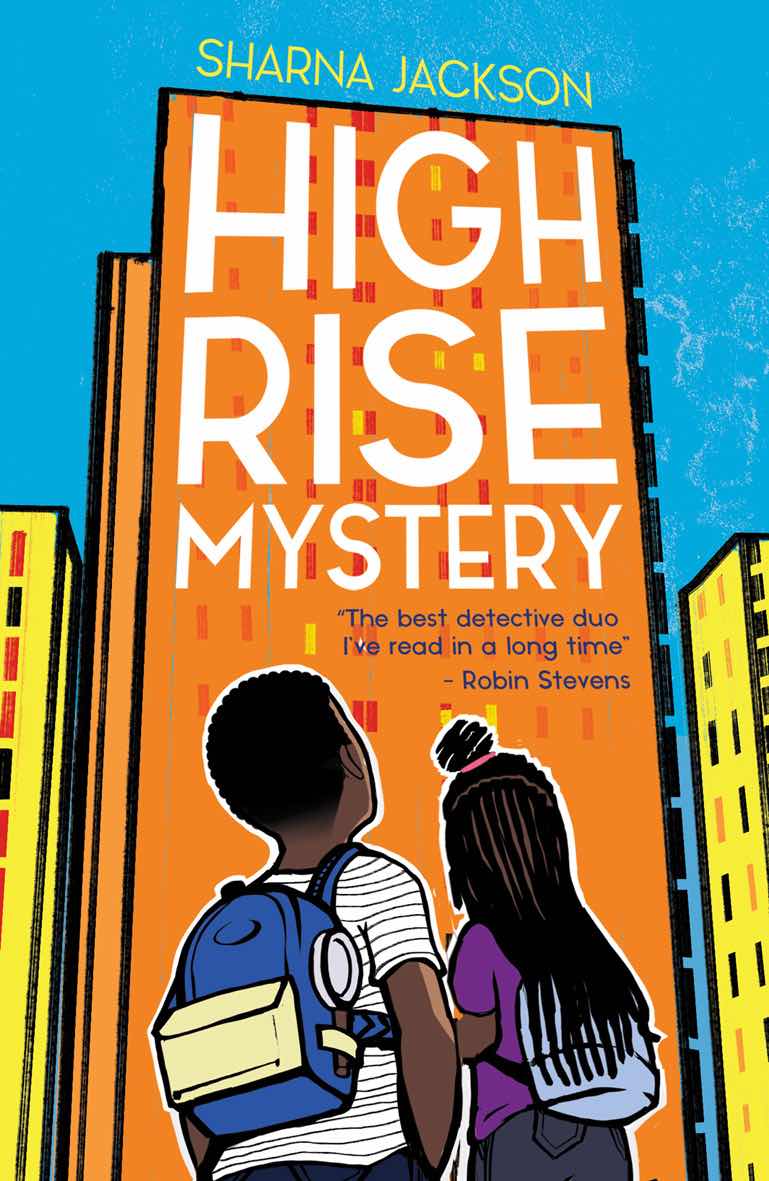
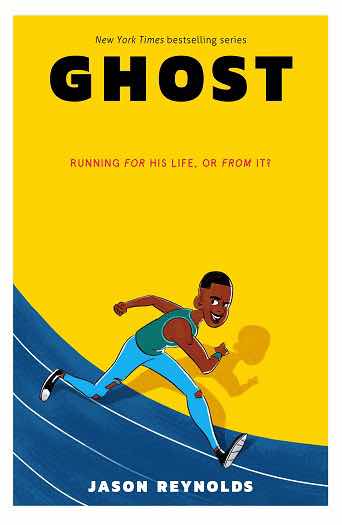
The High Rise Mystery by Sharna Jackson; Ghost by Jason Reynolds

New Knights on the block

‘Knights Of’ (KO) are an exciting new company dedicated to bringing more diversity into children’s book publishing in the UK: into management, production, editing, writing and illustration, as well as into the characters and contexts of the stories themselves. 

Recent years have seen massive strides forward in liberating and celebrating the roles of girls and women in children’s books, and a wonderful and important thing this is. Diversity and inclusion are starting to emerge far more positively too, but there is still a long way to go, so initiatives like this one are to be welcomed warmly  - and, hopefully, supported strongly. 

Happily, these two recent titles from KO look set to establish themselves amongst current bestsellers. They certainly deserve to do so. 


An important new take on a popular genre

Another fine writer, Robin Stevens, had done a great job of bringing something akin to ‘golden age’ detective stories to a children’s audience. Her ‘Wells and Wong’ murder mysteries have kicked off a popular trend in children’s fiction, as well as providing many young readers with thrilling entertainment, cleverly written and with some pertinent messages slipped in amongst their period coziness. 

Now Sharna Jackson has added important new dimensions to the children’s murder mystery. Her up-to-date story is set amongst the high rise blocks of an urban estate, and her two young detectives are kids from the top floor of one of them. These two protagonists, Nik and Norva, are wonderfully drawn, and their characters, providing complementary detecting skills, are clearly and entertainingly distinguished. Their lives and language feel very credible and their interactions are often amusing, always engaging. Many young readers will identify readily with  them. Similarly, the residents of their home block have identifiable elements of authenticity as well as providing the usual varied cast of  witnesses and suspects. The storyline is kept light, as befits the age of this audience, with the emphasis on the puzzle of the detection rather than the horror of the crime. (If such subject matter can be considered light - but then that is the way of the ‘cozy murder’ genre.). The mystery is as clever and entertaining as any - and its young detectives far more so than many. 

This book contributes an important contemporary counterbalance to the white middle-class ethos of some children’s books, whilst still providing a highly quality, light entertainment read for any enthusiasts of junior sleuthing. It will surely make many new fans for the this particular genre too, and is warmly to be welcomed. 

‘Nova grabbed my hand. “Time to shine,” she said, throwing her braids over her shoulders. “This is our moment.”’ (p 350) 

Indeed it is!


Far wider appeal than might first appear 

Ghost, by justifiably lauded US author, Jason Reynolds, is a truly exciting find for children’s reading and we should be enormously grateful to KO for bringing it to the attention of a UK audience. 

As someone not really into sport, or, for that matter, a fully paid-up subscriber to ‘The American Dream’, if I had been asked in advance if I were particularly interested in reading a book about a poor American kid, whose life was turned around by becoming a member of a ambitious track running team, under the direction of a pushy coach,  I would, in all honesty, almost certainly have said no. Same old, same old? Field of Dreams rework yet again? That just shows the folly of making rash assumptions. If I hadn’t actually read Ghost I would have missed out on a truly wonderful and important children’s book, so I am inordinately thankful for the book bloggers who raved about it so much that I felt I had better check out what the fuss was about.

Ghost is contemporary, relevant  and truthful. The voice of its first person narrator, Castle Cranshaw (Ghost is his self-chosen nickname) is superbly caught, with enough of the vernacular to convince of authenticity, without making comprehension over-challenging for those not of the culture. The story touches, very poignantly, on some of the hardest aspects of life for some children today. But it also majors on some of the qualities that are best, and some of the things that are most important, about humanity. It has warmth and heart as well as darkness. It reminded me, in part, of lines from a hymn I sang at school: ‘Love to the loveless shown, that they might lovely be.’  That it is set in America and concerns track running gives it grounding, but in no way limits its universal resonance. It is ultimately a positive, hopeful tale, and not only is that right for a book for this age group, it is right for all of us. 

It is not about winning the race; it is about starting it. 

Ghost is, of course, fiction, and its ‘reality’ is carefully manipulated by the author, as it should be, to create a fully satisfactory read. Yet it is one of those novels that is not only experienced as real in the reading, but contains enough of the truth of actual life, enough real experience and enough deep understanding of human beings, to give those with similar lives many point of identification, and those with different lives,  greater understanding and empathy.  Both of these are so important for our young readers, and for our world, for both provide insight that can change, for the better, how we see ourselves and others. 

It seemed like we were all connected in some strange way that none of us had imagined.’ (p 158)

Once again, I say, ‘Indeed!’


On shelves, please: in shops, homes, schools, libraries

It would be good to see both of these books included with the offers in many upper KS2 classrooms. They will contribute strongly to the range and diversity of reading available as well as to its attractiveness and quality. Getting and keeping children reading is often a matter of leading each one gently towards the right book at the right time. I am sure that these books will speak to many children, of all backgrounds, and I hope that Ghost, particularly, will become the hugely enriching part of their reading diet that it has the potential to be. 


Thursday, 4 April 2019

To the Edge of the World by Julia Green


‘I thought of those tiny remote islands . . . way out in the Atlantic ocean, right at the edge of the world.’  (p 54)

Simple?

Even being the hopeless fantasy addict that I am, I sometimes crave respite from remarkable children battling to save the entire world from unspeakable evil. I yearn, at least temporarily, for something more ‘real’. I need recovery from trying to keep track of numerous oddly-named characters and unravelling multi-stranded plots. My mood requires something simpler, gently evocative , perhaps, rather than viscerally exciting. 

I have been saving this book for just such an occasion, and it was a brilliant choice. In this context, Julia Green’s lyrical evocation of two children’s short summer in the Outer Hebrides was perfect. (And I do not use the word lightly.) I think many children sometimes crave the same things in their reading too.

This is a story completely devoid of wizards or monsters, yet is has its own magic, transportation magic. It is writing that takes you with it to the very places it describes, so that you see its wildly beautiful island landscapes. You hear the churn and crash of its waves against the rocks, you catch the sting of its sharp breeze against your skin, feel its white beach sand between your toes, smell the pungent tar of its boathouses, and taste the smoke from its tideline bonfires. There may be no spells here either, but the author so beautifully conjures the characters of her two protagonist, Jamie and Mara, that you live their experiences, share their days, know their hopes and fears, almost breathe their air. The story, too, may have no dramatic conflict between the light and the dark, but yet is far from being without excitement or tension. The young pair’s sea journey to remote, and long abandoned, St Kilda, is brave, foolish, cold, wet, terrifying and at times deeply moving. 

More than anything, though, this is the simple story about a boy and a girl (and a small dog) who share a few weeks in a remote and wonderful place, and, in doing so change each other, and help each other to grow. 

‘You’re always too careful . . . Though you’re getting better.’ (p 164)

It is also a tale of the wild ocean that takes them to the edge of the world and back.

Perhaps not so simple

However, the very best ‘simple’  writing is underpinned by well-honed craft and consummate artistry, and that is very much the case here. Julia Green is an author of subtly potent  language and of sensitive insight into the lives and minds of children. Apparently simple books can be profound too, sometimes the most profound of all. Here, a young boy’s all-too-understandable fear of the sea, and a young girl’s determination to control her own future, are transformed into a wild adventure,  dangerous and scary, but exciting too, alive - and survivable. This story embraces the wild wonder of remote islands, of their beaches, their winds, their skies and their stars - and, of course, of the sea that is their essence. And the sea can be many things; imagination, other people, change, freedom, danger, life; life that is a wild, scary, exciting, beautiful adventure; yet life that is also anchored in secure return to harbour and home. 

‘I want to live a big life.’ (p 188)

Like many of Julia Green’s books before, To the Edge of the World is a wonderful gift to our children. Her next, The House of Light, is apparently not far off, and I look forward to it enormously.


Sunday, 31 March 2019

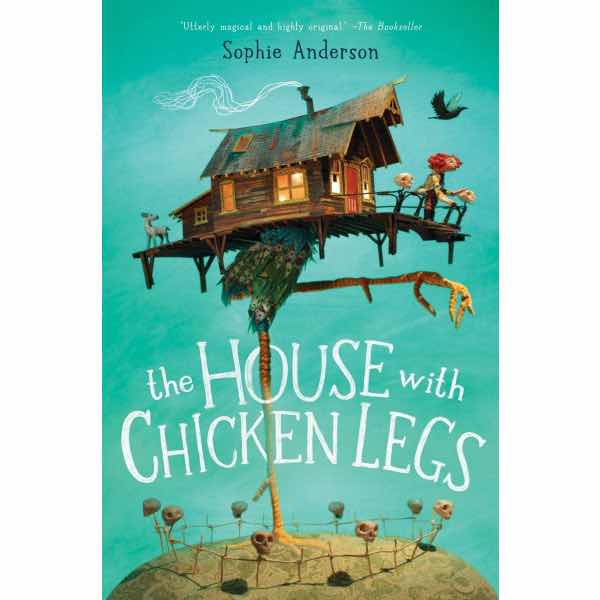
The House witn Chicken Legs by Sophie Anderson


“I don’t want to spend my life guiding the dead, and feeling all their joys and sorrows. I want to live my own life, with my own joys and sorrows. . . I want one life. My life.’ (p 289)

Late to the party

Yes, I know, I am shamefully late in getting around to this one. It took a CILIP Carnegie Medal shortlisting finally to precipitate it, even though I have been meaning read the book for ages. Moreover, The House with Chicken Legs has now had so many accolades and reviews that almost everything that can be said by way of recommendation probably has been. Yet, for all that, I was still so taken aback by just how wonderful a book this is, that I couldn’t resist adding my voice, even at this late stage. 

I have to admit that, generally, I am no great fan of the current fad for narrative written exclusively in the first person present tense. There are exceptions though, and this book is certainly one of them. The immediate intensity of the protagonist voice is here quite magically caught. The book also has many other exceptional qualities that make it stand head and shoulders above many other recent works of children’s fiction. 

Old Russian tales 

What I am, however, is a fully committed aficionado of fantasy fiction that is rooted deep in legend and folklore. It links a contemporary story to heritage, inherited truths, the origin of which may be long forgotten. Sophie Anderson’s tale scores highly on this front, building richly on images from Russian folk tradition. Such tales have only rarely been exploited by Western children’s literature, so this has the double benefit of bringing fresh imaginative stimulus, and an insight into a culture very different from ours, whilst still providing memes that resonate with a common humanity.

Narrative power

A second thing that makes this novel stand out is the sheer power and engagement of it storytelling. Without being a rollercoaster adventure, the story nevertheless moves through a sequence of engrossing twists and turns. Some of them are truly shocking and all of them completely compelling. The vividness of the author’s drawing of  protagonist, Marinka, ensures that we travel her personal journey ever eager to know what will happen to her next. The skill of her narrative construction leaves us always breathlessly enthralled. Other characters too, like her grandmother Baba  and her friend Benjamin, are rich and appealing, as are the shifting, and often deeply touching, relationships which develop between them. In another strongly imaginative twist, these characters include not only a bird, but a very special house too. (One with chicken legs, of course.)

Life not death

Yet there is one quality in the book that outshines even these exceptional delights, and that is the richness and depth of its ideas. The core of the story is that of the ‘Yagas’, semi-immortal beings whose role is to guide the dead through the last gate and towards their eternal destiny amongst the stars.  Marinka is brought up by a grandmother who is one such Yaga, and the girl herself seems destined to become her elder’s successor in time. The tale is very much about life and death, and yet it is never either morbid or particularly frightening. It is, in fact, often almost poetic, a paean to life. It is passionate yearning for life, not death, that drives Marinka’s personality and actions. As the story develops, she learns many lessons about what it means to be alive and readers will share much of that thoughtful education with her. 

‘I am not sure,’ she says at one point, ‘how long I will get to spend with Benjamin, but I will appreciate the time I have. I wish I had appreciated the moments I had with Baba more. Nobody is yours to keep. Nothing is for ever.’ (p 314)

The earlier and more deeply we can understand these truths the richer our life will be. Perhaps children will not get all the way there, but this book well help on that journey of understanding . And, in the final analysis, the story does celebrate something that is for ever - life. Not just our own life , but life in essence. This book is a most powerful working through of what it means to be human and to be alive. As such, is a most wonderful contribution to the canon of children’s literature. 

Elisa Paganelli’s internal illustrations, often strewing flowers or stars across pages that are occasionally black as well as white, also add beautifully to the atmosphere of this very affecting tale.

‘I see the whole universe in the tiny puddle and I smile.’ (p 337)

Justly lauded

So far this year, I have read several quite brilliant children’s books by Australian and American authors. Although there are many fine books by UK authors around, I have been searching for one of fully equal calibre. Now I have found it. This book deserves every one of the accolades it has received - and more. The biggest advantage of discovering it so late is that it is not too long to wait until the next one. 


US edition

For any who enjoy the opportunity to compare and contrast, Whichwood, by Tahereh Mafi, although perhaps for slightly older children, explores a similar scenario. It is also, in its own, different way, a very fine novel. (See post from Feb ‘18)

Monday, 25 March 2019

Storm Hound by Claire Fayers


Accessible delight

The last four books I have reviewed have been, in my view, wonderful examples of the very finest children’s literature.  However they were all very demanding reads, intellectually and emotionally. I was looking, next, for something that was still highly recommendable, but a little bit easier on the old grey cells. I found exactly that in Claire Fayers uber-charming latest book. I much enjoyed her previous Mirror Magic (see my post from June ‘18) but, if anything, I warmed to this book even more. It would make a great read-aloud for a younger KS2 (MG) class and is a ideal entry-level fantasy to hook children into the exciting world of magic fiction. It will equally delight many already committed young readers. It has numerous admirable, and hugely engaging features. In fact it is a storm of adventure, magic, humour and heart-warming sentiment.

Landscape and legend

In a very accessible way, it is a celebration of that tradition of landscape and legend that has been the stuff of many of our greatest works of children’s fantasy since the days of Alan Garner. 

‘What is geography, after all? It’s a study of the land, and you can’t begin to understand a land and its people until you know something about their legends. When you look at a mountain, what do you see? A pile of earth and rock, or a sleeping myth?’ (p 70)

And, here, it is mythological landscape in one of its most powerful geographical locations, Wales. The tale draws on powerful folk beliefs such as The Wild Hunt and shape-shifting white hares. It evokes the potency of legendary figures, with evocative names, and of ‘earth magic’. It calls up the power of storms that crash and flash off rugged mountains and rumble down lush valleys. And it pulls all these together into an exciting adventure, pitting engaging protagonists, and mysterious other-world characters, against against evil (if somewhat incompetent) magicians. 

Reality too

However it also succeeds in relating its narrative to real life and its issues. A story thread that treats of a young girl coping with the recent break-up of her parents, and a consequent move to a completely unfamiliar location, will illicit identification in many children and evoke empathy in others. 

In its direct, simple way, too, it is a celebration of creativity, of storytelling and image making. 

‘The creators had a special place of honour in Odin’s halls. Those who told stories or made pictures or played music. They saw the world a little differently.’ (p 76) 

A storm of a story 

Even more, running through all of this is that bonding of a child and a pet animal that pulls at the heart strings of so many young readers (and, perhaps, older ones too). In this case it is protagonist, Jessie, very unsettled by her recent drastic changes in domestic circumstance, who finds solace in an adopted puppy, Storm.

There is too an important developing friendship with a strange ‘non-boy ‘, Morfran. However it is Storm himself who is the real star of this book, and it is his depiction that is the imaginative triumph of author Claire Frayers. For Storm is not a mortal dog, but a Storm Hound of Arawn’s (Odin’s) Wild Hunt, accidentally left behind one night as a puppy in Aberystwyth. The complete delight of the book is that Storm still has the mindset of his wild mythological essence, but the behaviours of his present puppy form. The dichotomy and incongruity between these two, and the way they are so cleverly exploited by his creator, is a source of constant humour, delight and, at times, touching pathos. 

‘He was Storm of Odin, who ran with the Wild Hunt and tore the night apart for the joy of it. He was everything that was untamed and free. Humans and their little lives were over in an instant and none of them should matter to him. But, here and now, he was Storm, licking salty tears off his human’s face as she cried.’ (p 156)

The character of Storm is one of the true gems of recent children’s publications and he turns a book with many admirable qualities into a truly adorable triumph for Claire Fayers. 

There is an incredibly exciting storm of a climax, too, literally and magically. Potentially heartbreaking dilemmas strike lightening through the narrative, and, as befits a story for this age group, are resolved through love and understanding. The best of accessible, younger children’s stories can have their own particular greatness; this book is most certainly one such. 

And satire too?

And, in the last analysis, I cannot but warm to a writer who has her power-crazed, but somewhat buffoonish, magicians claim that they intend to ‘make magic great again.’ (p 26)


Note:
Claire Fayers’ earlier books are also published in the US (under slightly different titles). Hopefully this one will soon be published there too. 

Sunday, 24 March 2019

Lenny’s Book of Everything by Karen Foxlee


‘She was thin with worrying, our mother. She combed out her long fair hair with her fingers, closed her eyes. She was made almost entirely out of worries and magic.’ (p 4)


I admit I am no saint when it comes to book blogging. Often, the reviews I have in my head pile up on me and it takes far too long to write them up. However, sometimes, but only rarely, I read a book that makes me so buzz with excitement that I just cannot  wait to try and find the words to share my enthusiasm. Then I know the title is something very special indeed. And such is the case here. 

Of course, I should have known. To a large extent I did. But, even so, I was bowled over by just how breathtakingly wonderful this book is. It is made almost entirely out of worries and magic.

A marvellous boy and a magical girl 

I should have expected it because Karen Foxlee is one of my top favourites amongst contemporary children’s writers. Her first children’s book, Ophelia and the Marvellous Boy, is a little gem, exploring very real issues through charming fairy tale fantasy and has one of the most endearing protagonist of recent years. (See post March ‘15) Her second, A Most Magical Girl, is more of a ‘total’ fantasy, most beautifully written and, again, with a great deal to say. (Post June ‘17.) And now, hooray, we have her third. It is about young boy with a serious medical problem. 

Over recent years, there have been a good number of books about children with ‘conditions’, physical or mental. This sub-genre is epitomised, perhaps, by R. J. Palacio’s understandably lauded Wonder, although books about children with autism may be the most numerous. The best of these books play a very important role in engendering empathy and are most welcome additions to any young person’s reading experience. 

A (very) big little brother

That Lenny’s Book of Everything centres, unusually, around a young boy with a condition akin to pituitary gigantism, where a particular form of brain tumour promotes abnormal fast growth, already makes it very different. However, it has many other remarkable features too, that make it stand out, not only from other books of its type but, indeed, from most other recent children’s novels. 

Actually, this book is not principally about Davey Spink, the boy with the condition, so much as it is about his slightly older sister, Lenny (Lenora), who is the story’s narrator. Although we learn a very great deal about Davey and his issues, with which the clearly loveable boy copes amazingly, the story essentially explores how Lenny lives with and through the years of her own childhood alongside him. Although clearly a big feature, Davey is not the only trauma in her life. She is also coping with the departure from it of her father, a loss so sudden and complete that it is essentially a bereavement. 

All of which may sound very drear and depressing, but, in fact, Lenny’s story is laced through with warmth and humour in a continually delightful way. When Lenny is discussing her brother’s rapid growth with her school friend, CJ (‘a blast of fair hair that wouldn’t stay in the bunches her mother tied. Sometimes she had just one bunch left by the end of the day, like the handle on a teacup ‘):

‘“Like with Jack and the beanstalk, he just keeps growing,” said CJ. 
“The beanstalk kept growing,” I said. 
“Yeah,” said CJ, who was very wise, “but it’s the same thing.”’ (p17)

Burrell’s Build-at-Home Encyclopaedia

The framework for the story is provided by the fact that the Spinks win a competition, which earns them a free subscription to a part-work encyclopaedia, ‘The Gift of Knowledge’. The regular arrival of its alphabetical issues punctuates, and, indeed, soon become a major ingredient of the lives of both Lenny and Davey. Sometimes fascinating, at others more disappointing,  new letters bring new interests into their daily routines and provide major distraction  from both the humdrum and the heartbreak. Lenny’s obsession with beetles, and Davey’s with raptors, both derive from their ‘Burrell’s’, as indeed does a dream of  escape to the wilds of Canada’s Great Bear Lake, which they both share. 

The story has a beautifully evoked setting in the US of the 1970s. This brings with it a good number of references that will probably be unfamiliar to young UK readers, but they should not be a problem. It will be easy, with the internet, for children to explore the relevance of ‘Days of Our Lives’ or ‘space monkeys’, and insights into a culture simultaneously so like and so unlike their own will be enriching in themselves. 

Breathtaking language

But there is an even greater delight to this book. Karen Foxlee’s is some of the most deliciously wonderful writing I have come across in a long time. It is not that her vocabulary is challenging or her phraseology poetically fancy, but rather that she has a quite remarkable ability to turn a phrase, capture an image, and express a thought or feeling in a stunningly fresh and evocative way. She starts at the very opening of her first chapter:

‘Our mother had a dark heart feeling. It was as big as a sky inside a thimble. That’s how dark heart feelings are. They have great volume but can hide in small places.’ (p 2)

And she never lets up. She creates a rich cast of fascinating characters, both children and adults, and conjures them up vividly, often in only few lines. She conveys deep emotions in a breathtakingly communicative way, and brings situations to life that can be heartbreaking at the very same time as they are achingly funny. 
 
‘Sometimes rain made me want to cry, like there was something deep inside me - the sadness flower that opened up when rainy days came, and blossomed inside me until I couldn’t breathe.’ (p 22)

‘My eyes were tired from staring into my imaginings.’ (p 110)

‘We deliberately did not think of the possibility of finding our father. We imagined the cousins across our dark little room instead.  . . We imagined them to life. We imagined them bright as stars until they burned behind our closed eyes.’ (p 131). 

Karen Foxlee imagines her characters to life , through her stunningly original and potent language, until they burn behind the closed eyes of us, her readers. Similarly, under her pen, the everyday incidents of Lenny’s life fizz with such vividness that they feel charged with electricity.

The voice of the child

What is perhaps even more remarkable is that Karen Foxlee succeeds in turning this breathtaking language facility into the totally convincing voice of her young protagonist, Lenny. It wraps Lenny’s naive perceptiveness in a remarkable sensitivity. Her beetle-obsessed diversions from the realities of her life cushions but never quite shields her from its multiple heartbreaks. It sets her alongside Ophelia (she of the Marvellous Boy) as one of the most endearing and touching of contemporary children’s fiction creations. In this exceptional ability to voice children, Karen Foxlee reminds me of another great Australian writer, Ursula Dubosarsky (see my earlier posts), although both have many very distinctive talents too. 

In Lenny’s Book of Everything Karen Foxlee does not rush her story. But its slow unfolding, day by day, month by month, as the alphabet progresses and the part-work Encyclopaedia builds, only adds to our intense involvement in the life of Lenny Spink. 

Spinning towards the inevitable 

Iterative themes spiral through the story: the arrival of encyclopaedia parts;Lenny’s beetles and Davey’s raptors; the dreams of Mrs. Gaspar, their child-minder; the imagined trip to Great Bear Lake; the unstuck sticker from Buffalo, Wyoming, that is the only physical the legacy of their father. But just when the gyre appears to be widening into the sky, it twists inescapably downwards. You desperately want it not to, but you know it will. 

Karen Foxlee is a writer of sparkling genius. Hers is a hard book to read; not one with hard words, but one with a depth of emotion that is hard to take. It is all the more powerful in that it does not overly try to ‘make everything all right in the end’. But those who do read it will be glad they did. 

Actually, I would not classify this book with the ‘condition’ stories. It is not really a Wonder or a Goldfish Boy. For me, it belongs with those other great children’s works which deal with loss, yet bring their readers enormous gain - books like Bridge to Terabithia, A Taste of Blackberries, and Mama’s Going to Buy You a Mockingbird. It will break the hearts and enrich the lives of countless children for many years to come. 

‘Holy Batman!’ Indeed

Thankfully this book has recently been published in the UK. We should again be grateful to the fine imprint ‘Pushkin Children’s’ for bringing us yet another outstanding work of international stature. 

For once, the quote on the UK & US covers (above) is totally apt. In the story, one of Davey’s favourite expletives in ‘Holy Batman!’. R. J. Palacio adopts it to describe a response to the whole book. It says it all. 


original cover