Here are the occasional reflections of a joyful traveller along the strange pathways of fantasy and adventure. All my reviews are independent and unsolicited. I read many books that I don’t feel sufficiently enthusiastic about to review at all. Rather, this blog is intended as a celebration of the more interesting books I stumble across on my meandering reading journey, and of the important, life-affirming experiences they offer. It is but a very small thank you for the wonderful gifts their writers give.

Friday, 21 June 2019

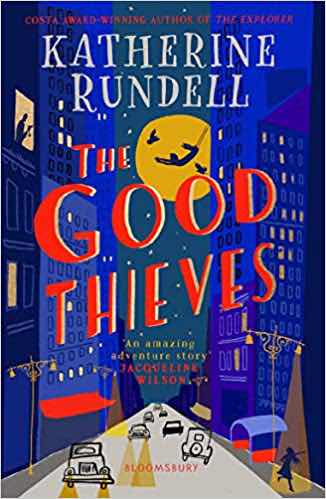
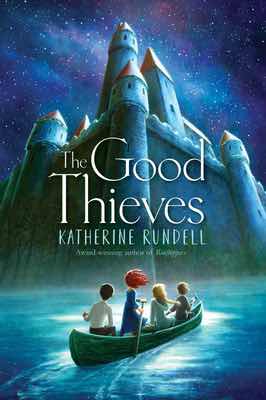
The Good Thieves by Katherine Rundell


Cover: Anna Morrison

‘New York waited outside the window, stretching up to the sky like the calligraphy of a particularly flamboyant god.’ (p 8)

A sizzling start

Philip Pullman is quoted as saying, ‘(Katherine) Rundell is now inarguably in the first rank.’ I would not even think of arguing. 

A book that on page one includes the deliciously quotable quote, ‘It is not always sensible to be sensible,’ grabs attention immediately. Then you don’t need to read many pages of this, her new novel, to realise that you are in the hands of a very fine writer - and promised an absolute treat of a read. 

Vita, the young protagonist of The Good Thieves, is a dead shot with hand-thrown missiles; pebble or penknife, she can hit any target with astonishing accuracy. Katherine Rundell hurls amazingly fresh language at the page with the same deadly accuracy, and so hits the thoughts behind her words with telling vividness. There is true wit in this writing and a modest but sharp intelligence, as well as a joyful play with the potential of our language. Yet nothing is either portentous or pretentious. It makes her book spark with thrilling electricity page after page. 

‘Is selfastonishment a word? Because if not, I need it to be one now.’ (p 187)

New York, New York

However, that is not all that makes this novel so captivating. It does not take the author long to propel her characters, and with them her readers, into one of the most exciting and compelling storylines I have encountered for quite some time. This is like the greatest heist movies novelised for children.

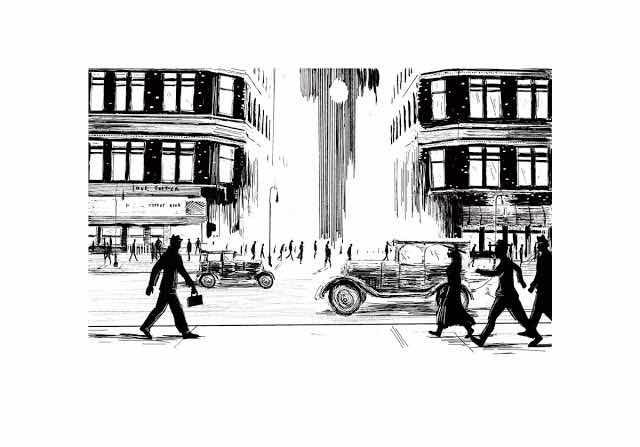
Part of the engagement comes from a superbly evoked setting of early twentieth-century New York. Here are the newly-built skyscrapers and the gridlines of bustling avenues, Grand Central Station and The Public Library, street vendors  and gangsters, prohibition and rampant capitalism, hotels for tycoons and the slums of the Bowery. It is all viscerally exciting and so vividly conjured as to enable the reader to experience the presence of the city in every episode. This feeling is also greatly enhanced by Matt Saunders’ wonderful chapter head drawings, themselves brilliantly evocative of both place and period. Amongst many gems, I particularly thrilled at his image of Central Park, which magically conveys a sense of space and calm amidst the turmoil of the never-sleeping metropolis.


Characters to die for, and live for 

Yet even more than its setting, it is this story’s young characters who bring it leaping off the page and into the minds and hearts of it readers. What a varied, original and engaging  bunch they are: Silk, an orphaned pickpocket; Arkady, an ‘animal-whisperer’ from an indoor circus (temporarily housed in Carnegie Hall, no less); Samuel, a black boy with aspirations to ‘fly’ a trapeze (or indeed anything from which he can swing); and Vita, an an English girl with a club foot, newly arrived in New York. She should by rights feel lost, but far from it, for she arrives  with a clear mission burning through every ounce of her being. Remarkably too, in a story about thievery that could carry a questionable morality, these young protagonists each bring a rectitude that not only balances the story firmly in favour of goodness but  also resonates strongly with important issues of our own times. Silk, hates the way poverty has forced her into dishonesty and desperately wants escape from her present life; Arcady despises the way his circus humiliates and tortures wonderful wild creatures, and seeks rather enlightened appreciation of the wonders of the animal world; Samuel bravely strives to fulfil his ambition despite being continually told that such paths are closed to those with his colour of skin; and, most of all, Vita is driven by deep love to do whatever is needed to right the terrible wrongs perpetrated on her grieving grandfather. 

‘Love has a way of leaving people no choice.’ (p 8) 

And even then, she makes choices that will not seriously hurt even those she hates:

‘To throw the knife would be death. . . She wanted nothing to do with death - nothing to do with finality, with endings, with the dark of it. She hated the man more than she hated any living thing, but he was living.’ (p 275)

Vita’s is a story for all who want to change the world for the better, whoever they are. It shouts loudly and clearly that those who may seem to have been given a raw deal in life, can actually achieve wonderful things.

More than . . .

This is the sort of book that I know I would  myself have enjoyed as a child, an all-absorbing, edge of the seat adventure, with a wonderful warm, resolution to make me feel that there was at least a part of life where everything was ‘all right’. It is just the sort of book that helped me survive the cross-country run that I loathed, the maths homework that I got all wrong, the ‘big boys’ who threw my school cap into the bushes. And that is no small thing. 

But no book that I read back then (probably a Malcolm Saville or a Geoffrey Trease) was anywhere near so well written as this, so rich in language and thought. And that is a big thing too.

Katherine Rundell’s story is full of warmth and wisdom:

‘Learn as much as you can, for learning is the very opposite of death.’ (p 16)

It embodies a  deep respect for life and a passionate belief in the potential of (young) human beings:

It is a book to inspire as well as to entertain royally. Today’s readers are incredibly fortunate to have such a writer. 


US Edition


Thursday, 20 June 2019

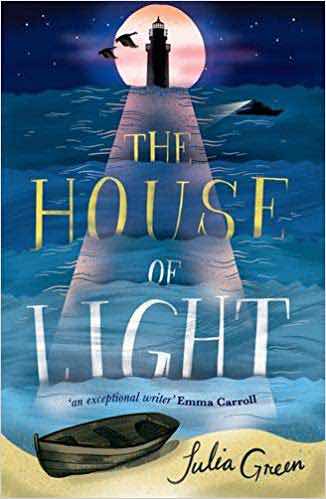
The House of Light by Julia Green


Cover: Helen Crawford-White

‘The sea never stopped. Wave after wave after wave, day and night, from since time began until time ended. Granada’s words came to her again. ‘Create a better world.’ That’s what they had to do now.’ (p 185)

Mastery of Children’s Writing 

I doubt it is possible to teach someone to be a fine writer. But it seems that it is possible to provide the opportunity to learn to be one. When I explore the background of contemporary children’s writers who particularly excite me, association with one of two writing courses seems to crop up with remarkable regularity. Both opportunities offer Masters in Writing for Children, although the two are located on opposite sides of the Atlantic. One is based at Hamline University in the USA, the other at Bath Spa University here in the UK, and each of them must be doing something very right to be growing so many wonderful children’s authors. 

Perhaps, though,  it shouldn’t be a surprise that the Bath Spa course helps so many fine writers to flourish, because its leader, Julia Green, is herself one of our finest contemporary children’s novelist. I greatly admired her last book To the Edge of the World (post April ‘19) but now I find her latest is even better. Her books appear uncomplicated, compared to those of many other children’s writers, and this one is no exception. Her language seems simple, with often short, telling sentences. Her narrative is straightforward and compact, although no less gripping for that. Her few characters are strongly and clearly drawn, with transparent thoughts and feelings. Her themes are lucid. Yet every word of her writing epitomises the ‘art that conceals art’. She can make her little say infinitely more that many other writer’s effusions.

Rowing to the light

The world of The House of Light is essentially classic dystopian, similar to that created by many other writers already, but Julia Green has no need to build her context through detailed exposition. Rather it is skilfully and subtly conjured through the lives of her protagonist Bonnie and the aging grandfather who had brought her up alone. Their subsistence living, gleaning a near-starvation diet from land and shore, together with the persistent  intimidating intrusion of over-regulation from ‘border guards’ is enough to paint a picture. Similarly the discovery of a small rowing boat and Ish, the ‘refugee’ boy to whom it belongs, are sufficient to prompt a terrifyingly audacious escape to a better life. The trio of girl, grandfather and boy fetch up on a tiny island with a long-abandoned lighthouse and there life moves on, as it inevitably must. The author’s handling of events is sensitive and compassionate, fully reflecting the maturing feelings of its young protagonists. The island and its house of light, bring them closer, too, to the wild, free beauty of nature. And that is also a wonderful thing. Julia Green’s images are potent, her descriptions vividly evocative. We come to know her characters simply but intimately - and to care about them deeply, even passionately.  So that when Bonnie and Ish eventually leave the island and launch themselves further into the unknown they carry us with them every oar-stroke of the way.

Hugely simple

Ultimately this is a book that needs to take its place with other children’s classics about escaping oppression and captivity: Lois Lowry’s The Giver, Morris Gleitzman’s Once, Sally Gardner’s Maggot Moon, Sonya Hartnett’s The Midnight Zoo. And it will. It is a title to bring consolation to any children who are coming to terms with the loss of a loved grandparent, as many will inevitably have to. It is a novel to embolden all who seek a better life, in any form. It is a simple song, but it is is huge in its simplicity. It is a hymn to the untameable, terrifying but uplifting beauty of our world. It is an anthem of freedom and the indomitably of the human spirit. It is for our time and all time. It is simply a wonderful book, a book of light.


The cover by Helen Crawford-White captures the elements of the story and their deep simplicity beautifully.

Tuesday, 11 June 2019

Hurricane Season by Nicole Melleby


Cover art by David Litchfield

‘Dark, angry purples and greys swirled in the sky as the rain poured down and met the ocean, which churned in shades of dark blue. . . It was like staring at a living Van Gogh painting. Fig walked to the edge of the boardwalk, squinting, wanting to see the impasto in those waves, the brushstrokes in the clouds.’ (p 237)

Educating for diversity 

I stand resolutely with the many parents, carers and other educators who believe we have a responsibility to help children grow as tolerant members of an inclusive society, happily accepting differences in background, ethnicity and sexuality as welcome aspects of a richly varied society. Our duty of care must include doing all we can to counter the influence of the stereotypes and prejudices that still blight that our current society. And if we cannot yet bequeath our children a completely better world, then we must at least open for them the possibility of building their own.

The books children read can provide one important route into developing an inclusive outlook. It has been said before that the best stories act as both mirror and window. They allow many children to see themselves there, and this can be a crucially supportive experience, particularly if they feel, or have been made to feel, different and inferior. To find, in a book, others just like them, presented in a positive light, is often both comforting and encouraging, helping to restore a positive self-image. Similarly children can learn, through fiction, to empathise with and come to accept people that they might otherwise have thought of as  different; to realise that differences are not to be feared but celebrated; to understand that ‘normal’ can and should be a wonderfully diverse concept.

Few better examples 

It is in this spirit, that I recommend US author Nicole Melleby’s Hurricane Season in the strongest possible terms. And yet I am able to recommend it not simply because it presents single-sex relationships, between females and between males, as a very positive  aspect of normal life, which it certainly does, but because it is a truly outstanding piece of children’s fiction on any count.

Hurricane Season is in many ways a truly beautiful book. It is beautifully conceived and written, beautiful in its cultural resonances, and deeply beautiful in its humanity. It is also a very harrowing read. But then it is one of those stories that, once you have read it, you are profoundly thankful that you did. In fact, it is not essentially about single-sex relationships, but about living with someone with mental illness. And that makes it even more important and special because children’s books like this one, bringing sensitivity and compassion to our  relationship with those suffering from mental health issues, are as rare as hen’s teeth. This is an inclusion issue for our society that shamefully lags behind even other deserving causes. 

Those we love, loved

Fig, the book’s vividly realised protagonist, lives with her single parent father, whose life is being devastated by a form of bipolar disorder. She loves him desperately and wants to help and support him despite her childish lack of understanding of what is going on. She lives in constant fear of them being separated by the social services to whom the case had already been notified by well-intentioned outsiders, and this permeates what are otherwise the normal, early adolescent concerns of an eleven year old schoolgirl. One of the very remarkable and powerful things about the novel is that the situation is always shared with readers through the thoughts and perceptions of Fig herself. Through this we come fully to experience the way her desperation to understand her father battles with her resentment at being shut out from his life. We learn about her situation, not through cold objectivity, but by sharing in an utter confusion and impotence, that is nevertheless permeated by deep love.

When Fig’s father, in due course, finds himself in a loving relationship with another man, Fig is initially resentful but works towards the realisation that this it is, in fact, helping all of them to move forward. As the partnership grows towards providing a new feeling of family for Fig, its positive role in making all their lives better is another of the book’s wonderfully integrated messages. That the author achieves this in a way totally accessible to her young audience makes it even more remarkable.

Hurricanes and starry nights

I have yet to mention, though, another of this novel’s greatest triumph, one that in my mind unreservedly elevates it into the category of fine children’s literature, and this is the way that iterative images and cultural parallels are woven through the narrative with consummate skill. First, there  is the theme of weather, particularly storms - the hurricane season of the title - which forms a powerful background of both actuality and metaphors to the turbulence of the tale. Even more striking, though, are the recurrent references to Van Gogh, his work, life, letters and, perhaps especially, his relationship to his brother Theo. These occur not only directly in Fig’s thinking about herself and her father, but subliminally too in chapter titles and other subtle references. It is all quite magically handled by this remarkable author.   

Complementing the story wonderfully, David Litchfield’s lovely cover illustration is to be warmly commended for cleverly referencing the Van Gogh connection, whilst still creating an image that captures the book’s unique feeling, and its accessibility to a children’s audience.


Some other strong recommendations 

I have recently enjoyed many other very fine books that incidentally introduce same-sex relationships in the way I think they should for children; that is, not as an issue, but as a perfectly normal aspect of a diverse society. Amongst special favourites are Piers Torday’s moving There May Be a Castle (reviewed here  Dec ‘16), The Marvels from the brilliant Brian Selznick (review July ‘15) and two delightful children’s books from Room author Emma Donoghue, The Lotterys Plus One (Review April ‘18) and its sequel, The Lotterys More or Less.     

Saturday, 1 June 2019

Call Me Alastair by Cory Leonardo


‘I tell Aggie about things I’ve never seen, places I’ve never been. I know them, though, somewhere deep in my bones. . . Like some long-ago bird whispered stars to my heart, made clouds scuttle through my veins. . . I know what it is to fly.’ (p 29/30)

Different voices 

A children’s fiction woven from the strands of three very different voices excites my interest immediately.  When the three are as distinct, innovative, and downright entertaining as they are in Cory Leonardo’s novel then I positively fizz with readerly excitement. Where else would you meet in the same book a poetry-writing parrot with considerable attitude, a lonely boy obsessed with the terminology of medical conditions, and an elderly woman much given to dancing and wearing a red feather boa (*1)? This book pushes the boundaries of children’s fiction in the kind of wonderful ways that thrills and delights me.

The titular Alastair, the book’s principal narrator, somehow manages to be a parrot of considerable charm despite, or perhaps because of, his distinctly curmudgeonly nature. (‘I’m not depressed. I’m anti-social.’ p 197) He can also be very funny indeed. Generally speaking, I am no great fan of anthropomorphic animals, and certainly not the kind who walk on rear legs and wear cute clothing. However, Alastair does not really fit in to that category, being more akin to Richard Adams’ rabbits. That is to say he can express and explain himself in human language, and even consideres himself ‘half-human’, but his behaviours remain essentially those of the caged African Grey that he is. He has learned to love classic poetry, and other information, through the act of tearing up and consuming the pages of various books, most notably Norton’s Anthology (*2) . He has even thereby developed a talent for composing both clever pastiches and original pieces. It is a learning strategy that I am sure many a teacher will dearly wish could be applied by their students. However, it achieves happy credibility in this context through the classic willing suspension of disbelief.

Prosody aside, pet-shop born Alastair has two principal redeeming features, a deep love of his fledgling sister, Aggie, and an instinctive yearning to fly free, with which I am sure we all identify, wingless status notwithstanding. 

Interspersed  with the parrot’s  own narration are those of two characters destined to become an integral part of his story: Fritz, a twelve year old boy who works part time in the pet shop, and Albertina Plopky, a feisty old woman, its sometime customer (of sorts). The contribution from Fritz, a would-be doctor, takes the form of his ‘Official Medical Log Book’, whilst Mrs Plopky writes letters to her husband, Everett. Part of the joy of the book is how well these three voices are brought to life, and it is particularly interesting to find an adult perspective as as significant, even if subsidiary, element of a children’s book. 

Hilarity and thoughtfulness 

However, for all the shenanigans of the parrot siblings, as sale items and subsequent purchases - and they are many and delightful - the novel has a rich, deep and indeed very touching theme running through it. Between the squawks and skirmishes seeps out affecting pathos. Underneath, this is a story about attachment and loss. Moreover, it is all the more touching as its emotive power creeps up on you subtly, a gradual awakening to the pain that all three of the book’s protagonists struggle to live through. Central is Alastair’s devotion to his sister Aggie, and his subsequent, devastating separation from her. However, this is echoed in many other heartaches of enforced separation and bereavement, human and animal.  It is a moving  novel, exploring the kind of  very real pain that touches all of us, or will do at some point in life. 

It is a book with a rich subtext. Much is implied rather than stated. Its full appreciation requires inference and deduction as well as literal reading, and, because of this, it is a wonderful gift to young readers. How refreshing that this clever author does not write down to her young audience, but leads them into the richness of understanding by degrees.

The power of poetry

Call Me Alastair is also a paean to the power and potency of poetry. The author’s many literary references are amongst its greatest delights. And if it focuses largely on American literature, then no matter, for its subjects are largely those writers who also loom large on the world stage. You don’t have to know something of classic poetry to enjoy this book, but it certainly adds an extra frisson if you do. And I love the unpatronising stance of that too. Amidst other delicious entertainments, the  parrot’s  pastiche of Jabberwocky is pure joy, not to mention the subsequent explanatory conversation between a cat and a goldfish. You have to read it. And perhaps the poetic references will even prompt a little exploration of the originals by some of its young readers. Wouldn’t that be a wonderful thing?

A gift of a book

Were I still teaching upper KS2, then this is just the kind of book that I would choose to read aloud, discuss and hope to enthuse my class about. It is one that would provide stretch and challenge, helping to open young mind to the full potential of fiction, whilst still amusing and entertaining them hugely.

Cory Leonardo puts these words into a the mouth (or perhaps I should say the beak) of Alastair himself:

‘The unexpected creeps up on you. One moment it’s silent in the shadows. . . and the next it explodes on the stage. . . You can’t predict where lightning will strike - or when a goldfish will explain your poetry with perfect clarity. Life is weird. Unexpected. Surprising .’ (p 220)

She could well be describing her own book. It is weird (in a good way), unexpected and  surprising. It is original and clever. It is is hilarious and touching. 

The art of flying

Throughout the book Alastair is prevented from flying free not only by clipped feathers, but by a broken wing that has never truly healed. The wing is actually as much the point as the feathers.  Feathers can grow, if we don’t, like Alastair, continually pull them out. Other things are part of who we are, and we just have to learn to live with them. But perhaps we can fly anyway.  

‘It’s not just wings you need to fly.’ (p 30)

If the conclusion of this tale seems to verge on the sentimental, well, that’s because the simple truths in life often do. Sentiment is not always such a bad thing, and being simple doesn’t stop them from being true.

‘Love is where you find it.’ 

This is a book that will help young readers to fly. It is a simple art.


Published in US as The Simple Art of Flying


*Notes:
1. In this instance, not a ‘red hat which doesn’t go’ (Jenny Joseph), although the intention is much the same.
2. A classic American anthology of poetry.

Tuesday, 28 May 2019

The Longest Night of Charlie Noon by Christopher Edge


Cover: Matt Saunders/Joel Holland

‘What might have been and what has been
Point to one end, which is always present.’
T.S.Eliot, Four Quartets 


Albie Bright, Jamie Drake, Maisie Day, and now Charlie Noon

When modern physics reaches for its boundaries, for the unimaginable vastness of astrophysics, and the equally unimaginable minuteness of quantum physics, it seems to encircle a globe of understanding from the two different directions and meet in much the same place. Of course, this place is not unimaginable at all, or else human understanding would never have reached it. Imagination is how it is reached, and the edge of comprehension is where it lies. It is indubitably a place of some of the most complex and challenging thinking in all science. 

Yet, it is this very realm of ideas that Christopher Edge has sought to bring to children - and has done so quite superbly in his set (*1) of recent books. He has done it so well, and so importantly, because he has done it through the medium that children can often understand best, the medium of story. He knows that story can bring subliminal, intuitive assimilation, even where explicit intellectual understanding is beyond reach. He has made himself the thrilling master of such books. And now he has added another mind-bogglingly brilliant novel to this set. 

A Night in the Woods

This time his subject matter is the concept of time itself. Consequently, if this novel feels a little distinct in quality from the earlier three, it is because it is as much about metaphysics as it is about physics. It is as much about the thinking of T.S. Eliot as that of Albert Einstein, as much about the fiction of Penelope Lively or Alan Garner as about the science of Steven Hawking or Carlo Rovelli. Rather, perhaps, it is about the meeting of minds of all of these and more (*2).What Christopher Edge has so skilfully created is science and philosophy, poetry and mysticism - for young minds. It is quite an achievement. I can only say little of the much he has created. You must read it for yourself, and, more importantly, so must our children. 

A great deal happens to Charlie Noon during this longest night, and the story has many layers, many levels. It takes place in the Wild Wood. It is the Wild Wood of Kenneth Graham (*3), the wood of imagination, of story. It is also the Wildwood of Roger Deakin (*4), the ancient woodland of Nature. Perhaps these two woods are ultimately much the same, the wood in which we must lose ourselves in order to find ourselves. They exist in time, and out of time, in past and future, eternally present. 

Time present

Christopher Edge, has consistently made more literary sense than most of narrating in the first person present tense. Here, it is particularly germane in a story about time that is always present. Think of the author , in his crafting of this book, as much akin to a stage magician. He is tricking you with clever sleight of hand. (Perhaps here we should call it ‘sleight of pen’.) As with the magician, it does not matter that you know that he is tricking you, he will fool you anyway. He is immensely clever at misdirection. Once you see what he has done, you will kick yourself for not getting it earlier. You will realise that the clues were there all along - small, subtle, but there. You should have known, but you didn’t. That is how clever he is.  But his meaning is in his trick.  It was never what you thought. You could never see from where you were standing. He had to fool you to get you to see. You had to lose yourself in the Wild Wood in order to find the answer. The way forwards was the way back. Much of the clue to the story is in code, and that is important too. Once again, when you have cracked the code, you will think you knew how to read it all along. But of course you didn’t. And I am certainly not going to tell you now. It must remain an enigma. I will not give away the conjuror’s secrets. Where would the magic be then?

Dawn chorus

However, if you think all of this exploration of abstruse ideas sounds dry and intellectual, then you couldn’t be more wrong. Christopher Edge’s great talent is to be able to explore his challenging themes through dramatic and very human narrative. This story of three children lost overnight in a wood is compelling; by turns, funny, frightening, affecting and shocking. His characters are as vivid and real as their experiences are fantastic and bewildering. Again, sorry, no secrets.  All I will say is that it ends well, or, at least, has the potential to do so. Dawn follows the long night, and the new day is wonderfully in tune with the natural world, quite literally. 

‘Another bird starts to sing and another and another and another. Whistles and warbles, chirrups and tweets; flurries of notes falling like rain inside my brain. The sound seems to be coming from all around, every bird singing at once, their melodies twisting and twining until my mind is filled with an ocean of song.’  (p 174-5)

The final message of this story is one of the most crucial for our children. And that makes this a very important book, as well as an entertaining, puzzling, thrilling and challenging one. It is a book for those who want children to think big thoughts, and live big lives. It says to us all, those who are children, or have been, or will be:

‘You can’t stop what’s coming, but you can help to shape it into something better. . . . The actions you take will change the world.’  (p 170/171)


*Notes:
(1) The Many Worlds of Albie Bright, The Jamie Drake Equation and The Infinite Lives of Maisie Day. These books are stand-alone stories, not a sequence, but are linked by their ability to explore  difficult scientific concepts through engaging narrative. 
(2) Christopher Edge helpfully lists many of his sources/inspirations under his ‘Acknowledgments’ at the back of the book.
(3) The Wind in the Willows, 1908
(4) Wildwood, A Journey Through Trees, 2007

Sunday, 26 May 2019

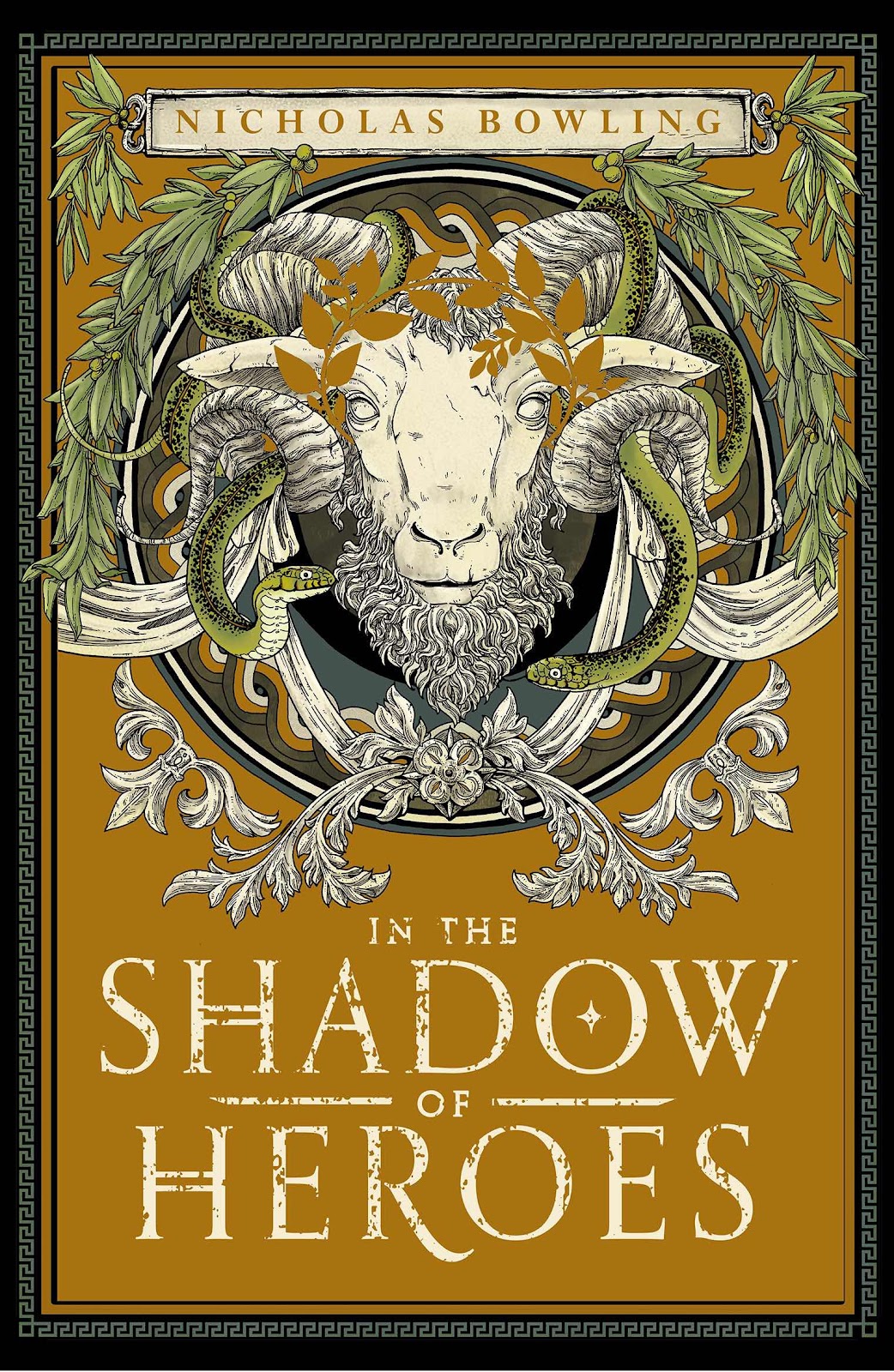
In the Shadow of Heroes by Nicholas Bowling


Illustration: Erica Williams

‘Even the heroes wept. They loved, and they lost. Indeed, it was their loving and their losing that made their stories worth the telling.’ (p 371)

Bewitching precedent

Although his first, hugely enjoyable, novel Witchborn had a strong and, in many aspects, authentic historical setting in Elizabethan England, it was essentially an entertaining YA fantasy adventure, often witty, but  with witchcraft bringing in elements of dark magic too.

His second novel for young readers, In the Shadow of Heroes, initially seems even closer to being a historical novel as such. Whilst clearly a fictional story, it is grounded firmly in the locations, events, beliefs and culture of a particular place and time. In fact Nicholas Bowling, a specialist in Greek and Latin himself, seems very much at home in the Roman world that is so integral to his narrative. His depiction comes across as authentic in detail as well as in broad background. He recreates the ethos of the ancient world quite wonderfully, and its atmosphere, by turns chilling and intoxicating,  is endlessly fascinating. In many ways this is very scholarly writing  (even Homer’s ‘wine-dark sea’ gets a notable revival), but the author wears his erudition lightly. His conjuring of a long-past world is highly evocative without ever being didactic, educational in the very best sense, and hugely entertaining with it. This is helped in no small part by language that is richly descriptive, but never heavily cloying. 

History red in tooth and claw

At the heart of this story, as with so many of the best, are its characters - and quite wonderfully rich, vivid creations they are. Intelligent young slave, Cadmus, makes a fine protagonist. Supposedly found abandoned by a benevolent master, he has been educated far beyond his status and makes a sensitive and observant guide to his world, yet with enough flaws and foibles to make him readily empathetic. It is however, Tog, his frequent companion in adventure, who, for me, is the book’s most compelling creation. A runaway slave, her taciturn personality resides within a physical frame of mind-boggling stature and strength, that renders her eventual revelation as the offspring of a Celtic British warrior chief completely credible. In, quite rightly, ensuring that his tale features a strong female protagonist, to equal (or excel) his male ‘hero’, Nicholas Bowling has moved about as far away from the simpering princess as it is possible to get. And good on him. 

Subsidiary characters are wonderfully drawn too, peopling Ancient Rome with the rich mix of the ordinary and the grotesque, the humble and the arrogant, the sympathetic and the downright chilling. They both bring his story to life and give it compelling power. They even include a megalomaniac and delusional Nero, whose portrait here, popular history tells us, may not be too far from the truth. The cruelty and violence of his time live and lurk behind the whole novel, but so too, in the telling of it, do the sensibilities of our own age

The story is not, in fact, confined to Ancient Rome itself, but ranges widely across the ancient map, embracing Athens  and indeed the shores of a Roman Britain as well. Yet the real strength and greatest interest of the book lies in the way that it draws not only upon the actuality of this ancient world, but on its storytelling too. 

 Myth lives on

Deep into the fabric of this narrative are woven the myths of the ancient world, principally those recorded by Apollonius of Rhodes in the Argonautica, tales of Jason and his companions who sailed on the Argo in quest of the Golden Fleece. Particularly pertinent is the character of Medea, Jason’s later abandoned helpmate and wife. 

What makes the book most particularly remarkable, though, is the way that remnants of this myth gradually impinge on ‘reality’, intrude into history and the lives of  Nicholas Bowling’s characters. The self-claimed descendants of the heroes, the Heroidai, make an appearance as, indeed does the Argo itself. Wreck of an ancient relic that  it has become, it is patched back into service, almost taking on a life of its own. 

‘The heroidai were concealed completely in (the Argo’s) shadow, giving the impression that it was being drawn to the sea of its own accord. On either side, trailing back up to the forest, it left a bow-wave of swirling yellow dust.’  (p 249)

This is an Act of Medea played out long after Euripides’ version has ended. I suppose it could be thought of as a history mystery. Not so much  ‘mystery’ in the later  Blytonesque sense of  The Mystery of the Disappearing Cat, but in the far older sense of the York or Wakefield Mysteries, masked actors, perhaps, reinvigorating the myths of belief amidst the daily lives of their times. This adds another rich dimension to the story and gives the title an extra frisson of meaning. It is delicious, original  stuff, and very clever writing to boot; the perfect spell for conjuring an imaginative past from the dust of history. It builds a world whose own stories and beliefs mingle with reality in its fictional present, just as they must have in its actual past. It credits young readers with the  ability to understand the distinction, and the lack of distinction, between them - and rightly so. 

A future for the past

As well as everything else, this is a cracking story that surprises at times, shocks at others, and keeps the reader guessing to the end. The final door to Cadmus’ future is left open. So are we simply to imagine for him a life of further adventures, or is this author going to provide us with them? If a further instalment is to be of the quality of this first, then I sincerely hope it is the latter.

This highly entertaining ancient history adventure has protagonists of around fourteen, and therefore seems aimed at younger teens. I am sure that any who want to escape for a while from the realities of the present will revel in the mysteries of its superbly recreated world. However, I suspect that many avid younger readers, of nine or ten plus, will lap it up too.


Friday, 17 May 2019

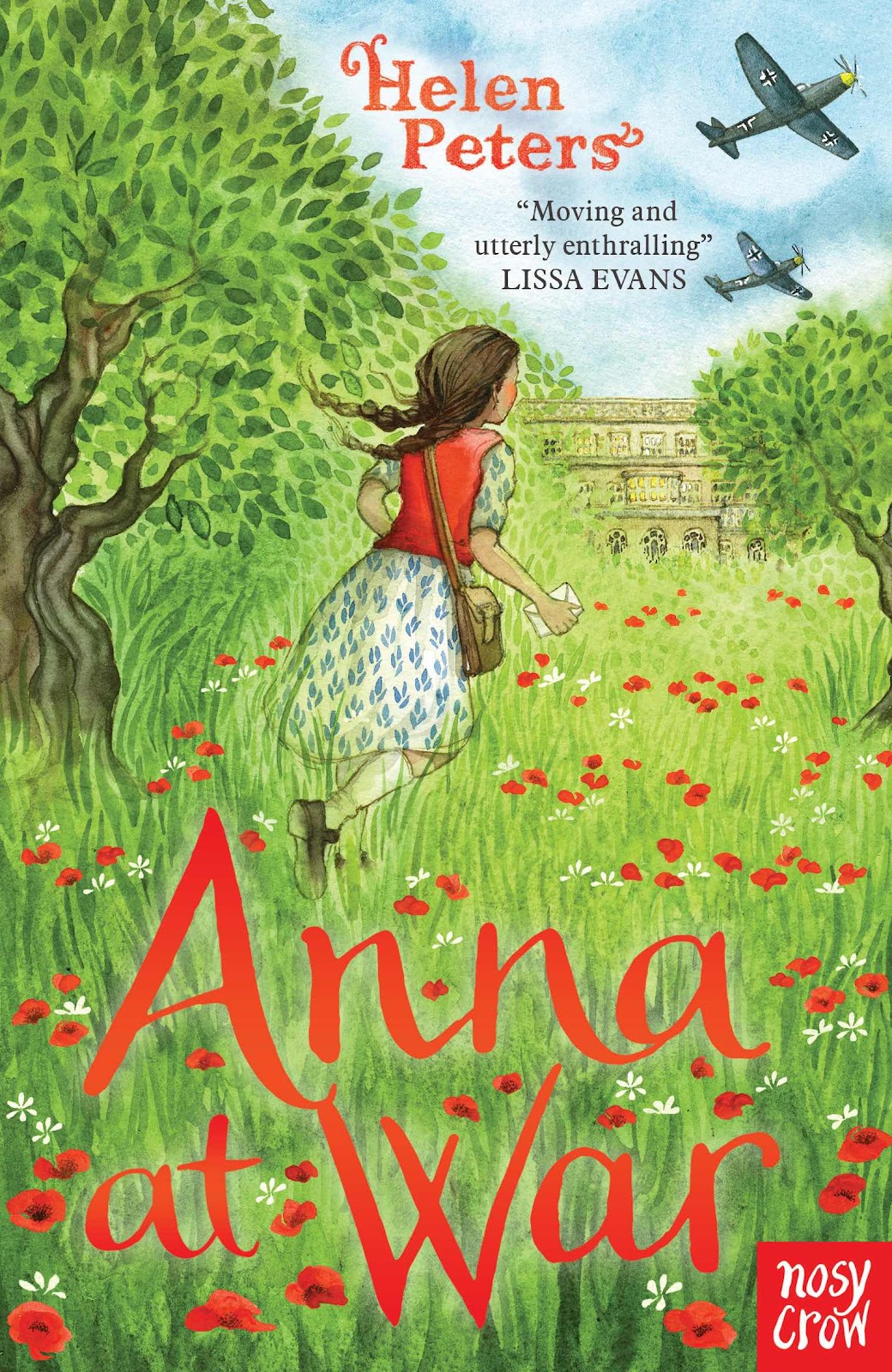
Anna at War by Helen Peters


Cover: Daniela Terrazzini

‘I am grateful for . . life every single day, knowing how many people would have loved my opportunities and never had them.’ (p 287)

WWII remembered

The period of our history involving the Second World War has attracted some of our very finest children’s writers, and there are many wonderful novels covering both children’s lives on the home front, and the truly appalling treatment of Jewish children by the Nazis. They are all hugely important books in terms of keeping awareness alive for children born into a world where this dark time is rapidly passing from living memory, even for their oldest relatives. However, the number of evocative and deeply moving examples of such books already available begs the question of whether the children’s canon really needs yet another one covering the same ground. The answer must be a resounding yes when it is as fine as the upcoming Anna at War. 

WWII relived 

This is one of the most accessible novels on this theme that I know, and yet it achieves this in the context of an involving and deeply affecting story. It takes considerable writing skill to say so much through such a relatively simply and straightforward narrative. In this, it harks back to something of the quality of Nina Bawden’s wonderful Carrie’s War. Only Emma Carroll’s and Lucy Strange’s recent books exploring the same period have had much the same qualities. Yet the more direct focus here on the human abomination that was the treatment Jews by the Nazis makes Anna at War even more powerful. Anna’s story is also an exploration of the experience of immigrants and of the consequences of prejudice. As such, it could not be more relevant and important for today’s children. 

For me, only Judith Kerr’s wonderful When Hitler Stole Pink Rabbit is more potent, and that comes largely from the fact that it springs from first-hand experience. But, even written over seventy years after the event, Anna at War too has its own very special qualities. Helen Peters draws on the experiences of real children who came to England on the Kindertransport. She has a wonderful ability to put herself inside the mind of Anna, and to take her readers there too. Through the voice of her young protagonist, she continually conjures the details of experience, yet expresses them in ways that seems genuinely that of the child. She vividly places a young girl’s everyday concerns into the context of momentous, and deeply troubling, times. Overall, it is the pure power of this author’s storytelling that makes the book so effective, direct, yet skilfully constructed to engage utterly. This is the past relived, and hence made relivable. Sometimes it is heart-wrenching , but it is also humanising; as uplifting in its resilience and love of life as it is paining in its cruelty and loss. Without ever preaching, it both enlightens and enriches. 

WWII honoured

To bring this period of history into the easy access of today’s 9-12 year olds, to make it an engrossing read, with elements of exciting adventure, without in any way exploiting history for cheap entertainment, is a fine achievement. Helen Peters also helps contemporary readers to relate this period to their own by a framing narrative that brings Ann’s experiences closer to the generation of her grandchildren. It all makes Anna at War highly recommendable, and the book could well, I hope, lead young readers into exploration of some of the many other exceedingly fine works of children’s literature that deal with the same period and its issues.  (See my post from January of this year.) 

Many have hoped that all the sacrifices of those years in the mid twentieth century would achieve the final demise of the despicable actions and attitudes on which the monster of warfare feeds. Subsequent events have shown that, tragically, this has not been the case. However, books such as this could well help a new generation of children grow up to build the better world for which so many gave so much.