Here are the occasional reflections of a joyful traveller along the strange pathways of fantasy and adventure. All my reviews are independent and unsolicited. I read many books that I don’t feel sufficiently enthusiastic about to review at all. Rather, this blog is intended as a celebration of the more interesting books I stumble across on my meandering reading journey, and of the important, life-affirming experiences they offer. It is but a very small thank you for the wonderful gifts their writers give.

Tuesday, 1 September 2015

A Curious Tale of the In-Between by Lauren DeStefano


I have noted before that some books seem to find their own way to you; they chose their own time to be read. Here is a good example. I am currently in the middle of reading Terry Pratchett's final Tiffany Aching , a book I that have been eagerly awaiting. It is a fine book and I am enjoying it enormously. I confidently expect that it will be the subject of my next post. Yet when A Curious Tale of the In-Between landed on my doormat, in consequence of a pre-order I had almost forgotten, I just flipped it open to get a feel of the writing and virtually didn't stop reading until I had finished it.

It is clearly a compelling little tale. This is in no small part due to wonderful writing, both in terms of its language and of its narrative. It is strikingly original in concept and in realisation. Both its language and its story have a certain quirkiness, an arresting weirdness, and emanate from a very unique and special authorial voice. Lauren DeStefano adds to this a protagonist - twelve year old Pram, who is beautifully drawn and readily engenders empathy - and a supporting cast of equally vivid characters. In consequence, a reading experience which starts off as intriguing rapidly becomes engrossing. Beneath its quirky, sometimes humorous, cloak this book shelters much truth, warmth and humanity.

A children's book (key audience around 9-13?) is I think a new departure for popular US YA author Lauren DeStefano. The genre of this relatively short novel is rather hard to pin down. It hovers between ghost story and fantasy. However it is probably in the end closer to fantasy, or perhaps 'magical realism'. Within its own parameters as a fiction, ghosts, and Pram's ability to see and talk to them, are perfectly real. Others may think she is imagining them, but she is not. This ability is her 'magic', her gift. Yet underneath this her situation and her issues are very grounded. In this, the novel shares much with a strong tradition of American children's literature that uses fantasy to explore the issues of very real kids, often when they find themselves in challenging life circumstances. It is related to other wonderful, and equally 'spooky' books like Holly Black's Doll Bones and Anne Ursu's Breadcrumbs, although as with both these examples, it is never derivative, always totally its own work.

On many levels 'spooky' is too comfortable a term for this book. There are many things about A Curious Tale of the In-Between which are genuinely frightening and possibly disturbing. The story opens with a brief but vivid scene of a pregnant mother hung from a tree; this sets something of a tone for later developments. It is a book for children, but for children with a certain maturity as readers. Actually these opening paragraphs are quickly passed and the story settles for quite a while into a charming and entertaining one where the ghosts encountered are no more threatening to either Pram or the reader than those of, say, Neil Gayman's Graveyard Book; they are friendly little chappies. In fact the principal ghost at this stage is Felix, a young boy who fulfills much the same role for isolated Pram as would the imaginary friend, even though he is actually as real as it is possible for a ghost to be. At the same time Pram's growing friendship with, Clarence, a living boy from her school, is warm and reassuring.

However, about half way through, the story takes a decidedly darker turn and enters a long sequence which verges on the surreal. It is at least disquieting and potentially genuinely frightening. Even though the final denouement returns to something much more positive, if still somewhat ambiguous, this is overall quite a long way from being a cozy read. To put this in perspective, the darkest parts are no more dark than those, say, in the final book of Harry Potter. However there is something in the way this book treats with death, and sets ghosts and the spirit world against a otherwise comparatively realistsic setting, that could be very troubling for some. I do hope that not too many children (or parents) are put off by this, for within, and indeed through, this somewhat dark context, this book has a great deal of humanity and compassion. More than anything it has much of major importance to say about being a child of this age.

Many books for young readers concern themselves with growing up, with coming of age, with an individual starting to become 'what they were meant to be.' This is of course a crucial theme. However A Curious Tale of the In-Between is not really about growing up. It is about being almost-but-not-quite-ready-to-grow-up, not-really-a-child-but-not-yet-an-adolescent-either, and this stage is in itself a most important and valuable part of life. It is not simply a preparation for adulthood or even for adolescence, it is something in its own right. Further, at its very heart this book is a pean to that quality of love that abides in very special, close friendship. This can often and particularly be found at this age, for it is a love which is not yet ready to be sexual, it is not even really romantic. Nevertheless it is love, a very intense and poignant love. It is significant that the nightmares of the book are precipitated by the sudden absence of the ghost Felix, but even more so by what happens to Clarence.

The friendship Pram has for Felix is indeed a childish one, a friendship of shared laughter and silly games, and by the end of the novel she is ready to move past it. But the friendship she develops for Clarence is truly one of love, perhaps the purest she will ever know. It belongs to pre-adolescence and to that period alone. It may be that in the furture it will grow into something different for either or both of them. But for the present it is what it is. It Is important. Their present stage of life is important, for them and for all children, and it is important for children to know this. It is a worry when our society pressurises them to hurry through or past it.

At the very end of the book Pram can start to see some of the things she might do and some of the things she might become in the the future. However she also knows that she is not quite ready yet to be older than she is. Good for her. This is a very special and rather wonderful book. It is a tale of the in-between in more ways than one. It is a tale about and for the in-between.

Thursday, 27 August 2015

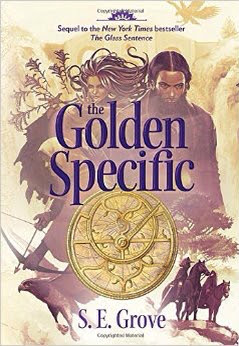
The Golden Specific (Mapmakers Book 2) by S.E.Grove


Currently the children's shelves at bookshops are crowded with easy reads, straightforward linear fictions with near stock characters and predictable plots. They entertain their readers with the warming escapism of silly humour or vicarious adventure. Such books are not to be belittled. The young often need the comfort of the familiar, the readily accessible, and anything that gets and keeps them reading is of considerable value. However it is also important that young readers are sometimes challenged with more complex stories, ones that introduce them to the wonderful possibilities of non-linear and multi stranded recounts. Many specialists believe that interaction with such narratives - whether in the medium of print, film, TV or indeed video games - actively contributes to the development of complex cognitive reasoning. I can well believe it. I certainly think such processing adds significantly to our understanding of interrelationships, of life and people, of thought and time, and perhaps especially to our knowledge of ourselves.

So when a work of children's fiction comes along that is brave enough to eschew condescension and challenge its young readers with multi layered complexity it is to be most warmly welcomed. When such a book not only provides challenge and its consequent reward but is hugely enjoyable too, then it is a true treasure.

This certainly applies to US author S. E. Grove's ongoing Mapmakers sequence, of which Volume Two is now available here, albeit only easily sourced through online retail. I was enthusiastic about its highly promising first book, The Glass Sentence (see my post from Jan '15), and this second is, if anything, even better; long and complex for young readers, but very exciting not least because of the wildly original, wonderfully imaginative stimulation it offers.

Other reviews have compared Mapmakers to Philip Pulman's His Dark Materials trilogy (The Golden Compass in US). The two actually have relatively little in common in terms of plot, characters or themes. What they do share however is the fact that they create stunningly rich fantasy worlds, each the product of a unique and very special authorial imagination. Each work is grounded in a place that appears initially to be much like one in our own world (Lyra's Oxford and Sophia's Boston) but which soon turns out to be not at all as we know it. Each too then extends into a vast fantasy creation much of which is again both fascinatingly like, and at the same time totally unlike, our own world and its history. What I think it is fair to say is that S E. Groves's creation is shaping up to be the most originally imaginative children's epic fantasy since Philip Pulman's.

The Golden Specific continues to explore the world of The Glass Sentence, one based on a globe that appears to share our own geography but has been devastated by a fracturing of history that has left it divided into wildly dispirate time periods or 'Ages'. In fact the consequences of this are more fully and directly explored here than in the first book. Over and above their weird simultaneous existence, these various historical ages are significantly different from those of our own world. They do contain certain familiar echoes - such as the expansion westwards into 'Indian Territory' by the early US settlers, the Spanish Inquisition, the wearing of 'plague doctor' masks in 17/18th Century Europe - but they also feature events, people and objects that we would call supernatural or magical. Here are also worlds of different politics, different cultures, different belief system, all with characteristics both familiar and strange. However all are quite wonderfully conjured and given their own reality by this author's incredible imagination and masterful pen.

Like the classic middle section of The Lord of the Rings, this installmemt of Mapmakers is told as a split narrative; it consequently has the same totally compelling engagement and drive. Sophia remains the principal character and pursues her quest for her missing parents by travelling across the Atlantic to another era where she has to engage with a hostile 'Dark Age' and seek out a magically restorative village. Alternating is the story of Theo, the book's other principal protagonist, who remains in Boston battling an old adversary and trying to prove that Spohia's uncle is innocent of murder. Interspersed again there is also a flashback first person narration by Sophia's mother of the events leading up to her and her husband's disappearance. There are stories within stories too, accessed through the uber-reality of this world's very special maps, or narrated by other characters. It is a heady brew. Sophie's adventures are not only by turns high-adrenaline and grippingly intriguing, they are also often mystical, philosophical, magical, even poetic. In contrast Theo's escapades can be gruesome and frightening, but also at times light-hearted, amusing, cartoonish, even farcical. They counterpoint the story quite wonderfully and provide just the needed respite to the more lyrical and intense threads.

A fiction of such eclectic fusions could in other hands have so easily become a disparate mash of confused and disjointed elements. However it is a testament to S. E. Grove's masterly writing that she holds all of these strands together. She ultimately constructs an intrinsic, if complex, logic even though this only manifest slowly as the novel develops. However she also leaves enough space within her narrative for readers to weft their own imaginative and cognitive bindings between the tale's multiple threads. It is actually this last skill which is probably the strongest indicator of her genius - and I do not use the word lightly. It is in these self-realised potentialities that the reader's greatest involvement lies. That involvement is, in consequence, as deep and multi layered as the narrative.

At the start of Chapter 34 the author writes this stunning passage. It is one of those rare 'Yes!' moments in reading that stopped me in my tracks and filled me with astounded admiration.

"Sophie had no notion of time passing. She was not entirely sure of where she was either. So completely had she submerged herself in the memories of the beaded map, she felt as though she had lived a year in Alvar Cabeza de Cabra's skin. She had seen the parched, harsh world as he saw it, grieved its losses as he grieved them, felt the feeble thread of hope given to him as he felt it. Somewhere, like a distant echo, she felt these things as Sophie, too."

In describing so poignantly Sophie's engagement with a magical map, S. E. Grove could not have better expressed the reader's experience of a rich, engrossing and evocative narrative like The Golden Specific. Such is this writer's astounding power of imagination and her command of language, thought, feeling and narrative that she magically creates for her audience just such a multi sensory, multidimensional map as she has invented for her characters.

Whilst, by the end of The Goldn Specific most immediate goals have been reached, much inevitably remains unresolved, and Theo's plight is nothing if not desperate. On finally closing the book readers will I'm sure be in an ambivalent position, thrilled that there is more to come, but devastated at the prospect of having to wait for it.

The very best stories are true even though they are not real. This applies strongly to this one. S. E. Grove has found human truth in wild fantasy and that is a very special talent indeed. The so aptly named Mapmakers is already a truly wonderful work, and a profoundly important one. By the time its third part is added I think there is every chance that it will prove to be one of the great works of children's literature of any age or clime.


Tuesday, 18 August 2015

Clariel (prequel to The Old Kingdom trilogy) by Garth Nix


Having discussed the importance of Australian children's writers in my last post, I realise that I have not yet actually written up here any of the recent books by the key fantasy author Garth Nix. This omission needs to be rectified as he is not only a wonderful writer in his own right but also a key influence on the fantasy genre itself. So much so that, if his YA novels seem somewhat familiar in approach and style, it must be remembered that it is he who set a trend since followed by others and not the other way around. Garth Nix is very much an originator and not an imitator.

Of course the start of what is almost certainly his most important work, the Old Kingdom trilogy (sometimes called the Abhorsen trilogy), is now some twenty years old, with Sabriel, its initial volume published in 1995. The two sequels, Lirael and Abhorsen followed in the early Noughties and this original sequence lies on the cusp of the C21 achievements I have set out to discover. In fact it is broadly contemporary in genesis with much of Harry Potter and can, in many ways, be considered the YA equivalent of that children's blockbuster in terms of its seminal significance.
 
However Garth Nix has far more recently produced a further substantial addition to the Old Kingdom sequence, Clariel, 2014, and this certainly qualifies as a gem amongst my recent reading. It is not only a hugely worthwhile extension of his earlier creation, but also a truly great work of fantasy fiction in its own right.
 
Clariel is actually a prequel to the earlier trilogy. It is set fully within the Old Kingdom, but about six hundred years before the birth of Sabriel. However there is much about her world as reimagined here that is immediately recognisable. For previous readers of the Abhorsen sequence it comes as a thrill to learn some of the history that shaped the society they already know. However it's nature as a prequel means that Clariel can also serve as a perfectly valid introduction to the Old Kingdom books, albeit without providing that same sense of illumination that it will for those already familiar with subsequent events. New readers have so much yet to discover. Whilst it is almost impossible to imagine that they will not want to go back, or perhaps rather go on, to the earlier books, Clariel does in fact also constitute a totally viable stand alone fantasy. Whichever way it is approached it is a very rich and rewarding read indeed.
 
In many ways Clariel epitomises what Garth Nix has achieved so fully in creating and defining high fantasy for a YA readership, even whilst it is also a shocking departure from the expected.
 
The first thing that this author does, and does supremely well, is to create an imagined world of extraordinary richness and detail. It is essentially a classic high fantasy world, a complex society with a broadly mediaeval feel: a highly stratified society of kings and lords, of hierarchical and powerful guilds, of downtrodden impoverished masses, but also of magic and powerful mages, of demons and monsters and of a wilder, older magic too. But these are no glib stereotypes. Everything is imagined and conveyed with rich and compelling complexity, glued together with its own convincing logic and described in vivid and telling detail. Just as tellingly conveyed is the vast topography of a whole world. In Clariel this is at its height in the creation and description of the principal city of the Old Kingdom, where streets, markets, hovels, towers and palaces all exist with staggering, often mesmerising presence. Similarly conjured for the reader are the varied landscapes of the countyside and the more rural Abhorsen House where Clariel finds herself later in the story. Garth Nix peoples this world with a staggeringly large array of beautifully drawn characters. And all of this is managed with a masterly skill which makes even his descriptive writing compelling, and fully integrated into some of the best and most enthralling storytelling I have encountered in a long time. The result of all this is a world and a book which is totally and completely involving; one which provides what I always think of as 'the Tolkein factor', a substantial immersive experience where the reader can vicariously live in a completely fantastical world which is magically imbued with a totally compelling reality.
 
However the key thing which Garth Nix began to do twenty years ago, so pioneering this particular genre of YA fantasy, was to place totally convincing teenage protagonists within this wonderfully rich and complex world; to tell stories which resonated emotionally with his young readership whilst still sitting with total credibility within their fantasy setting. In fact this setting created a very special context, where issues and feelings pertinent to his readers could be worked out at a 'safe' remove; allowing the process of growing towards adulthood to be explored vicariously; permitting hopes and fantasies to be pursued, perhaps even fulfilled, in a viscerally exciting way,whilst still protected from their actual consequences. This is something which he again achieves superbly in Clariel, but with the addition of further dimensions and subtleties.

Clariel is again primarily for a YA audience, although it undoubtedly also comes into the category which will enthrall and delight many adult readers too. It contains scattered sexually references, although these are very mild and never explicit. However what makes it ideally suited for YA readers is the fact that Clariel and her story are most skillful conceived to engender close identification from this particular audience. She lives fully in the world of the Old Kingdom, yet her issues are those of so many adolescents. Although aware that she is growing up, and in many ways wanting to do so, Clariel is not fully ready to enter into the 'adult' and demanding social and political world. She is on the verge of rebelling against her parents' wishes to fit her into this society and dreams instead of a future life away from other people, in the forest where she has spent an idyllic childhood. She also has a propensity towards violent outburst of anger, which she realises she must learn to master, but has not yet learned to control. Even though placed here in the context of raw magical power, this is a dilemma with which many young readers will be able to identify. Clariel is quite beautifully brought to virtual life by Garth Nix and soon engenders the reader's fully involvement with her story. We think and feel with her every moment; we share the confusion of her dilemmas and the naive optimism of her every decision.
 
Here it becomes very difficult to explain the real greatness of Clariel as a novel without indulging in what would be spoilers, and I would never wish at all to mar some other reader's pleasure in this way. For it is in the amazing, development of Clariel's character and story, essentially and intimately intertwined, that the genius and originally of this book lies. The directions which she takes and the outcomes of her actions are all the more devastatingly powerful because of the total reader identification which has inescapably been set up. Suffice it to say that Clariel is no Frodo figure, saving her whole world through innocent bravery. She does, in her own way, grow up and she certainly influences her world, by the end of her story - and beyond. However, the ways in which she does this are as disturbing as they are remarkable. She is a magical protagonist - but not really as we might have expected.
 
The result is that Clariel is one of the truly great works of fantasy fiction. It is a most notable addition to a modern classic sequence, but also a wonderful literary achievement in its own right.


One further short addition to the Old Kingdom sequence has been published very recently, although its actual writing predates Clariel. To Hold the Bridge is a novella first published in Australia in 2010, but now finally released here in a volume of Garth Nix short stories of the same name. It is the only item in the collection which relates to the Abhorsen world, and as a novella is not of the stature of the earlier works, or of Clariel which followed. It is nevertheless a very enjoyable read and an important further extension and elaboration of the Old Kingdom world.
 
The content of this novella is not part of the ongoing story of the Abhorsens as such nor does it involve the principal characters of any of the other volumes. However it does contribute new aspects to the topography, sociology and history of the Old Kingrom in vivid detail and as such further enriches the whole. Again, too, it treats of a young protagonist with whom easy identification is most effectively engendered. This time it is a young man, Morghan, who had been physically abused and emotionally neglected in his upbringing, who now seeks to establish an identity for himself and to carve out a significant role for himself in the world.
 
Although short, To Hold the Bridge still manages to engross the reader for a while in the magnificently imaginative creation that is the world of the Old Kingdom. It succeeds beautifully too in engendering involvement in the fate of a protagonist with whom it is easy to identify. Is is also far more positive in its outcome that Clariel. It may not share the greatness of the rest of the sequence, however, for those who do want to save the world, in their fantasies at least, this extra read is a wonderful quick fix.


Thursday, 6 August 2015

Song for a Scarlet Runner by Julie Hunt

Despite Australia having such a strong tradition of quality writing for children, comparatively few books by their wonderful authors seem to get onto bookshop shelves here in the UK. Of course best sellers like Garth Nix and John Flanagan are exceptions as is the brilliant Morris Gleitzman. (His Once/Now/Then/After sequence is undoubtedly a very great contribution to children's literature.) It is a delight too when treasures by fine writers such as Sonia Harnet and Karen Foxlee get published here. (See my post on Ophelia and the Marvellous Boy from March '15.) But I do know that there are many other wonderful Antipodean writers of MG and YA fiction of whom we hear far too little little over here.

It is therefore a great pleasure to discover that a real gem like Tasmanian writer Julie Hunt's latest novel is readily available online, even though not directly published in the UK; enough in fact to overcome my usual scruples about circumventing physical bookshops. Song for a Scarlet Runner has been shortlisted for a number of awards in Australia, and this is totally understandable; it is a very original, imaginative and engaging fantasy. Children here, indeed children anywhere, deserve the opportunity to have their reading experience enriched by it.

One of the qualities I value highly in new children's fiction is a degree of originality - providing of course that this is linked with quality - and this book certainly has originality aplenty. It is, refreshingly, not yet another of those fantasies where a child discovers that he/she has special powers and is destined to save the world from unspeakable evil. Far from it. In fact its general tone is something far closer to Fairy Tale, and perhaps even closer to traditional folktales. It treats, at heart, with a young girl, Peat, who is forced from her poor but cozy home to 'seek her fortune' in unfamiliar environments. Deep in the strange marshlands she is apprenticed to a storytelling wise woman. However she is subsequently used as payment for a magical pact with the sinister 'Siltman' and taken by him to an undying but unspeakably bleak alternative world. The principal thrust of the story then revolves around her actions to escape and undo the pact.

Of course this story takes elements from older tales, grounding the telling in its own traditions. However Julie Hunt reimagines everything vividly afresh. The language in which the story is told is not the rather impersonal, event-driven style of actual Fairy Tale, rather everything is conjured up in the writer's, and hence the reader's, mind in evocatively rich detail. Throughout, a sense of place, indeed of many different places, is wonderfully created. Peat's original home, and the humdrum but comfortable life she has there with with her cows; the eerily misty marshlands; the incredible, bustling underground/overground city which is the 'hub' of this imagined world; the central and powerful river; the desolate landscape of the Siltman's 'Ever'; all these are vividly painted fantasyscapes which will linger long with any reader.

This whole created world is peopled, too, with a rich range of memorable characters, brought to life with engaging originality. Central Peat, is both feisty and vulnerable. In many ways she is the classic girl protagonist, and this helps the reader to identify with every moment of her journey through the story. We laugh with her, dream with her, cringe with her, weep with her, almost breathe with her. It is brilliant storytelling. The companions who join her quest, an unpredictable creature she calls the sleek and an ancient boy with a charmingly antiquated way of speaking, are far from conventional though and add both humour and novelty. Whilst the representation of nightmare that is the Siltman is drawn with convincing chill, many of the book's other characters are neither wholly good nor wholly bad and show illuminating humanity.

Of course it is no happenstance that the novel has the feeling of a traditional tale because at its heart this is a story about storytelling, about the power of story itself. This alone would be enough to make the book a very important and powerful read. Like all great children's books, however, it is also about being a child, about growing up, and about learning what life most essentially means. It is both life affirming and life enhancing. This it achieves with affecting understanding, whilst still keeping within the bounds of what is accessible to its intended young readers.

It is rather nice too that Song for a Scarlet Runner does what it does and is what it is within a single volume, without pretention to develop into a trilogy or an even longer sequence. It is a big book in a small space. It is clever and imaginative. It is important in what it has to say about the magic of story and of life. Above all it is hugely entertaining and enjoyable.


Wednesday, 29 July 2015

Serafina and the Black Cloak by Robert Beatty

 
This book seems to belong only on the margin of what might be termed fantasy. However it is such a beautifully written book with so many exceptional and engaging qualities that I would not wish to miss the opportunity of recommending it. Of course it scarcely needs my recommendation, already bestselling as it is in its native USA. However it is perhaps not yet as well known here in the UK and it emphatically needs to be, of which more later.
 
For the most part Serafina and the Black Cloak is perhaps best described as a mystery, a mystery with possible supernatural overtones. Yet take this element out of the picture and what is left, actually the biggest part of the narrative , is essentially a period piece about an impoverished girl living in the cellars of a luxurious mansion who develops a friendship with the young nephew of the household. The location is Biltmore Estate, Noth Carolina, genuine home of the extremely wealthy Vanderbilts. The setting is the very end of the nineteenth century. The basic idea of Serafina and her father living unbeknown to the owners in the grand house's basement, with the girl occupying her night times prowling the corridors undetected and catching rats, seems initially a little on the fanciful side. (Clever author!) This apart, much of the story has a very real and grounded feel. The house and much of its interior are described in loving detail and the period setting is beautifully evoked. Both of these aspects speak of committed research and of the writerly skill needed to bring the results evocatively to life. Word painting is achieved most effectively and, indeed, at some length, although never in the least tediously. This is compounded by the most meticulous creation of the personality, thoughts and feelings of Serafina. Sometimes almost her every step, her every breath are brought to vivid life as she moves through the relatively short time span of the narrative. Rarely, as a reader, have I felt that I have come to know a character so well, to understand her so fully, or to empathise with her so completely. This is lyrical writing of the highest order and it is achieved through some of the most beautifully constructed, classical English prose that I have encountered for a long time. Not that this is thrust in the reader's face, quite the contrary. This writing epitomises the art that conceals art, but its phrases and sentences flow mellifluously across the reading ear. They are a constant delight and convey every nuance of atmosphere, thought and feeling superbly.

In all of this the book has, for me, a great deal of old fashioned charm, in the very best sense. English reader that I am, it reminded me as I went along of some of the later works of Eva Ibbotson, The Dragonfly Pool, for example, of Helen Cresswell's delightful Moondial, and, yes, even of Frances Hodgson Burnett's The Secret Garden.

Serafina and the Black Cloak is a sensitive, evocative piece of writing. Serafina herself is a quite wonderful literary creation and one who generations of children, boys as well as girls, will surely delight in discovering. Equally her rapidly, but deeply developing friendship with Braeden, the young master of the house - friendship that she has never before encountered except in books - is quite wonderfully and touchingly drawn. Both young protagonists personify admirable and most likeable characteristics, whilst remaining convincingly human and vulnerable. Serafina's gutsy determination and fierce loyalty, tempered but never daunted by her very real insecurities, are conveyed every bit as strongly as the author seems to have intended.

For these qualities alone this would be a notable book. But I have not yet reached the real reasons for its unique and very special appeal. Interspersed within the lyricism of this narrative are several passages of high tension, high adrenaline action, again skilfully, but now thrillingly, written. However, this is not the whole picture either. For very gently and subtly the elements of strangeness, of mystery, of horror even, are introduced and built through this lyrical narrative. There are weird goings on in house and in the nearby woods.There are strange things about Serafina too, of which she herself is only all too well aware. The story edges further towards the supernatural. As readers, we begin to feel less sure of our ground. What seemed initially to be Serefina's fanciful imagining creeps closer to reality. Then, in the truly amazing, compulsively exciting climax, the story, helter-skelters into a new understanding. Less well handled, these startling developments could have seemed inconsistent with the earlier tenor of the story. However, such is this author's skill that, once the shocking revalations are reached, we readers see that the seeds of its shifted reality were there all along, even in such subtle clues as the chapter head embellishments. It all makes sense to us in the end, as well as to Serafina, even if it took us a while to fully register quite what sort of world we were vicariously sharing.

It is Robert Beatty's wonderfully trick of turning one story into something quite other, and then getting us to see that it was that story we were being told all along, which makes this book so very special. He pulls it off wonderfully. And if the consequent denouement seems, to an adult reader, to verge on the sentimental, then it must be remembered that children of the age of the intended readership often need everything to be 'all right in the end'. And sentimental or not, even as an adult, it is heart-warming when things work out this way. Then, in the very closing pages, the author lifts us beyond this happy-ever-after with some powerful and imaginative speculation about Serafina's life in the future. It is all quite masterly; a book to fire the imagination and stir the heart, as well as to delight, excite and shock. Wonderful.

However it is most disappointing that this book is not yet published in the UK. If there is a fear that its very specific US context and setting would make it less relevant to a British audience, this is nonesense. Being given the chance to understand a different time and culture is most important for all children, and it is something they are perfectly capable of doing. In any case the parallels between life at Blitmore and that in some of the great English households at the end of the Victorian era appear to be strong. Americans clearly 'get' Downtown Abbey, so we will get Blitmore. Of course Serafina and the Black Cloak can easily be sourced via the Internet, and this is much better than having no access at all. But, as a firm believer in both this novel and in 'real' independent bookshops, I think an actual book presence here would be preferable by far.


Monday, 27 July 2015

Circles of Stone (The Mirror Chronicles #2) by Ian Johnstone


Although we know that he drew on many traditions and narrative precedents, Tolkein essentially provided the benchmark for the epic fantasy as a contemporary fiction genre. Since then such fantasy has proliferated in adult fiction. Although the stories produced have varied enormously in quality, the best are amongst the finest works of imaginative writing of our age. Epic fantasy has similarly been adapted for, or simply crossed over into, a YA audience. Philip Pulman's devastatingly wonderful His Dark Materials is perhaps the ultimate example. This is truly epic, but its sophisticated (anti)religious themes, drawing, sometimes obliquely, sometimes more directly on John Milton, probably require an audience at very least towards the oldest end of the children's fiction range and probably older. In contrast I am aware of hardly any recent examples of genuinely children's fantasy fiction that I would consider epic. By this I mean work which is not simply a long, possibly multi-part, sequence (of which there have been any number), but which is also vast in the scale of its concept and content. The true epic treats with matters of cataclysmic significance for an entire world or worlds, albeit ultimately resolved by a 'simple' individual and his or her companions. What such epic fantasy provides, perhaps more than anything, is a fully immersive experience where the reader becomes involved with a rich and complex world over an extended period of time, experiencing grand dramas both physical and emotional. The best are works of profound universal and personal resonance.

Of course some children's writers have come close. The seminal Harry Potter sequence is certainly vast in length if considered as a whole, but its seven volumes only really encompass a relatively limited world; despite its ultimate 'big battles' it is essentially a school story with Hogwarts always at its heart. Toby Forward's wonderful, and as yet rather under appreciated Flaxfield (US: Dragonborn) Quartet, creates a rich and rewarding world, but it is also relatively contained. Other writers have brought aspects of the epic into the sphere of children's reading by using comedy to offset and lighten the impact of its evil and traumas. A good example of this is Angie Sage's delightful Septimus Heap sequence. Many others have taken the ordinary-kid-discovers-special-powers-and-saves-the-world aspect of the epic fantasy and presented it with more of the ethos of the comic book, if not actual comedy, or compressed its length in supposed deference to the audience. But little seems to have seriously captured the full scope of the truly epic fantasy and successful rendered it accessible to a children's readership. Little, that is, until Ian Johnstone's The Mirror Chronicles. Here now we have developing a true epic fantasy for children - and it is very special indeed.
 
Circles of Stone is the second volume of what the author seems to have planned as a trilogy. I recorded my very positive response to the first volume, The Bell Between Worlds, earlier in this blog (see post from June '14). This second book is, in fact, very much a direct continuation of that first one, a true Part 2 rather than simply a sequel or a further book in a series. It therefore needs to be read after, perhaps ideally soon after, the first. Its rather gentle opening is the perfect respite, for protagonists and reader, after the high adrenaline climax which ended its predecessor; it would perhaps seem a slow start if approached separately. In any case the second book contains virtually no recap, so it is essential for any reader to be fully cognisant with the characters and events of the first. The pay off is a wonderful sweep of extended story.
 
I often find that the middle book of even a great trilogy can be the weakest and most meandering. Inevitably it does not have the power and potency of either the beginning or the end, being, by definition, neither. But not so here. I found this second book an even more powerful and engaging read than the first. This is largely because Ian Johnstone skilfully uses the same authorial technique as does Tolkein in The Two Towers, a split narrative. The Mirror Chronicles is essentially a portal fantasy and treats of two worlds, roughly our 'real' world of science and the 'other' world of fantasy. As presented they seem separate but are ultimately interdependent and need to be brought back together. At the centre of this tale are the the 'mirror' halves, the yin and yang, of the same individual, one character from each of the story's two worlds, a boy Sylas and a girl Naeo. In the first book they find each other and experience for the first time the potential power of their united self. Now they split up again to pursue broadly parallel quest, each in the other's world, and seeking the other's missing parent. Their characters are wonderfully drawn and their developing interrelationship highly engaging. Therefore the constant shift between their exciting adventures, so often cleverly left at an intriguing or cliff-hanging moment, draws the reader on in a helter-skelter of compulsive excitement. This is compounded by the author's use of language, which, though perhaps never mould-breaking in style (in the way, say, of Black North or Half Bad) is nevertheless masterly. The way in which Ian Johnstone can vividly evoke a location and thrillingly capture high adrenaline action is mightily impressive.
 
The world building of The Mirror Chronicles is very special too. Of course, being 'classic', post-Tolkein, high fantasy, the books draw on many archetypes of the genre. Here, for example, are to be found broad equivalents of Rivendell and Lothlorien, there is crucially a Sauron, with hoards of grotesque and gruesome minions, as well as a Galadriel and indeed several Gandalf figures. All of these root the story firmly in its genre and traditions but each is also given fresh and imaginative reinterpretation. Much previous fantasy writing has drawn on Celtic and Scandinavian sources for its characters and recreated mythologies. Others have tried, generally somewhat less successfully, to use Greek and Roman models. Ian Johnstone looks to the mythologies of Ancient Egypt for much of his inspiration, without tying himself to too literal a representation. This gives his world an excitingly different feel and sets up many powerful resonances. Thoth becomes his personification of ultimate evil and an Isis figure, his redemptive 'goddess'. He takes inspiration from an eclectic variety of other sources too though and succeeds in melding them all into a convincing and richly complex fantasy world. Many of Ian Johnsone's imagined or reimagined creations are quite superb, not least the double-helix spiral of a white marble tower that is the Temple of Isia, the black pyramidal Dirgheon and the wonderful but vulnerable sanctuary of the Winterfern Hospital. This latter must surely owe some inspiration to Cornwall's magnificent Eden Project, but, like eveything else, it is here turned into something quite breathtakingly magical.
 
The extended climax of Circles of Stone is so vividly imagined and skilfully crafted that it is viscerally exciting and turns the later part of this instalment into an irresistible page turner. However, as is fitting for a children's book, there is a good deal of consoling resolution to be found at its end, albeit achieved at considerable cost. Heart-warming reunions are made, but Thoth's war still looms and 'the black' continues to seep into the world. Part 3 awaits, hopefully not too long away. There are hints that it will centre around a visit to Egypt, and it's equivalent in the 'other'. As a life-long Egyptophile, this makes an already exciting prospect doubly so.
 
In Circles of Stone, what could potentially have been rather disparate elements are strongly held together by the story's key concept of the two related 'mirror' worlds and especially by the personification of these in Sylas and Naeo. They are inspired creations and the developing interrelationship of these two (one?) is absolutely fascinating and quite beautifully handled. There are many other strong and engaging characters too, with often moving relationships developed. These all give the book a very 'real', human feel despite its fantastical context. The issues of the divided world are real too. How science and fantasy relate and need to be reconciled, indeed unified, is something that matters. This is a book to excite and engage children, but also one to make them think; to imagine but also to reflect.
 
Ian Johnstone uses skilfully crafted language to weft his own highly imaginative and original yarns through a warp of classic fantasy archetypes. The result of this weave is the richest of narrative tapestries, epic in scale and vibrantly alive in colour, texture and figuration. His sequence thus far achieves every aspect of the immersive and all-consuming read that is epic fantasy, whilst still remaining a genuine children's book. However there is clearly more to come. The Mirror Chronicles now needs only a completion which maintains the qualities demonstrated in its first two parts for the whole to become one of the great works of children's fiction.

My only regret, as a collector as well as a reader of children's fiction, is that there is currently no hardback of this second volume to stand on my shelves alongside that of the first. Less selfishly, an important work of this quality surely needs an edition with more enduring and aesthetically pleasing presence than that provided by a paperback. Despite living in a largely disposable and e-media infused world, or perhaps because of this, our children too need to experience, at least on occasion, the feel, the heft, the smell, the joyful physicality of a beautiful volume.


Friday, 3 July 2015

Circus Mirandus by Cassie Beasley

 
I was lucky enough to master reading early and amongst the first longer books I read for myself, at around age five, were those about Mr Galliano's Circus by the then ubiquitous Enid Blyton. (No, sorry, not War and Peace. I was a bit precocious, but not that precocious.) Looking back from a much older perspective her circus stories are most certainly not quality literature, but they made a big impression on me at the time. I put it down to them that I have always had rather a thing about circuses - perhaps the image rather than the reality. I am always a sucker for a good story about a magic circus, and this is a particularly special one.

With Circus Mirandus we are firmly back on the shelf of children's fiction. In fact it is something of an old fashioned children's book - but in the very best sense. It is imaginative, thoughtful, engrossing, exciting, intriguing, moving and, ultimately, comforting.

There are ways in which It belongs firmly in the tradition of Roald Dahl: it has an orphan boy with a much loved grandfather figure; it has an obnoxious, child-hating great aunt; it has a cranky talking parrot; it has its protagonist unexpectedly finding entry into somewhere not totally unrelated to Wonka's Chocolate Factory. However, there are many strands drawn from its rich American heritage too - Katherine Patterson, say, and Betsy Byars - with more than a hint of a particular US brand of whimsy. More than anything it belongs with those children's' books that use fantasy as an expression of children's tussles with difficult aspects of life - and death.

Here the impending death is that of a beloved grandparent, an important issue as this can be the first experience of personal loss for many children. There have, of course, been many other books which have dealt sensitively and helpfully with this particular life event, not least several wonderful picture books. John Burningham's classic Granpa springs particularly prominently to mind and Benji Davis' Grandad's Island is a very notable more recent example. Circus Mirandus is very special too, though, and its longer fictional format and outstanding writing, allow some quite deep exploration of the final stages of a wonderfully strong and rich relationship.

But It is the magic circus, a circus of the imagination, which is at the heart of this little book, and needs most crucially to be a part of the experience of every child. It is because of the inspired conjuring of such a circus that this seemingly gentle novel punches well beyond its weight.

Circus Mirandus is a place of wonders visited first by Ephraim, the grandfather, when he is a boy, and years later by Micah, the story's young protagonist. Whilst there, Ephraim is promised a miracle by the circus's magician, the 'Man Who Bends Light' but decides with great maturity to delay its collection until he really needs it. On his deathbed Ephraim finally decides to call in payment of his miracle and Micah assumes that his grandfather wants what Micah himself so desperately wants, for his grandfather to get better and be his old self again. Whilst the reader begins early to realise that Ephraim's request was not exactly what Micah thought it, a big part of the story's engrossing intrigue is that we do not really get to know, or even quite guess, what the actual requested miracle might be - or whether it can indeed be achieved, even by a magician.

The story cleverly intertwines many other excellent elements too. These include a wonderfully drawn developing friendship between Miach and Jenny, a girl in his school class, and a family tradition of tying knots, which is quite magical - perhaps literally. The climax, which, at least for me as a reader, came as an enchanting surprise (and which I would never dream of revealing here) is very special indeed.
 
However one the biggest positives of all for this delightful book is its writing. The narrative structure is reasonably complex, with episodes around Ephraim's boyhood visit to the magic circus, skilfully interleaved with current events. There are too several changes in character viewpoint. These are not overtly telegraphed, yet still made accessibly clear for the young reader. Later other characters' stories are woven into the mix, most notably, and illuminatingly, that of Victoria, the Bird Woman. The levels of response to the magic circus are ultimately surprisingly rich and thoughtful for a children's book. It is comparatively rare, that young readers are trusted with so much complexity in the style and structure of their stories; they will benefit greatly from this lack of condescension.
 
Circus Mirandus is a book that will feed children's imaginations, help them deal with difficult emotions and begin to familiarise them with the glorious possibilities of multi-strand narratives. It is a little classic in waiting, ready to stand alongside the likes of Charlie and the Chocolate Factory, although it is, I think, actually the finer book by far.

Well done to UK publisher Chicken House for picking up so quickly on this super US debut.