Here are the occasional reflections of a joyful traveller along the strange pathways of fantasy and adventure. All my reviews are independent and unsolicited. I read many books that I don’t feel sufficiently enthusiastic about to review at all. Rather, this blog is intended as a celebration of the more interesting books I stumble across on my meandering reading journey, and of the important, life-affirming experiences they offer. It is but a very small thank you for the wonderful gifts their writers give.

Thursday, 22 June 2023

Island; the illustrated edition by David Almond and David Litchfield


‘That is the big question . . . Why is there a me in the universe? And there is no answer, but it is a kind of question we must ask ourselves, time and again.’ (p97)

Newly imagined

David Almond is one of the very finest living writers for young people. His stature is right up there with the greats of the past like Alan Garner, Susan Cooper, Lois Lowry and Ursula Le Guin, although his canon of exceptional work for a wide range of age groups is actually far more extensive. A new publication from him is something very exciting indeed.

It does need to be noted, though, that his novella, Island, is not itself completely new. It was first published back in 2017, as one of the little £1 titles issued for World Book Day. However, despite its short length, it is a wonderful, almost quintessential, piece of David Almond writing. Indeed it must be amongst the most distinguished of these tiny books ever produced. Nonetheless, whilst these physically slight paperbacks are vitally important for the occasion, they are easily lost and forgotten as the years pass. It is therefore thrilling to have a new edition of this significant work now re-published in splendid hardback - and with copious, wonderful new illustrations by David Litchfield to boot. It finally gives this title the presence it merits and allows it to take a proud, permanent place on the David Almond shelf. 

Much of his writing is deeply and significantly rooted in specific place, most often his native North East. This novella is no exception. The ‘island’ of Lindisfarne is central to a story that digs sensitively and passionately into our common humanity. Place, characters and themes are intimately interrelated in an exquisitely written narrative that is both thoughtful and affecting. 

Novella 

The novella format, can often feel somewhat unsatisfactory, a short story that outgrew itself, or a promising novel idea that didn’t quite have the legs for the full Monty. But this is most certainly not the case with Island. It is a perfectly formed, rounded miniature, complete and satisfying in and of itself. 

Essentially, a teenage girl, Louise,  who has lost her mother, arrives with her father on Lindisfarne, the location of many previous family holidays. Although she has lived without her mother for several years, the visit highlights that she is not completely ready to move on  herself, or to allow her father to do so either. The subsequent story is that of her growing into acceptance and seeing a positive future. The catalyst for this development is a mysterious boy, ‘Dark Star’. He is an an enigma, an acrobat, perhaps even a sorcerer, and even a threat in some eyes, Although Syrian, he is in many ways a symbol of the strange ‘magic’ of the place, but also of the dangerous excitement of Louise’s potential. Yet he is also a fully rounded character with his own background and issues. 

A big journey on a small island

It is quite remarkable how many important themes David Almond manages to thread through this relatively brief narrative: loss, grief and family, identity, war and displacement, prejudice, memory, wild nature, mystery, beauty, history, pilgrimage, freedom, the universe, healing, love. Even so, the piece never feels contrived or congested. Although the ideas are huge, the language is simple, but so apt, so potent. Place and story are alive with subtle but resonant images: the island itself, its causeway and isolating tides; a hut that is an upturned boat; a deer, alive and dead. As with David Almond’s writing, the sights, sounds, and even smells, the ‘holy’ air of Lindisfarne all refract and reflect, but never distort. And, ultimately, they let through shafts of sea-sparkling light that are hope and promise. 

It is a miniature masterpiece and no less a masterpiece for being miniature. In fact it is in its smallness that its greatness lies. It is hard to conceive a more satisfying novella. It is fiction. It is poetry. It is Lindisfarne, which is ‘Also called Holy Island, because of the miracles that were supposed to happen there, for the masterpieces that were supposed to happen there, for the atmosphere that still lingers there.’ (p 5)

It is a transcendent journey in a place that is almost, but not quite, cut off from reality, in a boat that sails upside down across the sky. It is an inverted voyage ‘through the astounding stars’.

The power of pictures

David Litchfield is a wonderful choice to illustrate this (almost) lost David Almond treasure. He has already produced images for several stunning jackets of David Almond books, including two of my absolute favourites, the recent masterpieces, The Colour of the Sun and Bone Music. I also much prefer his cover for the 2012 reissue of the fine story collection, Counting Stars, to the original one. In addition, he also complemented the simple but very moving text of War is Over with images that catch perfectly the affecting memories it conjures, childlike, but never childish. 

Beyond David Almond’s work, David Litchfield has also created a number of deservedly acclaimed picture books, both in his own right and with others. Further, his stunning illustrations for Gregory Maguire’s delightful Cress Watercress are a very significant element of an absolutely treasurable book that does not always seem to be known as well as it deserves. 

His stunning contributions to Island are another triumph. Apart from the cover, his images are entirely greyscale, but have immense impact. His simple figures, often silhouettes, are generally set against impressionistic, evocative backgrounds, displaying rich imagination, yet generously leaving much for us to imagine ourselves All are redolent with meaning and deeply sensitive to David Almond’s text. I have seen few more potent images of the island of Lindisfarne itself that that on page 5. And if it were possible to capture the essence of David Almond’s work in a single image, then I think the cover depiction of a human face melded with the topography of an island  (repeated on the title page) would come pretty close. Inscape and landscape. Deep humanity grounded in particular place. 

This new edition is breathtaking - and so very welcome.

Friday, 16 June 2023

Let’s Chase Stars Together by Matt Goodfellow


Illustration: Oriol Vidal

‘I am born
in the storm
of each second that we waste.’
(I am here p, 112)


Although poetry means a great deal to me and I read it often, I am only very occasionally moved to review poetry books for young readers. They need to stand out strongly to excite me enough to write them up. However here is one such stand out title, a collection whose apparent simplicity overlies keen perception and emotional depth. 

Vignettes of life

Now a grandfather myself, but still cherishing dear, if distant, memories of my own ‘Grandpa’, I was particularly affected by the poem Blackbirds; it captures perfectly a grandchild’s feelings about a relationship that is so often precious but inevitably ephemeral. However this is not the only gem here. Again and again Matt Goodfellow fixes in skilfully words  particular moments and thoughts from young lives. Here are the very real joys and losses of those growing towards adulthood, but. thankfully, not yet there. Many of the experiences reflected are extraordinary in their ordinariness - as young lives are. Others explore the trauma of difficult relationships and painful loss. (Darker Now is one of many sensitive and deeply moving examples.) They are poems with which many will identify; they will help young readers deal with their own feelings as well as developing empathy and understanding of the feelings of others..Yet overall Matt Goodfellow’s message is positive. He emphasises the joy and freedom that is to be found - if the young only look for it.  

Adolescence 

I think of this collection as adolescent poetry in a very positive sense, filling a vital gap in the available offerings. Not only does it hit very pertinently many issues of this age group, surely making it easy for a young audiencfind themselves there. It also bridges a gap between the lightheartedness of much children’s poetry and the challenge of many adult poems. This is to say, Matt Goodfellow skilfully crafts pieces that are short and accessible, yet are real poetry, not just entertaining verse. His poems are sometimes funny, sometimes surprising, but always communicate experience that feels deeply true. I would say that he repeatedly hits the nail on the head, were not that particular phrase so totally inapt for the subtle and sensitive way in which he captures the thoughts and feelings of the young. He is a refiner, a distiller of gentle spirit, and never hammers home his points.  When he plays with words and form, which he often does, everything is cleverly employed in the service of what he has to say. And he has a great deal to say, even, and perhaps especially, when he says it simply. 

Lose to find

The attractive cover and internal illustrations by Oriol Vidal reflect the spirit of the poems whilst also remaining strong and clear, adding to the accessible mindfulness of the whole.

This collection is subtitled Poems to lose yourself in; but even more these are poems for young readers to find themselves in. It has the potential to touch many young lives - and affect them for the better. 

Were I still teaching (children of 10+ say) this is a book I would most certainly want close to hand. I never approve of young readers being force-fed books, even good ones, but this is a little volume that should discreetly be put in their way, in the hope that many will find it for themselves. 


Note:
It seems that a new book by Matt Goodfellow is to be published this coming September, a verse novel called The Final Year. I am now looking forward to it keenly.

Thursday, 15 June 2023

Global by Eoin Colfer & Andrew Donkin, illustrated Giovanni Rigano


Coming into their own

I am delighted that graphic novels are finally included in the range of material provided in those classrooms where children are offered rich reading experience. No longer are such books considered simply as vehicles for the exploits of comic characters or superheroes. Nor is their only benefit that of providing  accessible versions of prose titles for less able readers. (Although they can, very valuably, do both of these.) Rather they are now more widely recognised as a rewarding literary medium in their own right. Many are not ‘easy reads with pictures’, but challenging texts with complex narratives and rich characters that demand sophisticated levels of visual as well as verbal literacy. Further, some deal with issues of high contemporary relevance, with powerful impact on their readers’ intellect and emotions. Graphic novels certainly do provide a most important way into books for some otherwise reluctant or less confident readers, but many have enormous amounts to offer more able and experienced readers too.

Artists at work

The incomparable Philip Pullman gave the medium a big boost when he authored his John Blake graphic serial for the The Phoenix comic. His full story was later issued in book format, a stunning volume titled The Adventures of John Blake: Mystery of the Ghost Ship (Art by Fred Fordham). Another important marker was set down in 2019, when popular author Eoin Colfer (Artemis Fowl) joined forces with Andrew Donkin and visual artist Giovanni Rigano to create the devastatingly important and deeply affecting graphic novel Illegal.* It is a book that should be on every Primary School’s shelves. Now the same team that have followed up with Global, another title which deserves a prominent place in upper KS2 classrooms.

Warming

Many of our children are already alive to issues of global warning, but in this new book they have the reinforcement of seeing them from a new perspective. In fact two new perspectives, because Global shows climate change very directly affecting the lives of two children from very diverse backgrounds. The two are widely separated by geography too. They are an Indian boy, whose former life with his fisherman grandfather is devastated by rising sea levels, and a girl from northern Canada, who is trying to save polar bears in the face of a melting ice cap. However, the  book is certainly not any sort of lecture in print. It is a totally engrossing, indeed thrilling, adventure, made all the more exciting, and ultimately moving, by the interweaving of its twin strands.

Art into action

The graphic medium is quite beautifully exploited with much of the story told through its images, not only the action, but its characters, relationships and emotions too. These images are wonderfully drawn and can be both dramatic (as in the cells depicting the storm on pages 113-116) and tender (as in the fireside scene in p 124). They can be joyous (p 88) and heart-rending (p58). But with their restricted colour palettes, subtly shifted for the two story threads, they always ravish the eye in a way that seems to awaken all the other senses and the emotions too, providing a truly immersive experience. They are a superb example of how the images of an outstanding graphic text are so much more than mere illustration of a storyline.

The text that accompanies them is clear and accessible yet strongly communicative, with, generally,  narrative thoughts in rectangles and direct speech in the conventional bubbles. But there is so much more to read here than the words themselves, just as there is so much more yet to be done in our world. This is ultimately not only a book about action, but a call to action. 

Global is another significant contribution to the canon of contemporary children’s literature from this remarkable trio of verbal and visual artists. It is important for children. And it will be important to them. 


*Other ‘serious’ graphic novels that pack a huge punch, and well deserve a place on Primary School shelves, include:
New Kid (and its sequels), Jerry Craft
When Stars Are Scattered, Victoria Jamieson & Omar Mohamed
The Breadwinner (film adaptation, OUP)

Saturday, 3 June 2023

Nightjar by Katya Balen; Jodie by Hilary McKay

Accessible fiction - plus

Publisher Barrington Stoke continues to do a brilliant job in producing high quality, accessible books to entice and support dyslexic and other less confident readers. Many of them provide enjoyable reads for a wider audience, too.

However, just a few of its authors demonstrate that even such concise novellas, with highly readable text, can be elevated to the level of significant works of literature. Anthony McGowan is certainly one such, as were two sadly missed masters of writing for young people, Mal Peet and Marcus Sedgwick. Now here are two more, Katya Balen and Hilary McKay.


Track record

In the last few years Katya Balen has proved herself one of the very finest of contemporary writers for children and has shot right up my list of all-time great authors for this (or any) readership*. I was honoured to have my review of her previous title, Birdsong quoted in the front of her latest Barrington Stoke book, Nightjar. And this new story is another gem, every bit as sparkling; a Chopin Nocturne of a book, short but gently poetic and replete with human truth. 

Writing skill

Katya Balen bring a range of brilliantly honed skills to bear here. Not only does she succeed in keeping her language simple and accessible but she can craft it in a way that is flowing, lyrical and tellingly evocative. Through this she is able to convey both atmosphere and emotions with remarkable depth and deeply affecting humanity. Added to this she has a remarkable ability to capture quite complex aspects of character in richly telling detail: communicating so much through a particularly thought, action or response. She understands that, on this scale, she needs to keep narrative tight and limits her story to a few days only in the experience of protagonist, Noah. Her focus is the interplay between a difficult visit from his estranged father and the adopting of an injured nightjar. In miniature, she finds an essence of the same interaction that made her much longer October, October such a masterpiece, that between a child’s emotional development and their intense connection to nature.

This little book is to fiction, what a finest haiku is to poetry. It is perfect in its smallness. And in its smallness it is great. 

Diversity and inclusion 

There is yet a further plus to Nightjar in that it foregrounds a Jewish child and his family. This is a representation that seems much more common in children’s fiction from The States than it is here. This is probably not surprising in the light of far wider Jewish heritage in the overall population over there. Nevertheless, it is minorities like these that still need better representation in children’s books here, so that those from the same background can find themselves in books and others come to appreciate the multifaceted richness of our common humanity. This story will be a big help and should encourage many to find out more about why certain family traditions and the ceremonies of Bat and Bar Mitzvah are so important in some children’s lives.


Treasure trove

Hilary McKay is a well established treasure of children’s/YA fiction and some of her best books are the apotheosis of the involving family saga for this age group (and older)*. Amongst her other outstanding titles, her Casson Family sequence (think The Larkins meets Outnumbered) will delight any readers interested in this genre. - and those who don’t think they are risk seriously missing out. Of her more recent titles, her stories covering the period of WWI and WWII, The Skylarks’ War and The Swallows’ Flight, are most strongly recommended for any readers upwards of about eleven. 

Now, in the newly published Jodie she shows that she can create truly fine fiction within the Barrington Stoke parameters, too.

Pitch perfect

Like Katya Balen, Hilary McKay establishes her main character (here the eponymous Jodie) in a way that is tightly economical, yet rich, truthful and deeply affecting. In just a few simple sentences she catalogues all that had gone wrong in Jodie’s short life, yet the writing does not feel at all abbreviated or rushed. Rather it creates instant empathy with a fully realised character,  deeply troubled, isolated and almost pathologically quiet. Although Hilary McKay’s language is generally not as overtly poetic as Katya Balen’s, she also paints for us a  a vividly atmospheric picture of the salt marsh location for the school field trip in which Jodie is reluctantly participating. With consummate storytelling, landscape and inscape complement each other potently.

Self and others

However, it is not only the character of Jodie herself that this author conjures with remarkably effective economy. In the space of a single chapter she introduces the five girls with whom Jodie is required to share a room. The skill with which she brings to vivid life their remarkable individuality, each with their own distinctive personality and implied issues, is quite breathtaking. And she does this with no more that a few pieces of simple dialogue, or a subtly but effectively established quirk. Truly remarkable.

As a novella, Jodie, seems to be being most frequently described as an ‘atmospheric and chilling ghost story’. And, of course, on one level, it is. Yet, for me, this is not the heart of the story. The ‘ghost’ element is only a catalyst for the important development in Jodie’s character and situation. There have been many recent books where protagonists themselves come to realise how specially different they are and this is indeed an important theme. However, I think what Jodie learns is more how special and different others are - and how people can come to help and support each other through that difference. I think it is of no small relevance that the final graphic image in the book does not relate to the ghost story as such, but shows the silhouette of the six girls in a group together, with (what I take to be) Jodie, tentatively reaching out a hand to touch another’s. It is subtly but  deeply affecting, as is this whole very special book.

Artistic Intelligence (and talent)

And that leads me on to say something about two absolutely stunning collaborations in these outstanding creations. Although very different in style, the illustrators of these two books (Richard Johnson for Nightjar and Keith Robinson for Jodie) each make an indispensable contribution. They demonstrate beyond the slightest doubt how important the images of highly talented, real-life artists, as opposed to computer-generated pictures, can be in complementing, and indeed extending, a fine piece of writing.

Richard Johnson’s tender drawings have a hazy softness, particularly in the landscape backgrounds, that feel almost pastel in quality (even in black and white!). They echo beautifully the heightened emotion and deep sensitivity of the story. The sharper, figurative elements are wonderfully expressive too, both in the characters’ body language and in their faces. Noah’s reaction to his pizza on page 49 is an excellent example. Overall they are very much an integral element of the narrative, not an adjunct to it.

Keith Robinson’s images feel somewhat more solid and ‘realistic’ (in a very good way). In terms of the Barrington Stoke primary target readership, they do an outstanding job of helping unpack the text, particularly in a rather complex scene like the rescue from the creek. Exactly who is doing what and where is cleverly clarified by the image on pages 76-77. However, the drawings are equally sensitive to the emotional content of the story, as beautifully illustrated by Jodie’s stark isolation in the image on page 39, or her facial expression on page 25. Here too is no mere ‘illustration’, but co-creation.

And what ultimately makes these two artists so very special is that they empathise fully as human beings, with the story and with its characters. This is something AI can never do


Note:
*If you’re interested, you could use the ‘search’ above to quickly find my earlier reviews of her books.

Tuesday, 14 March 2023

Wilder by Penny Chrimes


Illustrations: Manuel Å umberac

Synchronicity? 

I do not know if I actually go along with Carl Jung’s belief in Synchronicity, but I have somehow always wanted to.

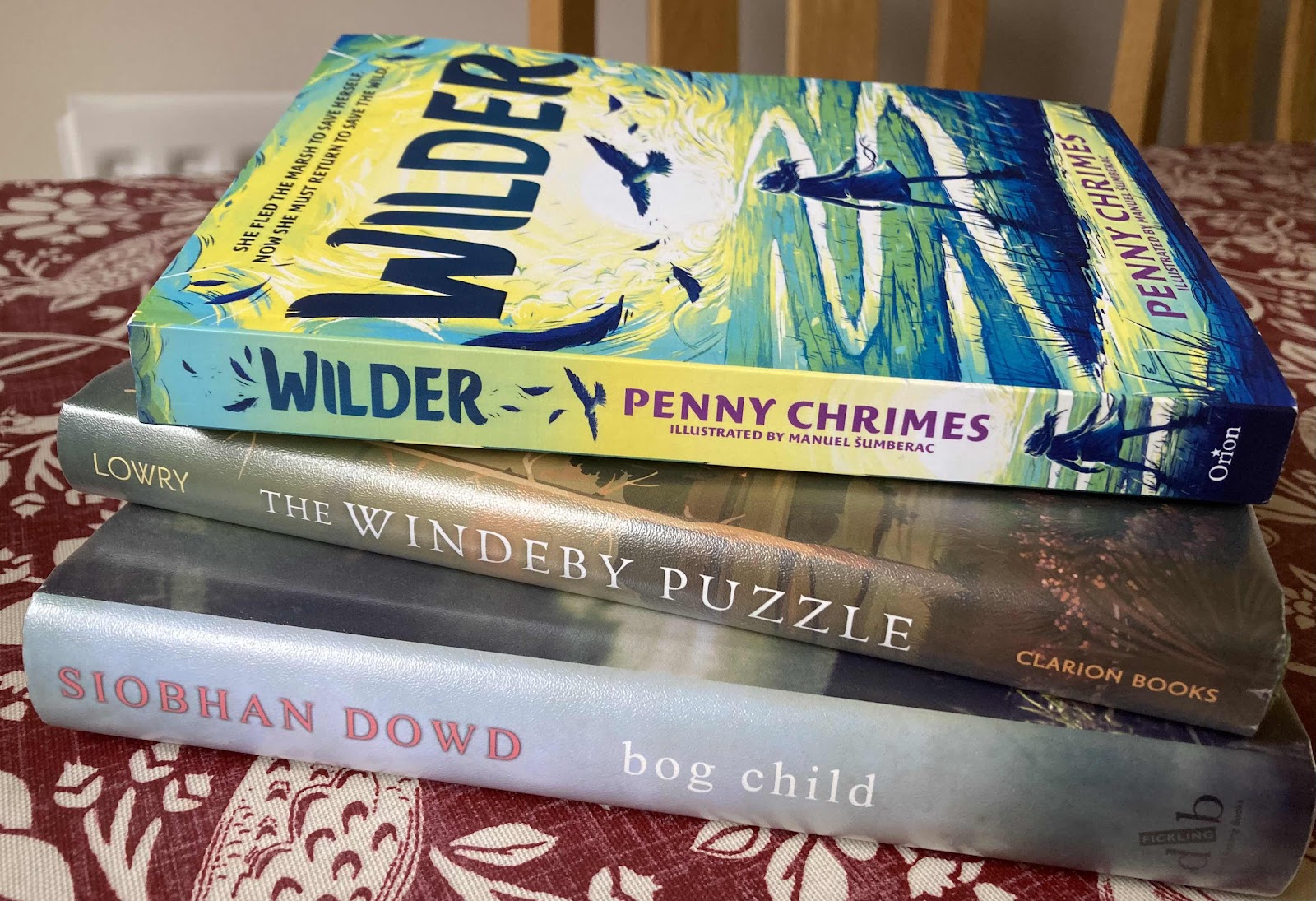
I recently picked up a first  edition hardback of Siobhan Dowd’s Bog Child from a second hand bookseller. It is a truly great novel, that I had not read for several years. Rereading it now reminded me just how wonderful a writer she was and what a loss to children’s literature her untimely death. 

Shortly after, I received a longstanding pre-order of the latest book, The Winderby Puzzle,  by one of the USA’s finest children’s authors Lois Lowry, a book also inspired by the discovery of a prehistoric ‘bog body’. 

Now I have just finished this new book, Wilder by Penny Chrimes, a story about a strange child emerging from what was, if not quite a bog, then at least a muddy marsh.


It struck me as at least surprising that even though I read a vast, eclectic range of books, I unintentionally ended up reading three together that are so markedly linked. Was it Synchronicity? Perhaps that’s stretching it. But, whatever, it was at least serendipity, because Wilder is an exciting new find; another very fine book to lie on top of this special little pile. 

 Painting with words

Rewilding is not just a series of actions, it is a state of mind, and Penny Chrimes book not only epitomises this in its story, but embodies it in Rhodd, its strange but endearing protagonist.

Wilder is was of those rare books that I knew I was going to respond to within the first few pages. When this happens it is more often that not the quality of writing that entrances me, and this was certainly the case here.. Early on in this book with a dominant theme of rewilding, Penny Chrimes ties the notion into a physical description of her young protagonist:

‘Rhodd . . . shook her tousled head impatiently, rewilding the sun-bright mane that Ma tried daily to tame into plaits.’ (p 8)

If, like me, this type of clever, writerly conceit makes you tingle with pleasure, then you will love this book. Regardless, there is much else about it to love too.

Penny Chrimes’ use of ravishing language in evocative descriptions, her striking, poignant images and her challengingly powerful vocabulary choices (‘susurration’, ‘skirling’) continue throughout this wondrous piece of writing. At one point  she says Cerys, Rhodd’s adoptive mother, ‘grew still. She gathered stillness about her, as if she were weaving a web every bit as fine as the spiders’, yet a thousand times more secret.’ (p 66). Just wonderful.

Rewilding 

However, Penny Chrimes also entrances and engrosses us in an involving story.

Seemingly born as a creature of the wild, Rhodd has the amazing ability to communicate with other wild creatures, not in words as such, but through mind pictures. So strong is her identification with them that she can also sometimes ‘borrow’ and actually see through their eyes. Foremost amongst these creatures is a perigrine falcon, who often hovers in the skies above her and with whom Rhodd has a very particular bond. 

Emerging fugitive and alone from the marsh and taken in by widowed Cerys, her ability to connect with the wild seems gradually to diminish as she is encouraged to try to fit is with her new surroundings. To the reader Rhodd’s loss of oneness with the creatures of the natural world, and indeed with her own true nature, is felt as almost heartbreaking.

The village in which Rhodd finds herself was once a thriving fishing port, but has now been abandoned by the river which joined it to the sea. Since the river somehow receded, to be replaced by a stagnant and lifeless marsh, its inhabitants have become bitter and resentful. Although Rhodd is welcomed with warmth and care by Cerys herself, she is treated with suspicion, fear and even hatred by the rest of the community. They already have a paranoid dread of the marsh; not only has it destroyed their livelihoods, but taken the lives of some of their children too. Now all their resentment seems to transfer to Rhodd herself.

The situation worsens as deadly sickness seeps from the marsh, not only killing all the wild creatures, but some of the villagers too. Worst of all, Rhodd’s  beloved ‘Ma’ succumbs to the illness and seems close to dearth. Further catastrophe is precipitated when landowner, Lord Stanley, arrives to evict all the villagers from their homes at heartlessly short notice. Rhodd becomes convinced that she alone can save what she loves and that she can only do that by rediscovering her own wildness. She feels that she is somehow linked with the disappearance of the river and determines to bring it back.

Once again Rhodd’s hair provides an image of her transformation, her new, wild energy:

Not even the rain could flatten her wild mane. Her bright hair drew the electrical charge to itself like a lightning conductor: it channelled and tamed its force and became a torch that channelled the brilliance of each strike’  (p 

Her transformation back into her true self is rivetingly exciting.

She was Peregrine. The face that stared back at her was savage, merciless. She did not know this Rhodd. But she liked it better than the tame, timid Rhodd who had hidden away for so long.’  (p 135)

And suddenly a story of people suffering the consequences of environmental disaster segues into that which had always been hinted at. It plunges into fantasy, into metaphor, into myth. And Rhodd and her story return to what she and it always truly were - something wilder more elemental.

Making myth

The strength of this book is not as an authentic geo-environmental case study, but as an aesthetic, an extended metaphor, an often poetic exploration of the concepts of the the wild, wildness and rewilding. Its characters become something nearer to archetypes.

Nemesis of the wild is landowner and industrialist, Lord Stanley, trying to contain nature, to force it into the service of his  own ends, out of greed for both money and power. Then there is Rhodd’s ‘Ma’, the ‘Wise Woman’, the seer, still in touch with nature and the healing property of plants, but always threatened by of accusations of witchcraft. There is the boy Gar, Rhodd’s  only human friend from the village, but who turns out to be the abandoned child of Lord Stanley, bloodline of the perpetrator, the inheritor of shame, yet determined to grow-up different, to make amends.There is the ever-faithful dog, Red, distant (thankfully luckier)  cousin of Gelhert. There is Hafren, the elemental river, lost, imprisoned  but in need of rediscovery and liberation. And over them all is Rhodd, wild-child, falcon, reconnecting with the voices of nature, seeking to reverse the sickness, the emptiness, the death of the land. 

‘Rhodd reached her arms to the sky. For anyone watching it would have been impossible to tell whether this scarred and ragged creature was praying or preparing to fly. Perhaps for her they were the same thing.’ (p 206)

Wilder is a myth for our times and, as such, is crafted beautifully, meaningfully, movingly. The climax of its story is cataclysmic, magnificent. It is an exceptional read that children will not only lap up; they will take imprint from its images and messages in a way that may just help to make our world better in the future.

Manuel Å umberac’s wonderful illustrations are a perfect complement to the text and evoke girl, falcon and marsh with a fitting power and potency. 

Friday, 10 March 2023

The Way of Dog by Zana Fraillon


Brilliantly illustrated by Sean Buckingham


This novel written in poems has promoted (a feeble attempt at) a similarly constructed review. So here goes . . . . 


TRAGEDY AVERTED


Why have I never
                                                  before

discovered books
                                by
Zana Fraillon              ?

She’s Australian, sure
but that’s no excuse.
So many of her books are published here.

I think
I’ve even heard of some of them.
The Bone Sparrow 
rings a certain bell.
I can tell. It has a familiar ring.
Even 
The Lost Soul Atlas
seems to have found its way
                                                        (somehow)
as a title 
into my library
of the half-remembered
                            half . . . 


             forgotten.

But I have never read them.

Shame.
                                No. 
                                                               Tragedy.

For now I know
just how much 
I’ve been missing out.


But thank goodness 
here          is
                                The Way of the Dog
read 
         closed
                    finished
and on my shelves.

Chance brought to it me
serendipity
my lucky day
I’d certainly say.

And it was
                                 reading heaven.


ON TREND

It seems that

fiction                
            written in                                                       V
                                                                                   E
                                                                                   R
                                                                                   S
                                                                                   E.                   (quite often terse)
has become a bit of a THING.

But 
IMHO            (as we seem to have to say these days)

its effectiveness, you see
can vary quite considerably.

Sometimes the ‘verse’ is so darned free
amounting to not much more than prose
divided into short lines                                          (Much like this, IHTS.)
so that it leaves you asking
what is the point?

At the other extreme are works like those by Joseph Coelho 
The Girl Who Became a Tree
The Boy Lost in the Maze.
The finest poetry 
in its own right
so cleverly shaped
to tell a profoundly moving tale
and tell it (breath)taking
ly.

If this is a spectrum
Pointless __________________________to___________________________Coelho
then
                                                                                                        The Way of Dog
                                                                         comes well towards the Coelho end.


VERSE NOT WORSE

Its all about a dog
for sure
but no way is this  . . . . . . .  DOGGEREL.

(Sorry!
 That was cheap at best.
  Not even 
  particu                larly                                funny :-)

It’s true enough though.
This is your actual poe          TREE
                                                           in full and verdant leaf.

It enchants the ear
                                delight the eye
provokes the occasional
                                 chuckle
evokes a genuine sigh.

Here are
rhythms
                  different rhythms 
                                                                      multiplemultiplemultipe rhythms 
                   co     m            Pl        eX  and
simple 
rhythms.

The rhythm of words
of
lines
and                                             spaces.


Language
and                      TY pog ra phy

Calligrams (sorry that’s too difficult)

dance and SING.

Each poem 
captures perfectly
a mood
               a moment
                                  a thought
                                                         a feeling

amusing
charming 
enchanting
H.           E.     A.                       R.  
                                     

                                  T.     breaki
                                                      ng

HEART mending
 

TELLING TAILS

But do all these poemspoemspoemspoemspoems
all these so clever words
Add + up + to = a coherent narrative 
amount to a story
worth telling               
                                              worth reading?

They surely dodododododoDO.

Here is a simple tale
that has been
told many times
before

Finding  - Loving - Losing - Grieving - Enduring - Surviving - Finding

Yet here it is
told with such deep truth
such honesty
such compassion

Here is the true doggy voice 
the voice a dog would have 
if dogs had voices.

Here is the yipping-yapping of the heart.

Here is the human in the animal 
the animal in the human and
It                                       S.
                                    D
                              N
                         E
                   C
              N
         A
    R
T

Its words move                                                                      beyond words.


TAO


And does
                    The Way of the Dog

sound (just a little bit)
like your old Buddhist philosophy
a relic from your hippy days (for those of us who ever had them)?

Then so it should.
This is ‘the way’ for today. 

A certain Benjamin Hoff  wrote The Tao of Pooh
and now we have The Tao of Dog
by Dog
by yipping-yapping-whimpering-bouncing-spinning
                                                                                    DOG
Just helped a little
by the aforesaid Zana Fraillon
who knows dog well.

For this doggy way is               
                                    love

one love

animal human 
gender race religion sexuality

ONE.


READITREADITREADIT

Read it.
                                         Just read it
            
For adults
the                       lure of                 poetry
will entrap them in a story
they might have thought
sentimental 
but which teaches them what children already know
that life           like  Christmas          is often
sentimental

and a dog is not just for Christmas
but for life.

For children
the                deeply captivating                tale 
of a dog
will draw them into poetry

its look on the page 
its sound in the ear
its feel in the heart.

Whoever

Read it ALOUD                          (It will read aloud quite magically.)

Read it aquiet                                                                 (Just for yourself.)

Like all good fiction
it will take you to 
                                   SOME . . . . . . ONE
you’ve never been
before 

Someone
not like you
and
               just
               like
               you

and return you not the same.

Just read it                                              or

MISS OUT.


POEM WRITTEN ALL ON ONE LINE, IF IT WOULD FIT, WHICH SADLY IT WON’T
(To be read all in one breath instead)

And now I’m off to an independent bookshop to buy The Bone SparrowThe Lost Soul AtlasThe  Raven’s Song and all Zanz Fraillon’s other books they’ve got and order any they don’t have in stock and rush back home and put my life on hold and read them all as soon as ever I possibly can because I’ve already missed out for far too long. 


Wednesday, 8 March 2023

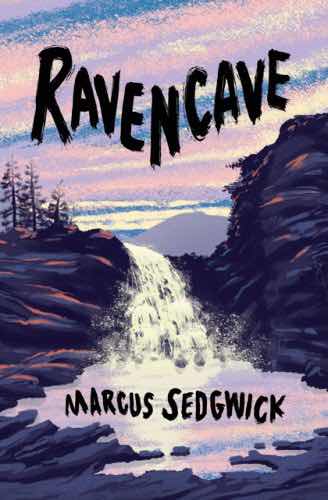
Ravencave by Marcus Sedgwick


Cover illustration: Paul Blow

A remarkable body of work

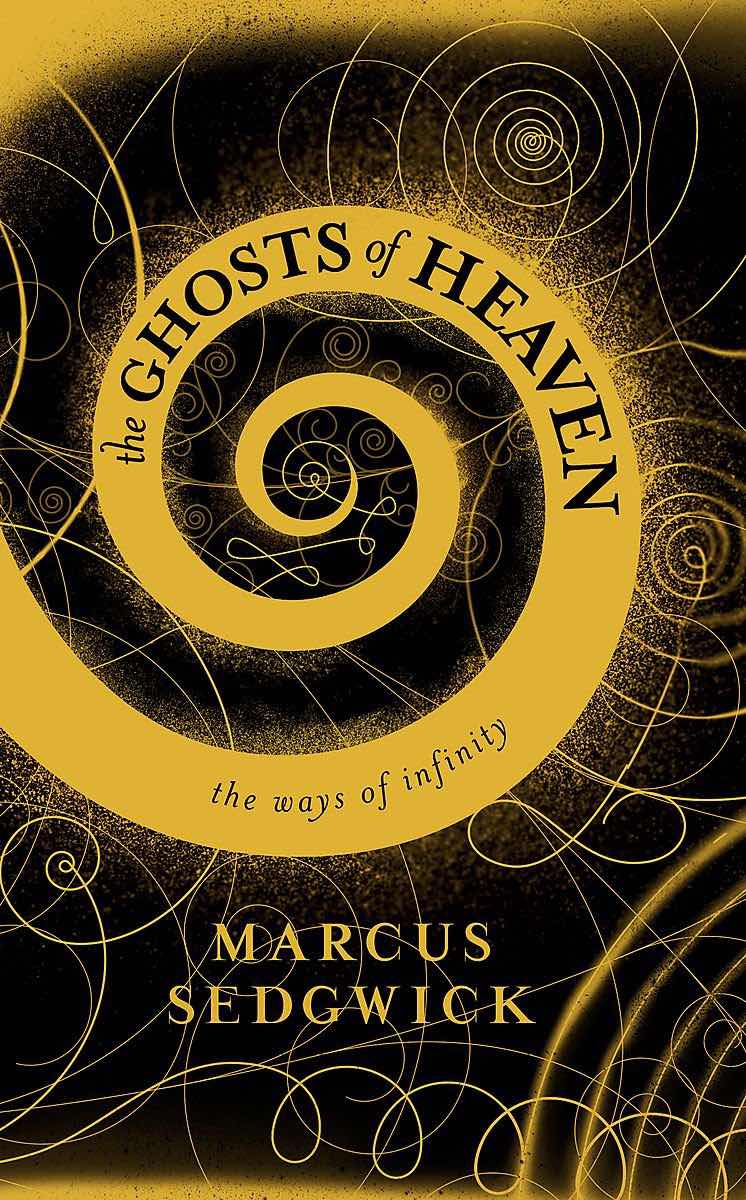
It was a very major loss to writing for young people when bravely original, award-winning author Marcus Sedgwick died last year, tragically all too young. I was a huge admirer right from his first novels in the early 2000s. (See my post from November 2014). Subsequently he wrote prolifically producing work for a range of audiences, including both adults and younger children, but his finest works were almost certainly his YA titles, including what I, and many, consider his towering masterpieces, the chilling Midwinterblood and the challenging, but devastating, The Ghosts of Heaven. (See my review, again from November 2014.) Amongst many other titles, Voyages in the Underworld of Orpheus Black, a collaboration with his brother, Julian*, and one of my favourite graphic artists, Alexis Deacon, is also umissable.

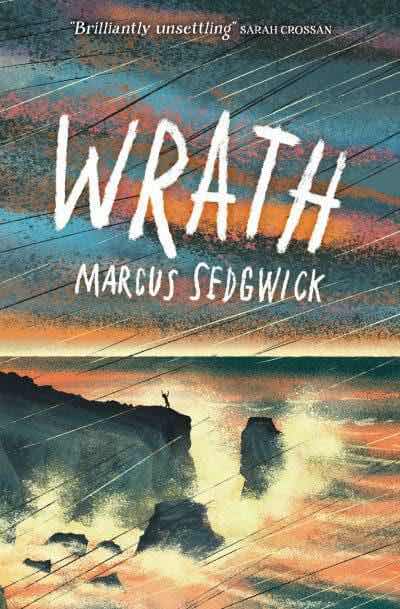
In more recent years Marcus Sedgwick has struggled with serious illness in the form of debilitating CFS (or ME). He has nevertheless completed some further remarkable writing. His three most recently published works of fiction have been in the ‘accessible reading’ format, Dark Peak for OUP’s ‘Super-Readable Rollercoasters’, Wrath for the brilliant Barrington Stoke, and now the posthumously published Ravencave, also from Barrington Stoke.

Easy to read, but with depth too

His writing suits this style of book, with its comparatively short length and straightforward language, rather well. Although, actually,  it is more the case that his writing ability is such that he can create multi-layered, high quality fiction  whilst still meeting the requisites of readability. In fact, he demonstrates wonderfully that there is no need whatsoever to patronise young readers simply because they lack confidence in actually accessing text. Further, he is able to create a context where the economy of language use, its terse directness, actually enhances the effectiveness of the story being told, bringing both setting and characters to life with vivid starkness. He also succeeds in communicating deep feelings with affecting and often beautiful simplicity, creating telling images that will live long in the minds of readers.

The best of Barrington Stoke titles (of which there are many) make excellent choices for any reader, as well as fulfilling their brief of access for the less confident. But Ravencave is one of the supreme examples, alongside titles like Anthony McGowan’s Lark and Mal Peat’s The Family Tree. These are fine works of literature in their own right, 

What is it all about?

It is hard to discuss the many merits of Ravencave without spoilers. And this is to be avoided at all costs, since it is the gradual, and very clever, build up of revelations that provides the compulsive grip of this story.

Suffice to say that the basic action of the story involves the events of a single day, although extensively suplementsed with recalled accounts from the past. It centres on a young boy, Jamie, during an outing in the Yorkshire Dales with his father, mother and older brother, Robbie. The prime objective of their hike is to scatter the ashes of his recently deceased grandmother in the area where she was born. It features several (actual) locations in the Dales, which, in the story, are associated with previous generations of his family. It is a place of ghosts. However, what startles from the very first words is the way in which Jamie seems strangely distanced from the rest of his family, as indeed they are from each other. They are:

‘ . . . four souls spread across the Yorkshire landscape.’ (p 9)

Clearly this is a book very much about family, about their relationship to each other, but also about their links to the past, to heritage, to their an ancestry. Jamie needs very much to discover exactly who he is, and where he fits.

It is obvious that particular place meant a great deal to Mark Sedgwick. Each of these last three of his books relates strongly to a very singular and affecting location. And this certainly applies to Ravencave; it is not only about its characters’ relationship with each other and to the past, but also very much to the land, to the place where they do, or don’t, belong. It is a novel of both landscape and inscape.  

The author clearly had strong socio-political views too and a thread of socialism runs through his narrative. This is linked particularly to working people displaced from their livelihood by a minority of rich, powerful owners who want to get even richer by reducing their workforce and embracing allegedly more efficient, but essentially cheaper, ways of doing things. He was very much on the side of the dispossessed, and admired their resilience.

‘How do people keep on going, even when everything seems to be against them?’ (p 9)

Ultimately, however, what comes through most strongly of all from Marcus Sedgwick is a basic confidence in the kindness and caring nature of ordinary human beings.

‘In both big things and small things, most people are good. They care for each other - it’s what people do.’ (p 110)

Last book and testament

This is a story about being reconciled with death but also about embracing life. It is a  story all the more poignant being written by a seriously ill author, who must have realised he could be coming towards the end of his life. It is perhaps a last testament.

In the story, Robbie’s mum ‘ . . .  wants there to be, well . . . more. 
More to all of this, this life we fall into and fall out of . . . . (She) wants to believe the world means something. ‘ (p 44)

So I think did Marcus Sedgwick. And through his remarkable writing he showed us that it does.


*There are also other excellent YA reads from Julian Sedgwick, the latest of which, Tsunami Girl, is another outstanding collaboration, this time with manga artist, Chie Kutsuwada.