Tuesday, 26 May 2015
The Eighth Day by Dianne K Salerni
Saturday, 23 May 2015
Story Singer by Sheila Rance
After a long fallow period in my reading of recent children's fantasy, finds that I considered high quality were starting to feel like hen's teeth. It was therefore a delight to discover the publication of the latest novel in Sheila Rance's quite brilliant 'magical reality' sequence, captivatingly started in Sun Catcher and beautifully followed up with Storm Chaser. Also set in her imagined version of the Bronze Age, this third volume, Story Singer, is no disappointment. In fact quite the contrary, it is an entrancing read and full confirmation that this sequence (which, at least as yet,appears to have been given no portmanteau title) is one of the truly great works of children's fantasy fiction. It scores amazingly highly for the quality of both its imagination and its writing and must surely become a classic alongside the likes of Diana Wynne Jones's Dalemark quartet, a work to which it seems cousin, albeit a distant one. Perhaps it is the hand-loom weaving of a magical story coat, in actuality and as image, that prompts this comparison. Certainly such a garment features prominently in The Spellcoats and quite magically pervades the whole of Sheila Rance's silk-crafted story. However broad comparison is not intended to the detrement of either work, exactly the reverse.
There are elements of Story Singer and it's precursors which seem to put them into the category of high fantasy - and the strap line on the cover referencing Game of Thrones reinforces this. There is certainly a kingdom with an unstable political situation. Despite young protagonist,Maia, having established a claim to the throne by proving herself 'Sun Catcher' she is still without a crucial 'Story Singer'. Her warrior-weaver father too is without the wherewithal to weave the mystical silk which is the fabric of the kingdom's power in every sense. Maia's scheming and malevolent sister is set to re-establish her own power through her thought-stealing daughter, Caspia. With her fierce husband she has enlisted the support of the half-beast Wolf Kin and their vicious Wulfen. Against them are arraying the forces of the noble Eagle Hunters and the Amazon-like Archers. All is set for monumental conflict. This is indeed the stuff of high fantasy.
However this basic 'goodies v baddies' scenario is filled with much that is far more subtle and ambiguous. I hope that the Game of Thrones reference helps to find readers for this wonderful creation but it is really far too crude and superficial a comparator. Whilst large scale conflicts and their consequences do background and drive the story, and come to the fore in its climax, they are in many important ways not what this story is about. It is the story of four young people. It is the story of Maia, who has only very newly found her talent and destiny as the Sun Catcher, of Kodo the boy who used to be a sea lizard rider, of Var the theif-assassin, and of the thought-stealing Caspia, Maia's rival for the queenly role. It is in many ways their personal, almost intimate story. It is a story of personalities and ambivalent relationships; of friendships and rivalries; of their shifting patterns of trust and mistrust in each other. Like other great works of children's fiction, it is about each discovering who they are, what they can and could do; of making choices about who they want and need to be.
It is a beautiful, intimate, often moving story, told in a kaleidoscopically fractured narrative, with constantly shifting viewpoints which illuminate each character with ever new insights. At the same time it is a mesmerisingly beautiful piece of writing which almost miraculously melds everything into an undulating, lyrical flow. This masterly author's language and thoughts continually create provoking images, often poetic in their intensity. She captures a world and vision that shimmers and shifts with the same elusive magical voice as the whispering silk which is one of her stories pervasive motifs.
Through all of these books Sheila Rance has wonderfully evoked her period and setting, drawing on much detailed research, but feeding it organically into her storytelling. Landscape, and her young characters' sensitivity to it, plays a very significant part in all these books. In the earlier ones it was often the sea, the shore and the cliffs. Here it is more the sands and scrubland of desert that are central and to which Maia and others, through the author herself, so sensitively respond. It is really quite magical writing.
By the end of this volume the story has reach a satisfying conclusion, although it is not so much the choices of its most apparent key characters, Maia and Kodo, which in the end precipitate this resolution, but those of the assassin-cum-theif, Var. Fortunately too, though, there are enough loose ends to promise more to come. Amongst others, Caspia's assisted escape and Maia's fascination with the desert rock drawings which tell of either her past or her future leave doors open to potential further tales of this world and its young 'magicians'. I sincerely hope they will be written soon.
Once again this book is greatly enhanced by quite thrilling art work from the highly talented Geoff Taylor. Some chapter headers are clearly new, whilst others character drawings establish continuity from the previous stories in the sequence. Too often I find that illustrations, particularly those of key characters, spoil works of this kind by failing to meet my imagined expectations. Not so here. Geoff Taylor's drawings, evocative but not over delineated, really do add greatly to both the atmosphere and aesthetic of the book, without impinging at all on my own mental picturing.
As a avid collector as well as a voracious reader of children's books, I have only one gripe. It is a tragedy that the usually excellent publisher, Orion,has not produced a hardback of this book, even though they did for the previous two. Please can we have a completion of the set. As a contemporary classic of the genre this sequence really needs preserving in durable first edition.
Tuesday, 5 May 2015
The Nowhere Emporium by Ross MacKenzie
This is a delightful book, a joy of a book, a veritable feast for the imagination.
As with the one in my previous post, this is very much a children's book, but this time a very accessible one too. It would indeed provide a wonderful way into fantasy for any coming new to the genre as well as a treat for young readers seeking further escape into a magical world. Even though the novel has two narrative strands, with key incidents from the earlier life of magician Lucien Silver interspersed through the main tale, this important back story is always well signposted. Its inclusion would make a good introduction to the added challenge, and excitement, of a slightly more complex structure.
The story revolves around benevolent Silver's creation of a magical time-and-place-travelling emporium, whose 'customers' are treated to a panoply of wonders. Even though they do not remember these after their visit, the experience nonetheless enrichs their lives. The young protagonist, orphan Daniel, is taken on as Silver's apprentice but, together with the magician's mysterious and spikey daughter, is left to try to rescue the situation when his master disappears and the emporium begins to crumble around them.
To young readers coming new to the story it will, I'm sure, provide a fresh, engaging and exciting escape into what is itself a world of imagination and wonder. To a far older reader like me, who has been around all the roundabouts of children's magical fantasy many times, it feels like a mashup of many precedents, whether conscious of unconscious. In here I find echos of numerous other works: there are elements of Doctor Who, of Dahl's Chocolate Factory, of the Sorcerer's Apprentice, of Harris's Chocolat, and even something of Blyton's Faraway Tree, along with many others. However this feeling of déjà vu is not a negative, for what author Ross MacKenzie does is take many classic elements of magical fantasy and skilfully rework them into a delightful new tale of his own.
Part of what makes The Nowhere Emporium so successful is the strength of its writing. In common with The Box and the Dragonfly, which I recently reviewed, its prose is so skilfully composed that it always falls comfortably on the reader's inward ear. Its simplicity belies its art and it communicates directly and powerfully, propelling the narrative most effectively. Its characters are most engaging too. Although orphan Daniel, his aprentice master Silver, and the malevolent Vindictus Sharpe are all essentially stock characters, they are effectively drawn. Young Daniel particularly is captivating in his mixture of naïvety and determination; his growth into his own magical potential captures every child's hopes and fears as it always does in the best work of this genre. There is additional interest too in the particulaly strongly conceived character of the magician's chippy but touchingly loyal daughter, Ellie. The narrative rattles ahead apace, with short telling chapters, which lead quickly from one page-turner to another. Consequently the reader is securely led through an increasing threat of disaster to a warm and satisfying denouement. No surprises here, but sometimes feelgood suits best. In the end, and true to the genre, an exciting if uncertain future lies ahead for the young protagonists - and perhaps a sequel for the reader? Who knows.
There is one more massive difference however between the core nature of this book and that of The Box and the Dragonfly. In that work the author was at pains to explore explanations for all its supernatural elements, leading the reader into complex reflections on what might or might not be possible and what the consequences might be if it were. Here there is no such depth.Many things happen without any rational explanation. However in this instance it does not matter at all. It is enough for the characters in the story, and ultimately for the reader, that things happen by magic. This book is nowhere close to rational. It is pure whimsy. It is something approaching a children's equivalent of Erin Morgenstern's Night Circus. The whole book is a flight of fancy. It is a celebration of imagination: the characters', the author's and, of course, the reader's. As such it is a wonderful thing in its own right. It is well worth a place on any child's shelves and the deserved successor of many older classics of the genre.
Monday, 13 April 2015
The Box and the Dragonfly by Ted Sanders
By the end of the book the fact that it is the first of a new sequence becomes a cause for much rejoicing. This first volume feels in many ways almost like a prelude to a story, but those ways are all good ones. There is so much unexplored and unresolved. There are so many intriguing things yet to discover about characters to whom we have become fully committed and about their conflict with the malevolent Riven. There are other characters too about whom we as yet know so little. It is to be sincerely hoped that we are to discover stories and even back-stories to complement fascinating glimpses of the likes of Gabriel, Neptune and the flute-playing Ingrid, not to mention Beck and of course, astoundingly, Horace's . . . but no spoilers. Suffice it to say that what appears initially to be the story's wind-down coda turns out to contain one of the most profound and devastating surprises of the whole tale.
The Keepers has all the makings of a great addition to the canon of children's fantasy literature. Even as a stand-alone The Box and the Dragonfly is a cracker of a book.
Tuesday, 24 March 2015
The Mark of the Dragonfly by Jaleigh Johnson
Tuesday, 3 March 2015
Ophelia and the Marvellous Boy by Karen Foxlee
Here is another stunningly good find from publishing house Hot Key who seem to have been signing up some wonderful writers recently.
It is good too to have made my first recent discovery of a great new book by an Australian author. There is such a strong tradition of outstanding children's literature from Australia. Going back a while, I would certainly place Patricia Wrightson on my list of all-time greats, and there are many deserved classics like Ruth Park's Playing Beatie Bow. More recently Sonya Hartnett and Morris Gleitzman spring to mind (especially the latter's deeply affecting Once, Then, Now and After sequence) and there are many more
Karen Foxlee certainly proves herself to be a writer fully worthy of this rich heritage. However Ophelia and the Marvellous Boy also belongs to a tradition of children's literature to which I refered in a vey recent post (on Holly Black's Doll Bones), that in which young people's traumatic issues are worked out through a (metaphorical) involvement in fantasy, often in the form of reimagined or reinvented fairy tale. This is a sub-genre which I primarily associate with US writers, although of course there is a lot of cultural interchange between The States and Australia. Ophelia is certainly a splendid addition to this important strand of children's literature. The tradition has already provided many all time greats and there is good reason to think that here we have another.
Superficially, however, there are several basic aspects of this book that seem rather a long way from being particularly original. The central issue of the book concerns a young girl, the eponymous Ophelia, trying to cope with the recent early death from serious illness of her mother. Such bereavement of children has already been the subject matter of a good many notable antecedents. It is, of course, an important topic and will come as fresh and vital to many of this book's young audience. However, in children's literature terms, it has been rather well worked already.
In the fairy tale world which intrudes itself into Ophelia's life the principal character is an evil Snow Queen who is holding the land in perpetual winter. Of course, one of the features of fairy tale is that it uses easily recognisable archetypes. Certainly too this queen is an excellent metaphor for the frozen emotions that Ophelia's family experience following the bereavement. However, it is also a figure that has already been very well used in children's story, not least of course by C S Lewis. Is it perhaps getting over-worked? The idea of this fairy tale persona eventually conflating with the principal adult character of the 'real' story is again not new.
The setting too, a museum, although offering lots of fascinating potential is one that has already featured in numerous children's books. And then the core of the inner narrative revolves around a 'prophesy', the fulfilment of which eventually inevitably emerges as falling to Ophelia. If any story device in a fantasy book is likely set my alarm bells ringing it is that old chestnut the prophesy!
In fairness, Karen Foxlee does add to these familiar elements many imaginative and inventive features of her own. The whole character and story of the Marvellous Boy himself, the unlikely hero who has been sent to find the 'Other One' needed to defeat the Winter Queen, is charming and original. Additionally many of the witch's minion creatures, not least the 'misery birds', do very potently conjour up nightmarish fears.
However it is not the plot as such, nor even the basic theme, important and potent as it is, that makes this book so very compelling. It is the way that the novel is written. This is quite wonderful and undoubtedly transforms what could have been a good but slightly unoriginal story into an all-time gem of children's literature.
Three things particularly excite me about Karen Foxlee's writing, although I could go on for ages about its many delights and stunningly effective qualities.
The first is her use of language itself. What is remarkable here is not so much the vocabulary she employes, although this is has that quality of apt and deceptive simplicity that makes it easily readable yet immediately communicative. Rather it is her turn of phrase, her imagery, and her patterning of language which is such a constant delight. Often mellifluous, always fresh and exciting, this writer can build words together in ways which constantly enlighten and enliven her storytelling. Her wording really draws the reader into her characters, as well as into the two initially different, but gradually integrating, worlds of her story. There is a richness that continually catches both the imagination and the inner ear of the reader. It unobtrusively but surely beguiles that reader to enter right inside her narrative. Karen Foxlee's creation proves, is effect, not to be that of an impoverished or derivative voice, but of an enormously rich and lively authorial imagination. Over and again she demonstrates a lightness but sureness of touch which belies very considerable writing skill. One particular aspect of this is that she is almost obsessed by lists. But not in a bad way, in a totally entertaining and delightful way. The beautifully constructed and patterned lists which permeate this narrative - lists of the museum rooms through which Ophelia runs, lists of her putative names for the Marvellous Boy, lists of the thoughts of the ghost girls who haunt one of the rooms - give it an energy and rhythm which verge on the poetic and would make it a wonderful text to read aloud. And there are not only actual lists, but stylistic 'lists' too. Karen Foxlee makes frequent and effective use of those rhetorical devices of repeated words and phrases which are often associated with Churchillian speeches; things like anaphora and isocolon, if we want tobe technical. But technicalities don't really matter here. Felicities abound.
The second feature of this writing which so impressed and thrilled me is the clever subtlety with which character, plot and theme are in practice revealed and communicated. This writer never hits you over the head with exposition or explanation. Rather she reveals gently, often briefly, but always tellingly too. And what she reveals is therefore all the more believable and all the more affecting. A great of example of this is the way in which, once we have been introduced to her little behaviours, it only takes a simple statement that Ophelia has puffed at her inhaler, or tugged on one of her own hair plaits, casually mentioned, often without elaboration, for us to know exactly how she is feeling and reacting. All the depth of thought and feeling associated with the loss of her mother is dealt with in exactly the same casually simple but profoundly revealing way. In fact the central character, Ophelia herself, is so cleverly and sensitively drawn that she ends up as one of the most endearing and moving protagonists that I have encountered in a children's novel for a long time. In her own way she is very much a Frodo. She is basically insecure, lost, afraid, and yet she presses on with doing the difficult things which need to be done in a way that shows character and bravery far exceeding flashy heroics. This is epitomised in one of my very favourite lines, spoken by Ophelia after the Marvellous a Boy has thanked her for rescuing him: 'I probably shouldn't do it again. I have very bad asthma.'
The third aspect of the writing that I found so compelling was the structuring of the whole narrative. The way the 'back story ' of the Marvellous Boy Is integrated through the early sections is beautifully handled with gently differing styles distinguishing the two realities. Even more telling is the way the two world converge as Ophelia's quest evolves. The metaphorical dimension of her crucial part in defeating the Snow Queen becomes gradually clearer as her own 'real' emotional journey deepens. The resolution, which is of both the fairy story and of the real-life issue, is a small triumph of storytelling.
As well as being a book about dealing with loss and grief , this is also a book about the importance of fantasy itself. Initially Ophelia finds her security in order, rational explanation and scientific understanding, traits very much inherited from her father. By the end she has allowed her life, her thinking, and her being to be balanced by imagination, by the creativity that is the legacy of her story writing mother. Opelia has learned to follow her heart as well as her head, and this is another wonderful thing.
On the surface, this is a relatively short, easy read intended primarily for a young audience. There is no problem in that. Indeed the writing skill, the imagination and the sensitivity which have gone into its crafting have resulted in a true little gem. I am tempted to include it on my list of the real greats of twenty first century children's literature to date. In fact I will. Children who read it thoughtfully will not only have an enthralling experience but also end up more sensitised to important aspects of the human condition. Even if unaware of it, they will have experienced extremely skilful writing too - and that is another most valuable thing. They will have been enriched.
Tuesday, 24 February 2015
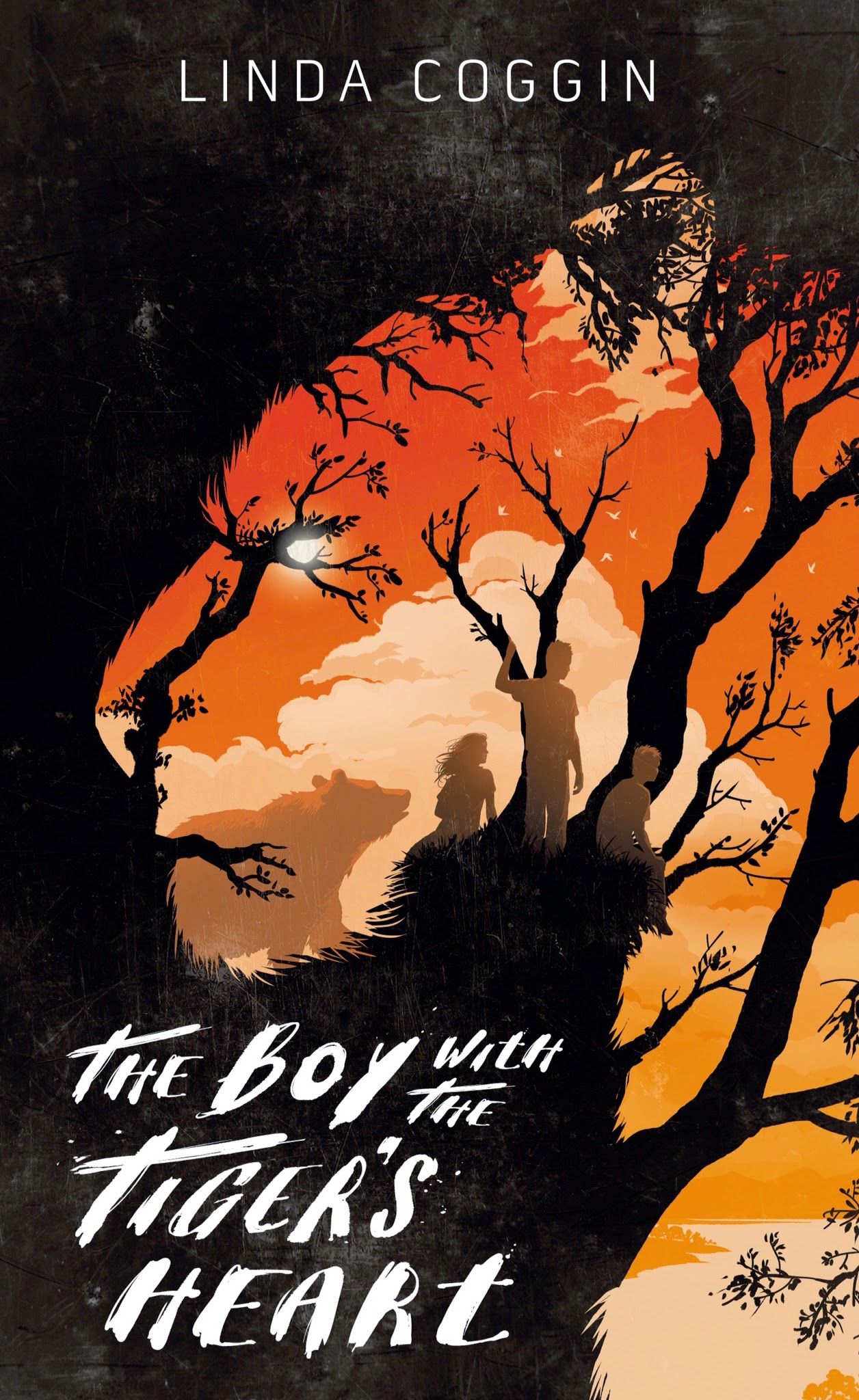
The Boy with the Tiger's Heart by Linda Coggin
This is a strange book - but strange in a good way, in fact strange in a rather wonderful way.
The title is a very good one and in many ways captures the strangeness and power of the book. The boy in question, a prominent figure in the story, yet not the actual protagonist, has the heart of a tiger in both a literal and a metaphorical sense. Yet the literal is not actually possible. We are on the verge of fantasy. Reality is ambivalent.
The same quality of ambiguity is evident in the very dramatic and wonderfully apt cover illustration by Levente Szabo. The image is simultaneously of a tiger's head and of a wooded outcrop with figures. It is the trees that form the tiger 's stripes - or possibly vice versa. Perception shifts between the two depending how you look at it, in a way that approaches the old optical illusion of candlesticks and faces. The realities merge. The picture is illusive. So is the book. It has no concrete presence, just shifting images that hover between nature and fantasy.
The protagonist of the story, a girl initially unnamed but later called Nona, has been brought up by dogs, although later adopted by an odd and eccentric 'scientist'. He is an experimenter who has kept specimens of live wild aminals in a world where almost all the rest have been purged to keep the population 'safe'. However, the book does not so much explore the implications of the girl's feral upbringing, to the extent that several other fictions on this subject do. Rather it uses it as a explanation for her empathy with animals and as a symbol of her essential wildness.
When Nona's adoptive Father is hounded by the ruling authoritarian regime, he releases his specimen animals and kills himself. Wrongly accused of his murder the girl flees in search of a free, wild world beyond that in which she now lives. She sets off on a long and difficulty journey-quest, accompanied by an erstwhile dancing bear but pursued by the evil authorities. Later she meets and teams up with an abused boy, as well as the tiger-boy of the title and a number of other escapee beasts.
One of the few words I can come up with for this book is poetic. But I do not want to give a false impression. Its language is not elaborate or fanciful. Rather the reverse. It is extremely clear and straightforward; at times almost clipped, particularly in its dialogue. Rather it is poetic in the sense that its story, its characters, its actions are more image than reality, metaphors; its reality is gently shifting, vague, translucent around the edges.
Both the geographical and human landscape through which the companions travel are a strange mixture, sometimes almost fairy tale, at others dystopian grunge, almost cyber-punk in feel. Many of the incidents on the journey and the characters met are not totally credible in a naturalistic sense. The 'circus' Nona reaches part way through is not quite like any other circus, more perhaps of a freak show, though whether the humans or the aminal are freaks . . . ? The small band of children and beasts who journey on from the circus is not quite a fellowship in the Tolkein sense; all are rather prone to wander off on their own; they have their own motivations as well as a common one. A pit of innumerable snakes bars the way out of the animal-culled, allegedly danger-clear world. It seems to represent the fear of the unknown which cows and contains the inhabitants of this world. But the snakes have eaten themselves by the time the children reach it. Yet the land which they eventually succeed in reaching is no Shangri La. It has always been called and remains The Edge. It is unknown, wild and dangerous. But it is alive.
Another way to describe the world of this book might be as a dreamscape. But this too could potentially mislead. This is not a simplistic then-they-woke-up-and-it-was-all-a-dream story. Rather it is a dream in the sense that odd things happen without them seeming odd. Explanations are not always completely rational, or logical, but do not need to be. This world is engrossing yet distanced; perceived rather than experienced.
One of the features which helps create this pervading strangeness is that the story is written entirely in the historic present tense. This is an authorial device that can often seem rather pretentious and become tiresome to the reader, particularly when sustained over a whole book. Yet here it strangely works. It puts the reader at something of a distance from the action, almost watching from outside, more as you would experience a film rather than a novel, sympathising rather than empathising. Yet it is not as simple as this. The author sometimes slips from an objective narration and let the reader into the thoughts and feelings of a character. It is odd, but effective. Strange.
The book is easy and quick to read, but lingers long. It is thought-provoking, strong in message, but without haranguing. It is gently disturbing. It is exciting and frightening in parts. It is sometimes beautiful. It is certainly original, unique. It is a strange book - but strange in a good way.